
A remedial programme is a one-year preparatory programme, run by a university, for candidates whose O’Level results have deficiencies — missing credits, wrong subject combinations, or grades below the requirement for their target course — giving them a year to repair those deficiencies and qualify for admission into that university’s degree programmes at 100 level. If your O’Level results already meet your target course’s requirements, a remedial programme is not for you — it exists for the deficiency case, and only for that case.
Remedial programmes are often confused with pre-degree programmes. The distinction is the starting point: pre-degree prepares candidates who already meet O’Level requirements; remedial repairs candidates who do not yet meet them.
Who should apply — and who should not
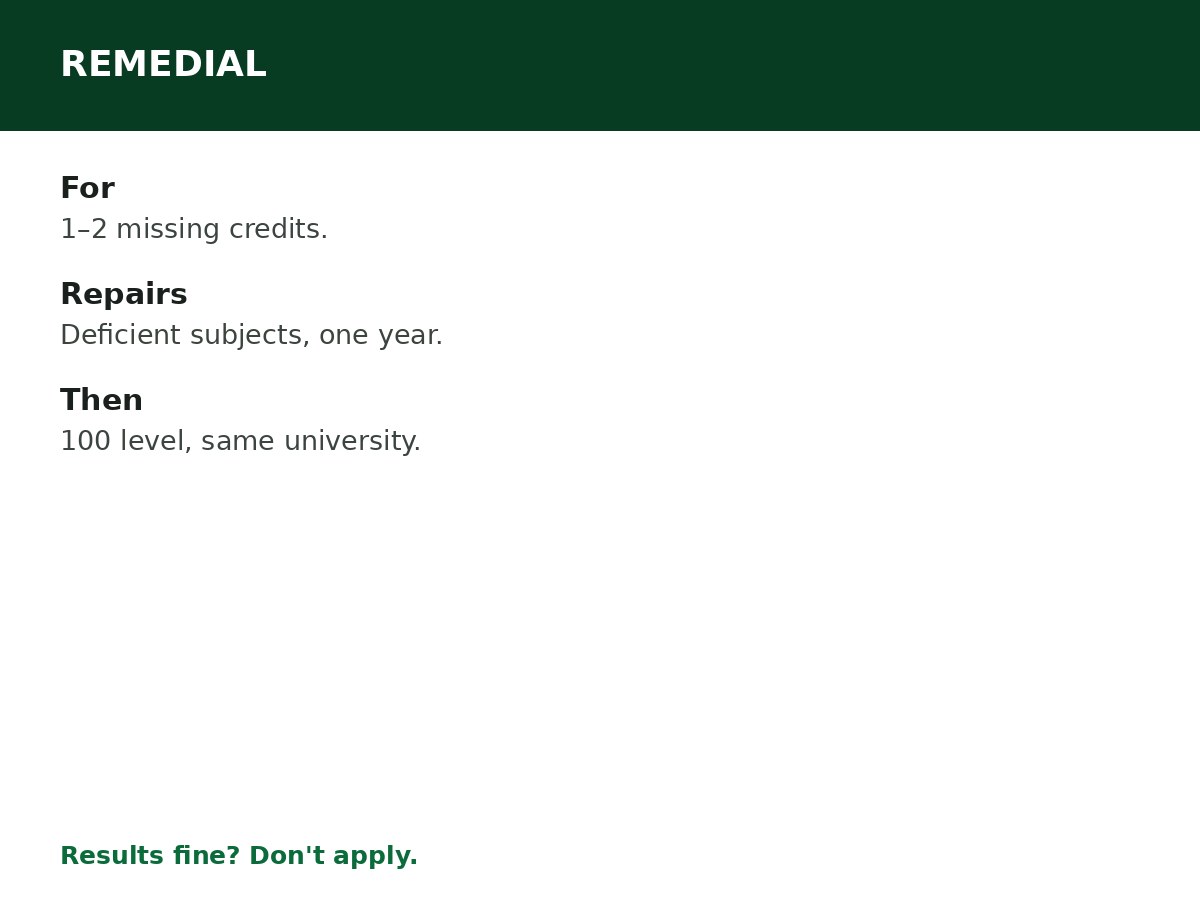
Should apply: candidates with one or two O’Level deficiencies for their target course — for example, a missing credit in a required subject, or a required subject passed at the wrong level — who want to repair those deficiencies within a university programme, rather than (or alongside) retaking the O’Level examination externally.
Should not apply: candidates whose O’Level results already meet their target course’s requirements (pre-degree, UTME, or Direct Entry routes fit better); candidates whose deficiencies are extensive (more than the programme can repair in one year — in that case, retaking O’Level examinations externally is usually the faster route); and candidates targeting a different university (remedial programmes prepare you for the same university’s degrees, not generally for transfer elsewhere).
How remedial programmes work
- One-year preparatory study (duration varies by institution — confirm for the session), focused on the deficient subjects plus relevant preparatory subjects for the target course.
- Admission into the programme requires O’Level results with deficiencies the programme can repair — the programme page for the session states which deficiencies it accepts and which it does not.
- Progression to the degree depends on the programme’s rules for the session: typically, successful completion of the remedial programme (including any required re-examination of deficient subjects), plus a UTME score meeting the university’s minimum (and, where applicable, the department’s cut-off), plus screening — or, in some programmes, progression based primarily on the programme’s own assessment. The programme page for the session states the progression rules.
- Entry level: typically 100 level in the university’s degree programme, after deficiencies are repaired.
- Programme-specific, not transferable: a remedial programme at one university prepares you for that university’s degrees. It does not generally transfer to another university’s admission process.
Remedial vs retaking O’Level examinations
| Remedial programme | Retaking O’Level examinations | |
|---|---|---|
| Setting | University programme, with lectures and assessment | External examination (WAEC/NECO), self-study or tutorial |
| Duration | One year (varies) | Next examination diet (typically months) |
| Scope | Deficient subjects + preparatory subjects | Only the subjects retaken |
| Progression | Programme rules → same university’s degree | New results → any university’s UTME/DE process |
| Best for | Candidates wanting structured repair + university preparation | Candidates with few deficiencies and a clear retake plan |
Neither route is universally better. Retaking is usually faster for a single deficiency; remedial is usually more structured for multiple deficiencies or for candidates who also want university preparation.
Related Guides & Next Steps
- Admission Requirements for Nigerian Universities
- How to Correct Name on JAMB Portal
- Pre-Degree Programmes in Nigeria Explained
- How University Admission Works in Nigeria
- 2026/2027 University Admission Guide for Nigerian Students
Frequently asked questions
What is a remedial programme? A one-year preparatory programme run by a university, for candidates whose O’Level results have deficiencies for their target course, giving them a year to repair those deficiencies and qualify for that university’s degree programmes at 100 level.
Who should apply for a remedial programme? Candidates with one or two O’Level deficiencies for their target course, who want structured repair within a university programme. Candidates whose results already meet requirements should not apply.
Does remedial guarantee admission? No. Progression depends on the programme’s rules for the session (programme completion, UTME score where required, screening) — the university’s admission decision still governs.
Can I use a remedial programme to enter a different university? Generally no — remedial programmes prepare you for the same university’s degrees. A different university’s admission process requires its own route (UTME, Direct Entry, or its own preparatory programme).
Is remedial better than retaking WAEC or NECO? It depends on the deficiency: retaking is usually faster for a single deficiency; remedial is usually more structured for multiple deficiencies or for candidates who also want university preparation.
Sources and last update
- Remedial structure (deficiency-repair purpose, one-year preparatory programme, same-university 100-level progression, programme-specific rules) from institution remedial programme practices, as compiled by CareerMedal.
- Comparison table (remedial vs retake, pre-degree distinction) from the cluster’s route guides, summarised here — the route guides govern where they differ in detail.
- No remedial fee, programme list, or progression threshold is asserted — all are institution- and session-specific.
Last updated: 24 October 2026. Guide — review every admission session and on every institution remedial programme update.

Written by Olaitan Ilori
Olaitan Ilori is the founder and lead researcher at CareerMedal. He provides verified, practical guides on Nigerian tertiary admissions (JAMB, CAPS, Post-UTME), NELFUND student finance, NYSC service-year survival, and early-career job placement.
View all guides by Olaitan Ilori →