

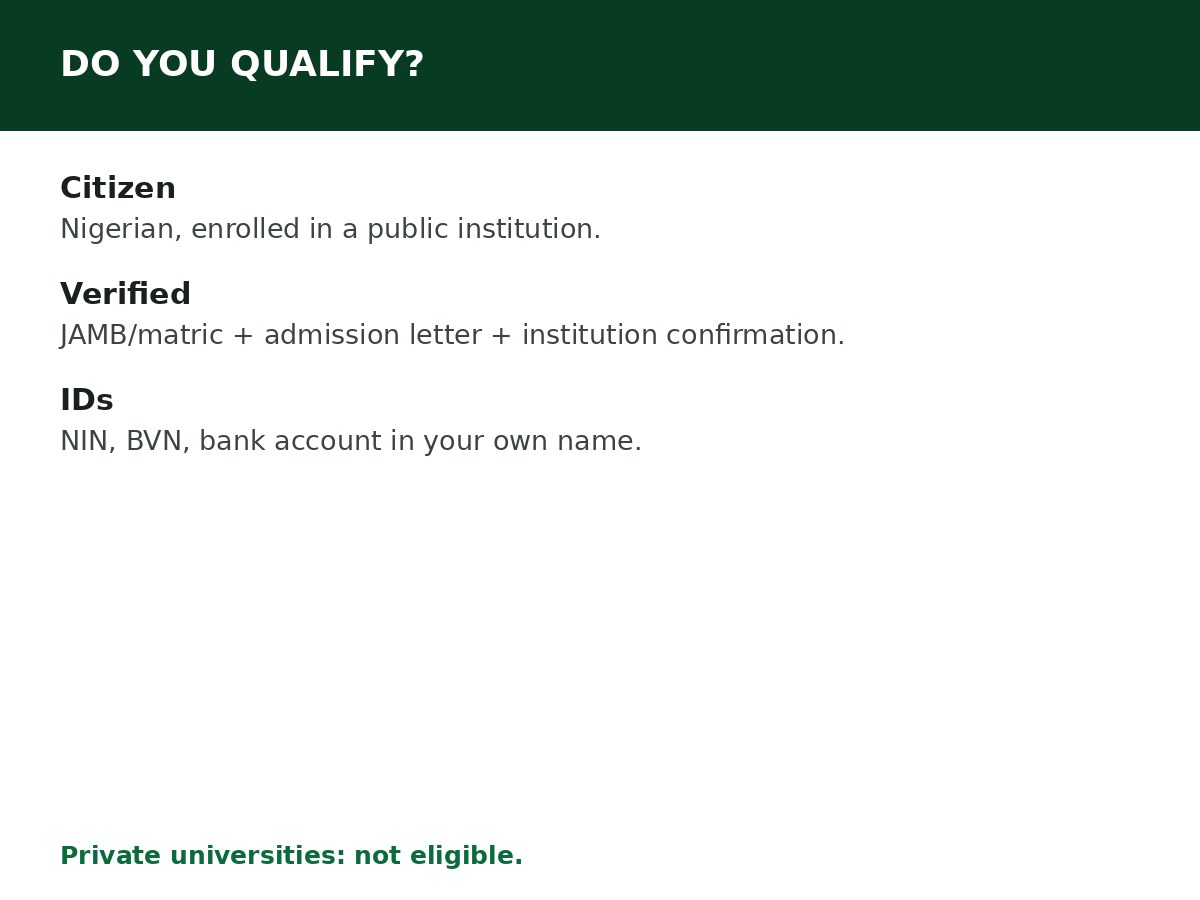
To qualify for a NELFUND student loan, you must be a Nigerian citizen, enrolled as an undergraduate in a recognised public Nigerian tertiary institution, with a verified admission, a NIN, a BVN, and a bank account in your own name. Private university students are not eligible under the current structure — that is the eligibility fact most often got wrong.
NELFUND’s requirements are not suggestions. The portal verifies them against JAMB, NIMC, and your institution’s records. Failing any one of them stops your application, no matter how strong the others are.
The requirements, one by one
1. Nigerian citizenship. You must be a Nigerian citizen. Guides report that dual nationals are not eligible — confirm this on the portal if it applies to you, as eligibility rules are updated between sessions.
2. Enrolled in a public tertiary institution. You must be enrolled as an undergraduate in a recognised public institution — a federal or state university, polytechnic, or college of education that participates in NELFUND. Over 240 institutions were reported participating as the programme expanded.
3. Verified admission and student status. You must have a JAMB registration number and/or matriculation/admission number, and an admission letter from your institution. Your institution must confirm your enrolment — an admission letter alone, without institutional verification, does not complete the check. See How to Verify Your Student Status on NELFUND.
4. National Identification Number (NIN). Your NIN is used to verify your identity, and your name on NIN must match your school records. A name mismatch between NIN, JAMB, and your institution is a common cause of verification failure — fix mismatches before applying.
5. Bank Verification Number (BVN) and bank account. You need a BVN and an active bank account in your own name, where upkeep (if requested) will be paid. The name on the bank account must match your records.
6. No loan default. Guides report that applicants must not have defaulted on any previous bank loan. A defaulted loan disqualifies you.
7. No disqualifying conviction. Guides report that applicants must not have been convicted of fraud, forgery, examination malpractice, drug offences, or cultism.
8. Good academic standing. Guides report that applicants must be in good academic standing with their institution — not on academic probation or suspension. Confirm your standing with your institution if you are unsure.
Private universities: the exclusion to understand
Private university students are not eligible for NELFUND loans under the current structure, as reported by multiple NELFUND guides. The programme is designed for government-owned (public) institutions. If you are at a private university, explore scholarships and state bursary options instead — do not apply to NELFUND expecting an exception, and do not pay anyone who promises to “add” your private institution to the programme.
One guide’s summary line mentioned private institutions among eligible enrolments, but the programme’s own structure and the majority of guides describe it as public-only. If this ever changes, NELFUND’s portal will be the source that shows it — check there, not in a blog summary.
Documents checklist
- NIN (number, and slip where asked)
- BVN and bank account details
- JAMB registration number and/or matriculation/admission number
- Admission letter (scanned, clear)
- Student ID card (where asked)
- Institution fee invoice or schedule (where asked)
- Passport photograph (where asked)
- Active email address and phone number you control
What does not qualify you
- Being a Nigerian student is not enough. You must be enrolled, admitted, and verified — not merely intending to apply to a university.
- Financial need alone is not the criterion. NELFUND is a loan programme for enrolled public-institution students, not a general hardship fund. Guides list “evidence of financial need” among application materials in some summaries, but the deciding checks are enrolment, verification, NIN, and BVN.
- A school fees invoice alone is not an application. Without verified student status, an invoice proves nothing to the portal.
Related Guides & Next Steps
- How to Apply for NELFUND Student Loan
- How to Create a NELFUND Account
- How to Verify Your Student Status on NELFUND
- NELFUND Student Loan 2026/2027: Complete Guide
- NELFUND Frequently Asked Questions
Frequently asked questions
Can private university students apply for NELFUND? No, not under the current structure. NELFUND is for public (federal and state) tertiary institutions.
Can new students apply, or only returning students? Both, provided they are enrolled and verified. New students apply with their JAMB number and admission letter; returning students with their matriculation number. Institution verification applies to both.
Do I need a guarantor? No. NELFUND requires no guarantor and no collateral, unlike commercial loans.
What if my name differs across NIN, JAMB, and my school records? Fix the mismatch before applying. Name mismatches cause verification delays and rejections. Start with NIMC for NIN errors, and your institution for school-record errors.
Can I apply if I am on academic probation? Guides report good academic standing is required. Confirm your standing with your institution before applying.
Sources and last update
- Requirements (citizenship, public institution enrolment, JAMB/matric verification, NIN, BVN, bank account, no default, no disqualifying conviction, good standing, private exclusion), cross-checked across multiple independent NELFUND guides.
- Private-institution conflict explicitly flagged: one guide’s summary line vs the programme’s public-only structure as described by the majority of guides and NELFUND’s own framing.
Last updated: 24 October 2026. Guide — review every session and on every NELFUND guideline update.

Written by Olaitan Ilori
Olaitan Ilori is the founder and lead researcher at CareerMedal. He provides verified, practical guides on Nigerian tertiary admissions (JAMB, CAPS, Post-UTME), NELFUND student finance, NYSC service-year survival, and early-career job placement.
View all guides by Olaitan Ilori →