

Writing a leave request means requesting time off, professionally, in writing, with dates, reasons, and handover — so managers can approve it smoothly, not scramble to cover you. This guide covers leave requests specifically, distinct from the resignation-letter guide (which covers resignations) and the professional-email guide (which covers workplace emails broadly).
What a leave request is
- Written request, not verbal alone — leave, requested in writing, as workplace policies and managers state, for clear records.
- Dates, reasons, handover — leave dates, brief reason, and handover arrangements, stated clearly, for manager decisions.
- Policy first — leave entitlements, notice periods, and approval processes, as your workplace policy states, checked before requesting, for compliance.
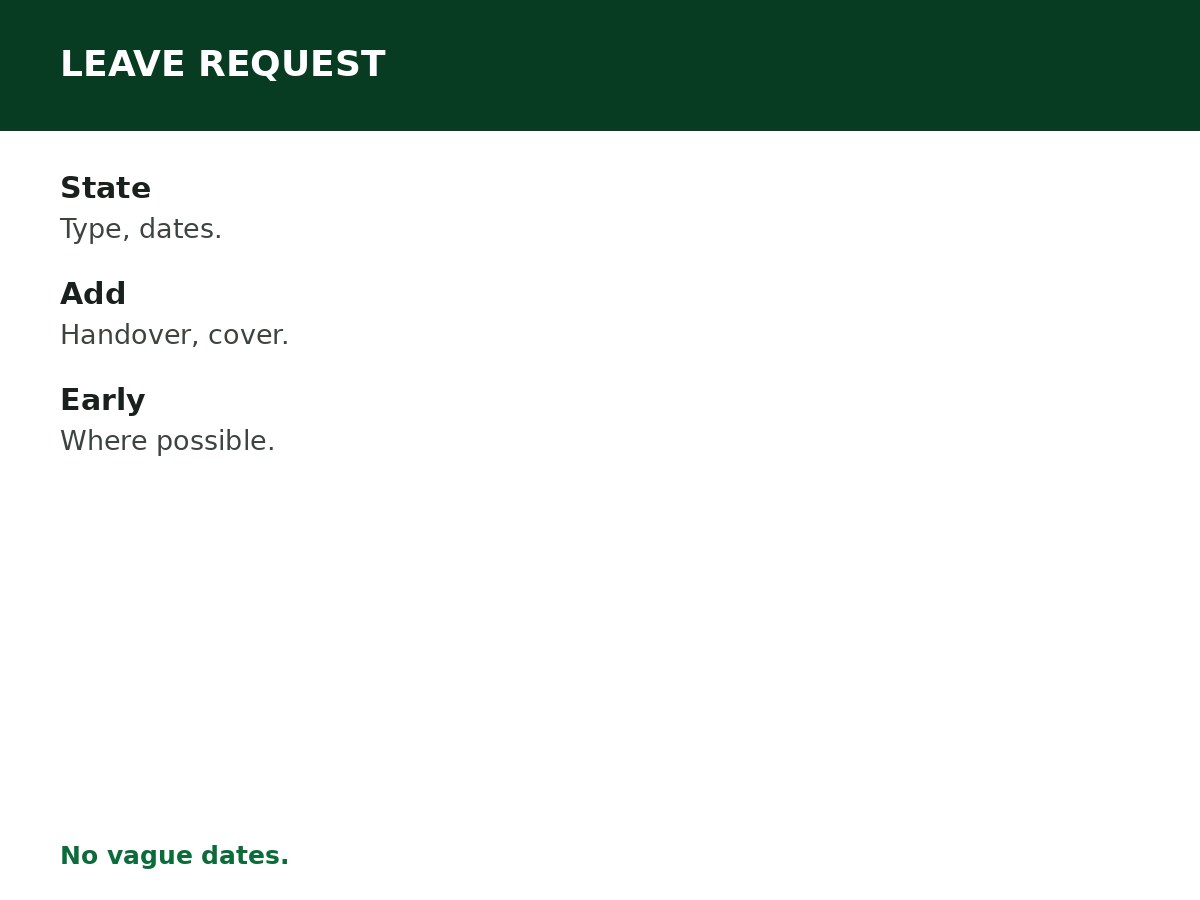
Leave request structure
- Header — name, date, and manager addressee, as on workplace correspondence.
- Request statement — leave type (annual, sick, casual, as policy states), dates, and return date, stated clearly, in the first paragraph.
- Brief reason — brief reason, where policy requires it, without excessive personal detail, as managers state.
- Handover — handover arrangements, covering colleagues, and urgent contacts, stated, for continuity.
- Closing — thanks, and availability, where appropriate, with professional sign-off.
Leave request example (original, adaptable)
‘Dear [Manager],
I am writing to request annual leave from [Start date] to [End date], returning on [Return date]. During my leave, [Colleague] will cover [Responsibilities], and I can be reached for urgent matters at [Contact, where appropriate].
Thank you for your consideration.
Yours faithfully, [Name]’
Adapt wording to your leave type, dates, and workplace policy, honestly, for every request. Examples are templates, not text to copy.
Leave request mistakes
- Late requests, where notice is possible — late requests, without urgency, disrupting planning, as managers state. Request early, where possible.
- Vague dates — vague or missing dates, delaying approvals, as managers state. State dates and return date clearly.
- No handover — leave without handover, leaving colleagues uncovered, harming team trust, as managers state.
- Excessive personal detail — detailed personal reasons, where brief reasons suffice, breaching privacy, as managers state.
Related Guides & Next Steps
- How to Write a CV With No Work Experience
- How to Write a Professional Email
- How to Build a LinkedIn Profile as a Graduate
- How to Write a Resignation Letter
Frequently asked questions
What is a leave request? A written request for time off, with dates, brief reason, and handover arrangements, as workplace policies and managers state, for clear records and smooth approvals.
What should a leave request include? Leave type, dates, return date, brief reason where policy requires it, and handover arrangements, stated clearly, in the first paragraph.
How early should I request leave? Early, where possible, as managers state — late requests, without urgency, disrupt planning. Check notice periods, as your workplace policy states.
Should I give detailed personal reasons for leave? No — brief reasons, where policy requires them, without excessive personal detail, as managers state.
Can I copy a leave request example? No, verbatim — examples are templates, not text to copy. Adapt wording to your leave type, dates, and workplace policy, honestly, for every request.
Sources and last update
- No salary figure, vacancy count, or hiring outcome is asserted anywhere in this article, deliberately — employer career pages and reputable boards, checked at application time, govern.
- No company is named as currently hiring anywhere in this article, deliberately — hiring windows open and close; employer career pages govern.
- Scam patterns: fees for jobs, payment to personal accounts, guaranteed jobs or placements, and mentorship or networking schemes selling access are red flags — verify every employer and programme on official channels before applying or paying anything.
- No job, salary, placement, or hiring outcome is promised anywhere in this article.
Last updated: 24 October 2026. Guide — review every 6–12 months, and on every major hiring-platform change.

Written by Olaitan Ilori
Olaitan Ilori is the founder and lead researcher at CareerMedal. He provides verified, practical guides on Nigerian tertiary admissions (JAMB, CAPS, Post-UTME), NELFUND student finance, NYSC service-year survival, and early-career job placement.
View all guides by Olaitan Ilori →