

CV format for Nigerian job seekers means the layout, sections, and length Nigerian employers expect — one clear document, with education, NYSC, skills, and experience, in the order employers scan. This guide covers CV format specifically, distinct from the ATS guide (which covers ATS parsing) and the graduate CV guide (which covers graduate content).
Standard Nigerian CV format
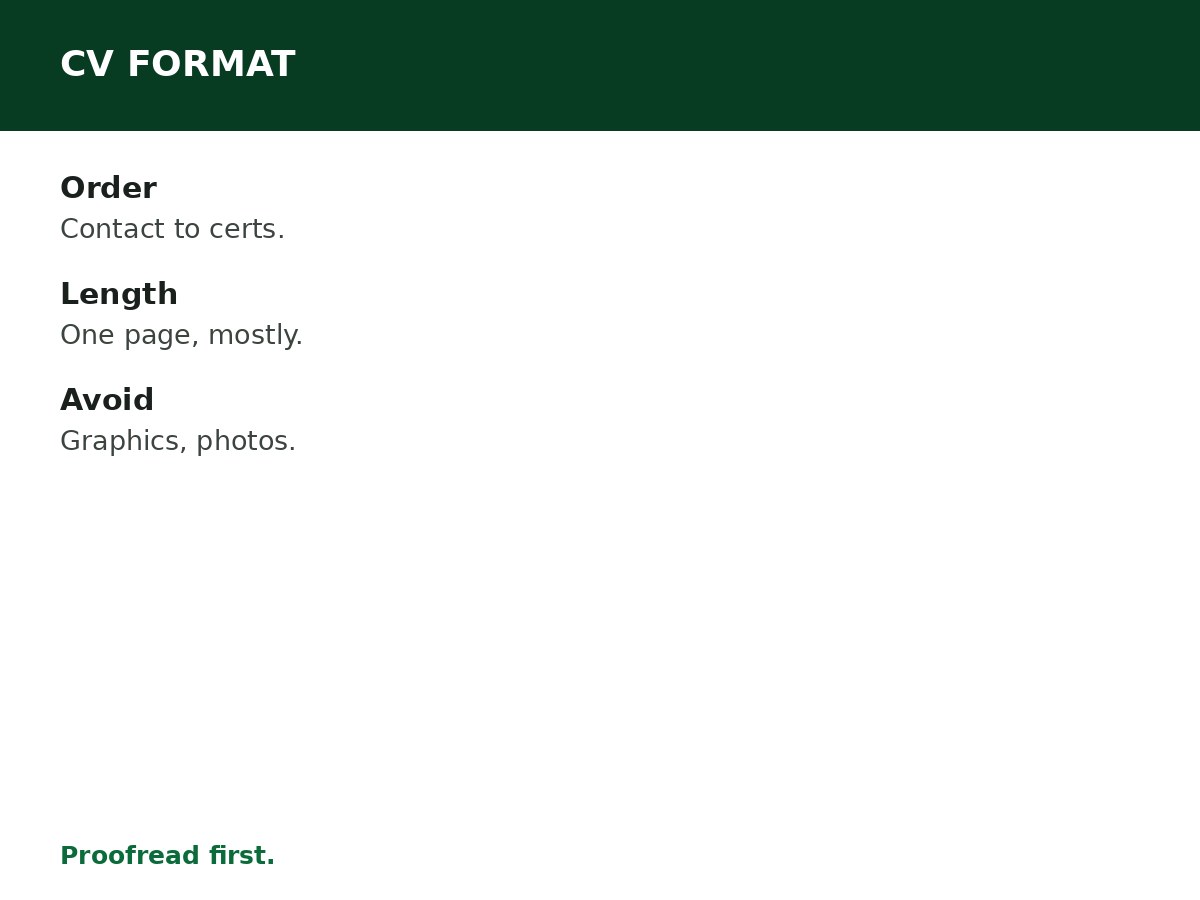
- One page, for most applicants — one page, for fresh graduates and entry-level applicants, as employers state. Two pages only where experience justifies the length.
- Reverse-chronological order — most recent education and experience first, as employers state.
- Clear sections, in order — Contact, Profile, Education, NYSC, Experience, Skills, Certifications, as the market states, with standard headings.
- Simple, professional layout — single column, standard fonts, consistent formatting, no graphics or colours, for employer readability.
Section-by-section format
- Contact — name (largest text), phone, email, city, and portfolio or LinkedIn link, where available. No full address, date of birth, or state of origin, unless the application requests them, for privacy.
- Profile — 2–3 lines, on degree, skills, and target roles, as the profile guide covers.
- Education — degree, institution, year, and relevant coursework or projects, most recent first.
- NYSC — status, year, and PPA, where relevant, as the NYSC-listing guide covers.
- Experience — role, organisation, dates, and responsibilities with results, most recent first.
- Skills — skills with evidence, grouped by type, not long unproven lists.
- Certifications — relevant certifications, with providers and years, where earned.
Formatting mistakes
- Multiple pages without justification — long CVs, for entry-level applicants, lose employer attention. One page, unless experience justifies more.
- Inconsistent formatting — mixed fonts, sizes, and spacing, signalling carelessness, whatever the content.
- Graphics and colours — graphic CVs, colours, and photos, distract employers and break ATS parsing, as the ATS guide covers.
- Personal details overload — full addresses, dates of birth, and state of origin, included by default, risking privacy, where applications do not request them.
Before sending
- Proofread — spelling, grammar, and formatting, checked before every submission.
- Tailor per role — skills and experience, matching each role’s requirements, highlighted first.
- Save correctly — file named clearly (Name_CV_Role), in the format the application states, for employer filing.
Related Guides & Next Steps
- How to Write a CV With No Work Experience
- Best CV Skills to Add as a Graduate
- How to Write a Professional Profile for Your CV
- How to Write an ATS-Friendly CV
Frequently asked questions
What is the standard CV format for Nigerian job seekers? One page for most applicants, reverse-chronological order, sections in order (Contact, Profile, Education, NYSC, Experience, Skills, Certifications), single column, standard fonts, no graphics.
How long should a Nigerian CV be? One page, for fresh graduates and entry-level applicants, as employers state — two pages only where experience justifies the length.
Should I include my photo on my CV? No — photos are not standard on Nigerian CVs, as employers state, and distract from content. Include photos only where the application explicitly requests them.
Should I include date of birth and state of origin? No, by default — full addresses, dates of birth, and state of origin, included only where the application requests them, for privacy.
How should I name my CV file? Clearly (Name_CV_Role), in the format the application states, for employer filing.
Sources and last update
- No salary figure, vacancy count, or hiring outcome is asserted anywhere in this article, deliberately — employer career pages and reputable boards, checked at application time, govern.
- No company is named as currently hiring anywhere in this article, deliberately — hiring windows open and close; employer career pages govern.
- Scam patterns: fees for jobs, payment to personal accounts, guaranteed jobs or shortlisting, and CV services selling fake experience are red flags — verify every employer on official channels before applying or paying anything.
- No job, shortlisting, or hiring outcome is promised anywhere in this article.
Last updated: 24 October 2026. Guide — review every 6–12 months, and on every major hiring-platform change.

Written by Olaitan Ilori
Olaitan Ilori is the founder and lead researcher at CareerMedal. He provides verified, practical guides on Nigerian tertiary admissions (JAMB, CAPS, Post-UTME), NELFUND student finance, NYSC service-year survival, and early-career job placement.
View all guides by Olaitan Ilori →