

Economics is one of the most versatile UTME subjects in Nigeria: it opens Commercial courses, Social Science courses, and several management and Arts courses, and it is accepted as a fourth subject for computing and some science courses. The list below groups the main options, with the UTME subjects each typically requires. Check the JAMB brochure for your course and institution for the session, because Economics’ role varies by institution — some courses require it, some accept it as one of several subjects, and some do not require it at all.
Economics is often treated as a Commercial subject only. It is not — it is also a Social Science subject, and it opens more courses across fields than any other single Social Science subject.
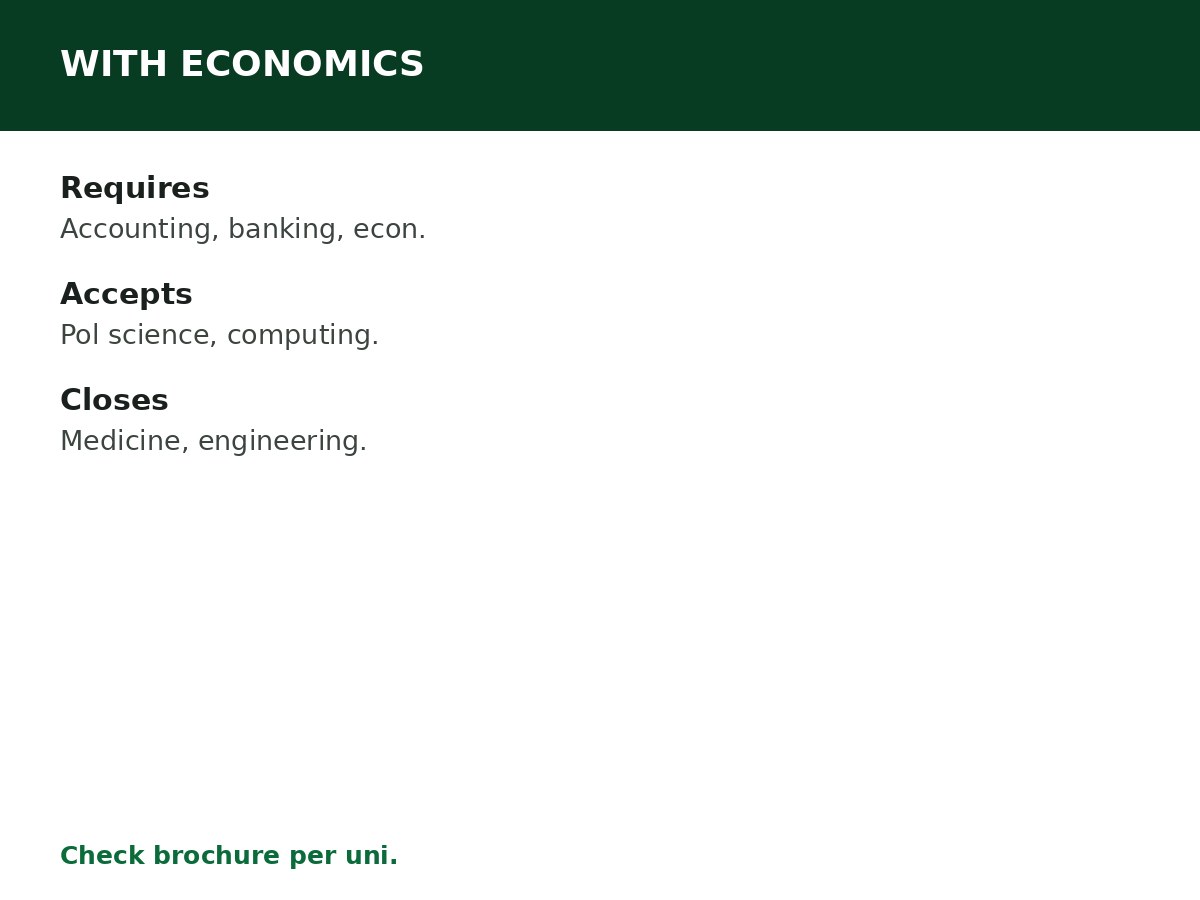
Commercial and management (Economics required or central)
- Accounting — English, Mathematics, Economics, and one other subject. 4 years + ICAN route.
- Business Administration, Marketing, Human Resource Management — English, Mathematics, Economics, and one other subject. 4 years.
- Banking and Finance, Insurance — English, Mathematics, Economics, and one other subject. 4 years.
- Economics — English, Mathematics, Economics, and one other Social Science subject. 4 years.
Social sciences (Economics required or central)
- Political Science — English, Government, Economics, and one other Social Science or Arts subject (Economics accepted as one of the Social Science subjects at most institutions).
- Sociology, Public Administration — English, Mathematics or Economics, and two other subjects (as the brochure states).
- Geography — English, Geography, Economics, and one other subject (as the brochure states).
- International Relations — English, Government, Economics, and one other subject (as the brochure states).
Computing and technology (Economics accepted as fourth subject)
- Computer Science — English, Mathematics, Physics, and one of Chemistry, Biology, or Economics (at institutions that accept Economics in place of Chemistry or Biology — check the brochure; at institutions that require Chemistry, this course is closed without it).
- Data Science — English, Mathematics, and two of Physics, Chemistry, Biology, Economics, or Geography (as the brochure states).
- Mathematics, Statistics — English, Mathematics, Physics, and a fourth subject as the brochure states (Economics accepted at many institutions).
Arts and humanities (Economics accepted at many institutions)
- Mass Communication — English, Literature-in-English, and two other Arts or Social Science subjects (Economics accepted as one of the Social Science subjects at many institutions — Literature remains the core requirement).
- Law (LLB) — English, Literature-in-English, and two other Arts or Social Science subjects (Economics accepted as one of the Social Science subjects at many institutions — Literature remains the core requirement).
What Economics does not open (on its own)
- Science courses (medicine, pharmacy, nursing, microbiology, biochemistry) — Economics does not substitute for Biology, Chemistry, or Physics, which those courses require.
- Engineering — Economics does not substitute for Mathematics, Physics, and Chemistry, which engineering requires.
Related Guides & Next Steps
- Admission Requirements for Nigerian Universities
- How to Choose a Course After JAMB
- How University Admission Works in Nigeria
- Best Universities to Study Medicine in Nigeria
- Courses You Can Study With CRS or IRS
Frequently asked questions
Which courses require Economics? Accounting, banking and finance, business administration, marketing, insurance, and economics itself require it at most institutions. Political science, sociology, and public administration accept it centrally at many institutions.
Can I study accounting without Economics? No, at most institutions — Economics is a core UTME and O’Level requirement for accounting and most management courses. Retaking Economics is the route if accounting is your goal.
Can I study computer science with Economics? At institutions that accept Economics in place of Chemistry or Biology for computer science, yes; at institutions that require Chemistry, no. Check the brochure for your target institution.
Is Economics useful for Arts courses? As a UTME subject, yes at many institutions — Economics is accepted as a Social Science subject for law and mass communication, alongside Literature-in-English. As knowledge (markets, policy, data), Economics training transfers broadly — but the knowledge does not substitute for a brochure requirement.
Should I offer Economics at UTME if I am unsure of my course? Yes, if you are leaning toward Commercial or Social Science courses — Economics keeps accounting, business administration, banking and finance, economics, and political science open, and is accepted as a fourth subject for computing at many institutions. If you are leaning toward Science courses, Economics does not help, and your UTME subjects should match those fields instead.
Sources and last update
- Course groupings and Economics-requirement patterns from JAMB brochure patterns and the cluster’s course guides, with per-institution brochure confirmation directed throughout — Economics as requirement vs accepted subject is explicitly institution-dependent.
- Durations and professional routes from the respective course guides (Batches 13–17), summarised here — the course guides govern where they differ in detail.
Last updated: 24 October 2026. Guide — review every 3–6 months and on every JAMB brochure update.

Written by Olaitan Ilori
Olaitan Ilori is the founder and lead researcher at CareerMedal. He provides verified, practical guides on Nigerian tertiary admissions (JAMB, CAPS, Post-UTME), NELFUND student finance, NYSC service-year survival, and early-career job placement.
View all guides by Olaitan Ilori →