

No — not under NELFUND’s current structure. NELFUND is designed for students in government-owned (public) tertiary institutions: federal and state universities, polytechnics, and colleges of education. Private university students are not eligible, and no application route, agent, or “special list” changes that.
This is the dedicated answer to the question, because it is asked constantly, and because the wrong answer costs private-university students application effort, and sometimes money paid to people who promise an exception that does not exist.
Why private universities are excluded
NELFUND’s programme, as established under the Student Loans (Access to Higher Education) Act and as described by NELFUND itself, covers public tertiary institutions. The rationale reported in programme descriptions is that the loan exists to prevent students in government-owned institutions from dropping out due to financial constraints, where fees are set by public institutions. Private universities, with privately set fees and private funding models, sit outside that design.
That is a programme-design fact, not a judgment about private-university students’ need. Need does not create eligibility where the programme’s rules do not provide it.
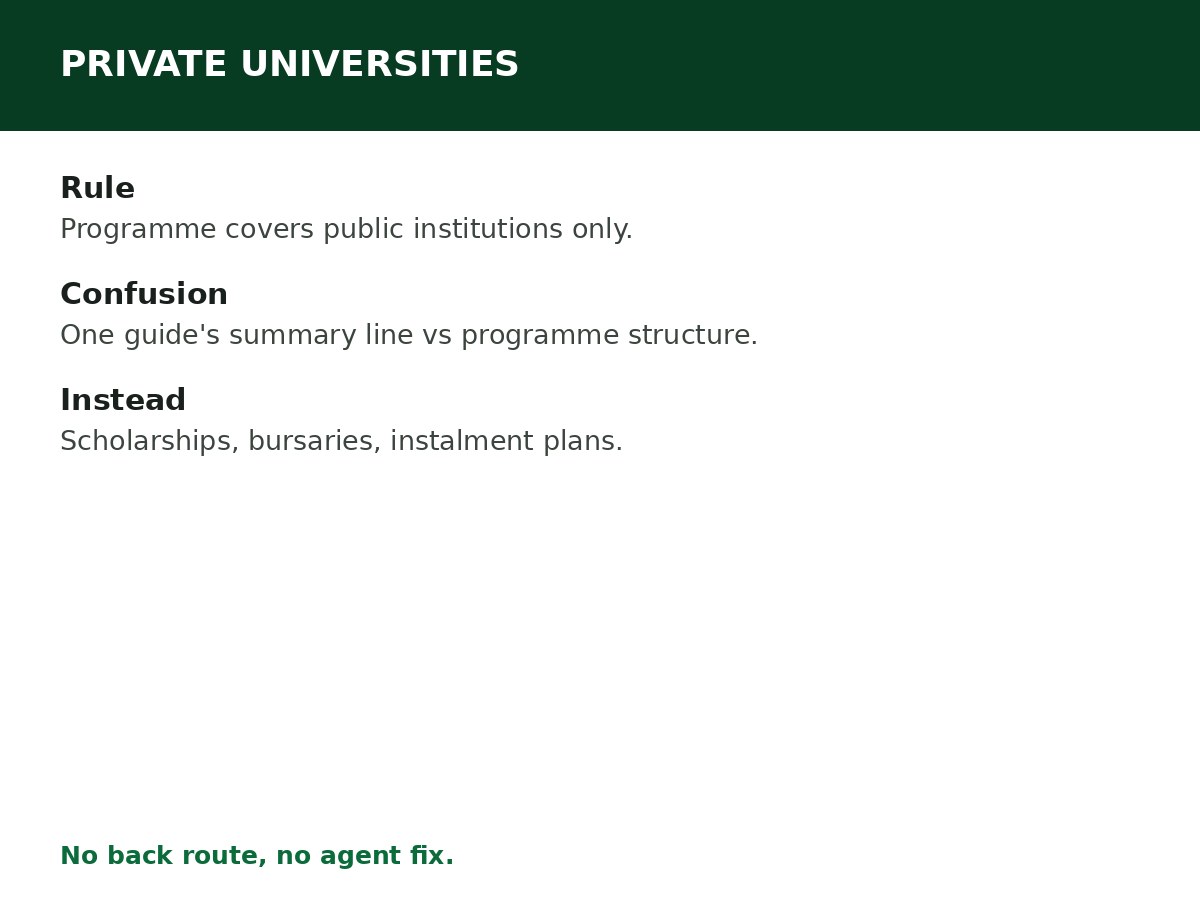
The confusion, and why it persists
- One guide’s summary line mentioned private institutions among eligible enrolments. That line conflicts with the programme’s public-only structure as described by NELFUND and by the majority of guides, and CareerMedal flags it as an outlier rather than following it. If the programme ever extends to private institutions, the portal’s institution list will show it — a blog summary will not be the source of that change.
- “Federal government-owned” vs “state” confusion. Some summaries describe the scheme as prioritising federal institutions, with state institutions added in phases. That phasing is about onboarding order among public institutions, not about private inclusion. A state university that is onboarded qualifies; a private university that is not onboarded does not, regardless of phase.
- Agents promising private-institution access. Anyone who offers, for a fee, to “add” your private university to NELFUND, or to process a private-university application through a back route, is not NELFUND. There is no back route. Do not pay, and do not hand over your NIN, BVN, or bank details to such a person.
What private university students can do instead
- Scholarships. Merit-based, need-based, and provider-specific scholarships are the main alternative funding route for private-university students — see NELFUND vs Scholarships: Which Is Better? for the comparison, and the Scholarships & Bursaries cluster for specific opportunities.
- State and institutional bursaries. Some state governments and some private institutions run their own bursary or financial-aid schemes. Check your state government’s education/bursary programmes and your institution’s financial-aid office — these are separate from NELFUND and have their own rules.
- Institutional payment plans. Many private institutions allow fee payment in instalments. Ask your institution’s bursary about instalment options before assuming a lump sum is the only route.
- Family and employer support, and part-time work — with the usual caution that work must not jeopardise the full-time enrolment and academic standing that other funding routes may require.
None of these is NELFUND, and none should be presented as NELFUND. If a funding offer claims to be “NELFUND for private universities”, verify it on nelf.gov.ng and portal.nelf.gov.ng before engaging with it — and expect it not to verify.
Related Guides & Next Steps
- NELFUND Student Loan Requirements
- NELFUND vs Scholarships: Which Is Better?
- NELFUND Student Loan 2026/2027: Complete Guide
- NELFUND Frequently Asked Questions
- Can NELFUND Pay for Accommodation?
Frequently asked questions
Can private university students apply for NELFUND at all? No, not under the current structure. The programme covers public institutions only.
What about private polytechnics and private colleges of education? The same public-only rule applies, as reported. Private polytechnics and private colleges are not eligible either.
Will NELFUND extend to private universities in future? That would be a programme change announced by NELFUND itself. No such extension is asserted in this article, and no date is given for one — check NELFUND’s official channels for any future announcement, rather than a blog prediction.
I applied as a private-university student and my application is pending. Will it be approved? No, if the institution is private and the programme’s rules have not changed. A pending status is not an approval, and an application that cannot be verified against a participating public institution will not be approved. Do not pay anyone to “push” it through.
Can I transfer to a public institution to become eligible? Eligibility follows your current enrolment in a participating public institution, verified for the current session. A transfer is an academic decision with its own consequences (admission, programme, credits) — do not transfer solely for loan eligibility without weighing those consequences, and confirm your new institution’s onboarding and verification before assuming eligibility follows automatically.
Sources and last update
- Private exclusion (public-only structure, programme design, Act framing), cross-checked across NELFUND guides and NELFUND’s own programme descriptions.
- Outlier guide line (private enrolments mentioned in one summary) explicitly flagged, with portal-list check directed as the authority for any future change.
- Alternatives are framed as separate routes with their own rules, not as NELFUND equivalents.
Last updated: 24 October 2026. Guide — review every session and on every NELFUND guideline change.

Written by Olaitan Ilori
Olaitan Ilori is the founder and lead researcher at CareerMedal. He provides verified, practical guides on Nigerian tertiary admissions (JAMB, CAPS, Post-UTME), NELFUND student finance, NYSC service-year survival, and early-career job placement.
View all guides by Olaitan Ilori →