

Physical verification is the in-person check where NYSC confirms a foreign-trained graduate and their documents, at a designated verification centre, before mobilisation. It is not a formality, it cannot be done by proxy, and it cannot be bought. This guide explains what happens, what to bring, and what follows.
What happens at physical verification
- In-person attendance — you attend a designated verification centre, as NYSC announces per batch, with your original documents.
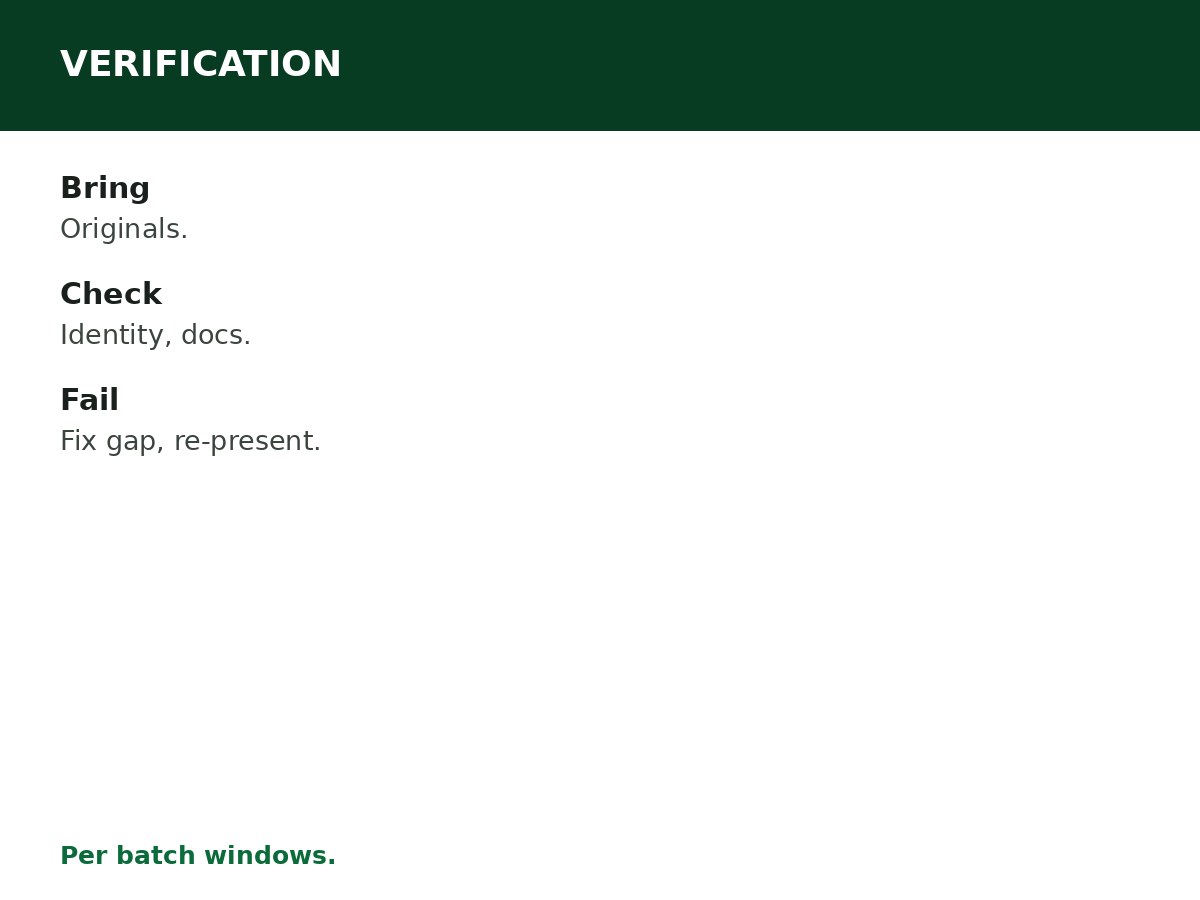
- Document check — NYSC officials check your evaluation letter, degree certificate, transcript, passport, and O-level results against your registration details.
- Identity check — your identity is confirmed against your passport and documents.
- Verification recorded — once verified, your details enter NYSC’s system for mobilisation, and you proceed to registration in the batch your verification falls into.
What to bring
- Evaluation letter from the Federal Ministry of Education.
- Degree certificate and transcript, originals.
- International passport, valid.
- O-level results.
- Any additional document NYSC states for the batch’s verification exercise.
- Copies of everything, kept separately from the originals.
After verification
- Register — on portal.nysc.org.ng, in the batch your verification falls into.
- If verification fails — NYSC states the reason (document gap, evaluation gap, identity mismatch). Fix the stated gap through the issuing authority, and re-present at the next verification exercise. Do not pay anyone to ‘pass’ verification.
- Timing — verification windows are announced per batch. Missing a window means waiting for the next exercise, and falling into a later batch.
Scams around verification
- Proxy verification — verification is in person. Anyone offering to verify on your behalf is running a scam.
- Paid verification — verification is an official process, not a paid service.
- Fake verification letters — detected at registration, with serious consequences.
Related Guides & Next Steps
- NYSC 2026 Batch A, B and C: Complete Guide
- NYSC FAQs for Prospective Corps Members
- NYSC Correction of Date of Birth
- NYSC Correction of Name
- NYSC Foreign Graduate Registration Requirements
Frequently asked questions
What is NYSC physical verification for foreign graduates? The in-person check where NYSC confirms a foreign-trained graduate and their documents, at a designated verification centre, before mobilisation.
Where does NYSC physical verification happen? At designated verification centres, as NYSC announces per batch.
What do I bring to NYSC physical verification? Evaluation letter, degree certificate and transcript (originals), international passport, O-level results, and any additional document NYSC states for the batch.
Can someone verify on my behalf? No — verification is in person. Anyone offering proxy verification is running a scam.
What if my physical verification fails? NYSC states the reason — fix the stated gap through the issuing authority, and re-present at the next verification exercise.
Sources and last update
- NYSC portal: portal.nysc.org.ng (typed directly — never via a forwarded link).
- Dates, camp details, and batch-specific rules change per batch — the NYSC official timetable and announcements for the batch govern, and no batch-specific date is asserted anywhere in this article, deliberately.
- Scam patterns: agents, fake exemption or exclusion letters, and payment demands to personal accounts are red flags — NYSC documents are issued through the official portal and your institution.
- No mobilisation, deployment, exemption, or exclusion outcome is promised anywhere in this article.
Last updated: 24 October 2026. Guide — review every batch cycle, and on every NYSC announcement.

Written by Olaitan Ilori
Olaitan Ilori is the founder and lead researcher at CareerMedal. He provides verified, practical guides on Nigerian tertiary admissions (JAMB, CAPS, Post-UTME), NELFUND student finance, NYSC service-year survival, and early-career job placement.
View all guides by Olaitan Ilori →