
Building a portfolio with no experience means creating proof — projects, case studies, and supervised work — where none exists yet, so employers and clients can judge your skill. This guide covers portfolio building specifically, distinct from the beginner skill guides (which cover learning) and the freelancing guide (which covers finding clients).
What a portfolio is
- Proof, not a CV — finished work, projects, and results, demonstrating skill, for employer and client trust. Certificates alone are not portfolios.
- Quality over quantity — a few strong projects, with process and results, beat many weak projects, for hiring decisions.
- Field-specific proof — design = portfolio pieces, web dev = deployed projects, marketing = measured results, trades = finished work and references, data = analyses and dashboards, as the market states.
How to build with no experience
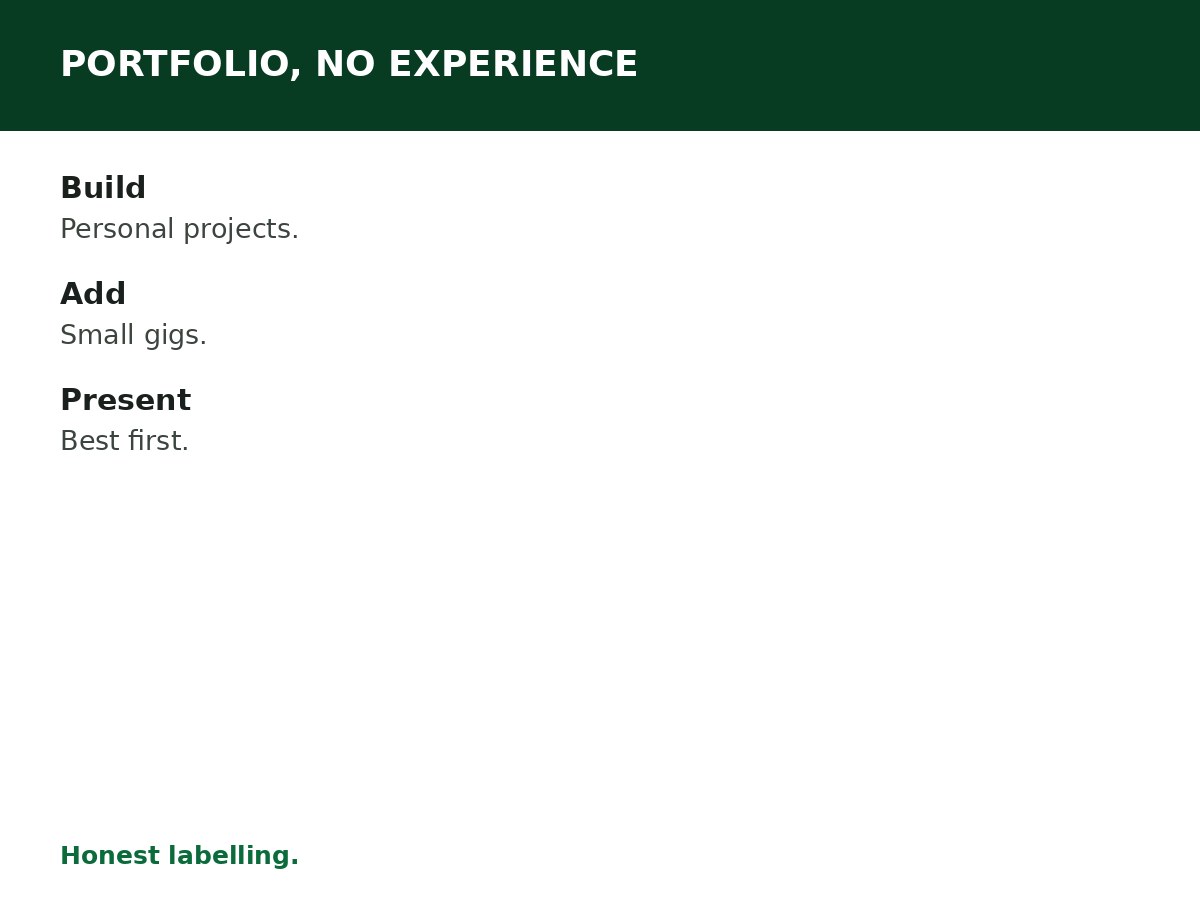
- Personal projects — projects you create yourself, solving real problems, demonstrating skill, even without clients. Personal projects are legitimate portfolio proof.
- Redesigns and case studies — redesigns of existing products, with process and reasoning, demonstrating skill, without passing off copies as original work.
- Volunteer and small gigs — small, paid or volunteer work, for local businesses, societies, and referrals, building real client proof.
- Supervised work — apprenticeship, internship, and SIWES work, with references, demonstrating skill in real settings.
- Document process, not just results — problem, process, decisions, and results, for each project, showing thinking, not just output.
Presenting your portfolio
- One page, clear navigation — a simple portfolio page or document, with projects, process, and contact, easy for employers to navigate.
- Best work first — strongest projects first, weakest last, for hiring decisions. Employers judge early.
- Honest labelling — personal, volunteer, and client work, labelled honestly. Mislabelled work, discovered, ends trust.
- Keep updating — new projects, replacing old ones, as skill grows, so portfolios reflect current competence, not past learning.
Portfolio scams and mistakes
- Copied portfolios — passing off others’ work as your own is fraud, and discovered copying ends careers. Build original work, through practice.
- Certificate-only portfolios — certificates without projects prove attendance, not skill. Employers judge projects, not certificates.
- Quantity over quality — many weak projects, hiding strong ones, waste employer attention. Few strong projects, well presented, win.
Related Guides & Next Steps
- Federal Government TVET Programme 2026
- Free Certifications Nigerians Can Earn Online
- Government-Funded Training Opportunities in Nigeria
- How to Learn UI/UX Design
Frequently asked questions
How do I build a portfolio with no experience? By creating personal projects, redesigns and case studies, volunteer and small gigs, and supervised work, documenting process (problem, process, decisions, results) for each project.
What counts as portfolio proof? Finished work, projects, and results — design pieces, deployed projects, measured campaign results, finished trade work, analyses and dashboards — as the market states, not certificates alone.
Can personal projects go in a portfolio? Yes — projects you create yourself, solving real problems, demonstrating skill, even without clients, are legitimate portfolio proof, labelled honestly.
Should I label personal vs client work? Yes — personal, volunteer, and client work, labelled honestly. Mislabelled work, discovered, ends trust.
Can I use others’ work in my portfolio? No — passing off others’ work as your own is fraud, and discovered copying ends careers. Build original work, through practice.
Sources and last update
- No programme is named as currently open anywhere in this article, deliberately — training windows open and close, and a frozen list misleads readers within months. Official programme channels, checked at application time, govern.
- No fee, stipend, or income figure is asserted anywhere in this article, deliberately. Official programme pages, checked at application time, govern.
- Scam patterns: training fees demanded for ‘free’ programmes, payment to personal accounts, and guaranteed jobs or income are red flags — verify every programme on official channels before applying or paying anything.
- No job, income, certification, or training outcome is promised anywhere in this article.
Last updated: 24 October 2026. Guide — review every 3–6 months, and on every official programme announcement.

Written by Olaitan Ilori
Olaitan Ilori is the founder and lead researcher at CareerMedal. He provides verified, practical guides on Nigerian tertiary admissions (JAMB, CAPS, Post-UTME), NELFUND student finance, NYSC service-year survival, and early-career job placement.
View all guides by Olaitan Ilori →