
Applying for a PTDF scholarship is a portal process with screening — not an agent process, not a payment process, and not a guaranteed process. This guide walks through the application step by step, for both the in-country and overseas schemes, and tells you where the cycle-specific details live — because amounts, deadlines, eligible courses, and approved universities change every cycle, and no amount, deadline, course list, or university list is asserted anywhere in this article, deliberately.
Before you apply: the checks
- Scheme — in-country (Nigeria) or overseas (abroad)? The schemes have different universities, coverage, and processes.
- Level — undergraduate, master’s, or PhD, as the scheme states for the cycle.
- Field — your field must be on the cycle’s eligible-courses list.
- University — your university must be on the cycle’s approved-universities list.
- Cycle — read the cycle’s announcement on the PTDF official page. Do not apply from a previous cycle’s details.
Step by step
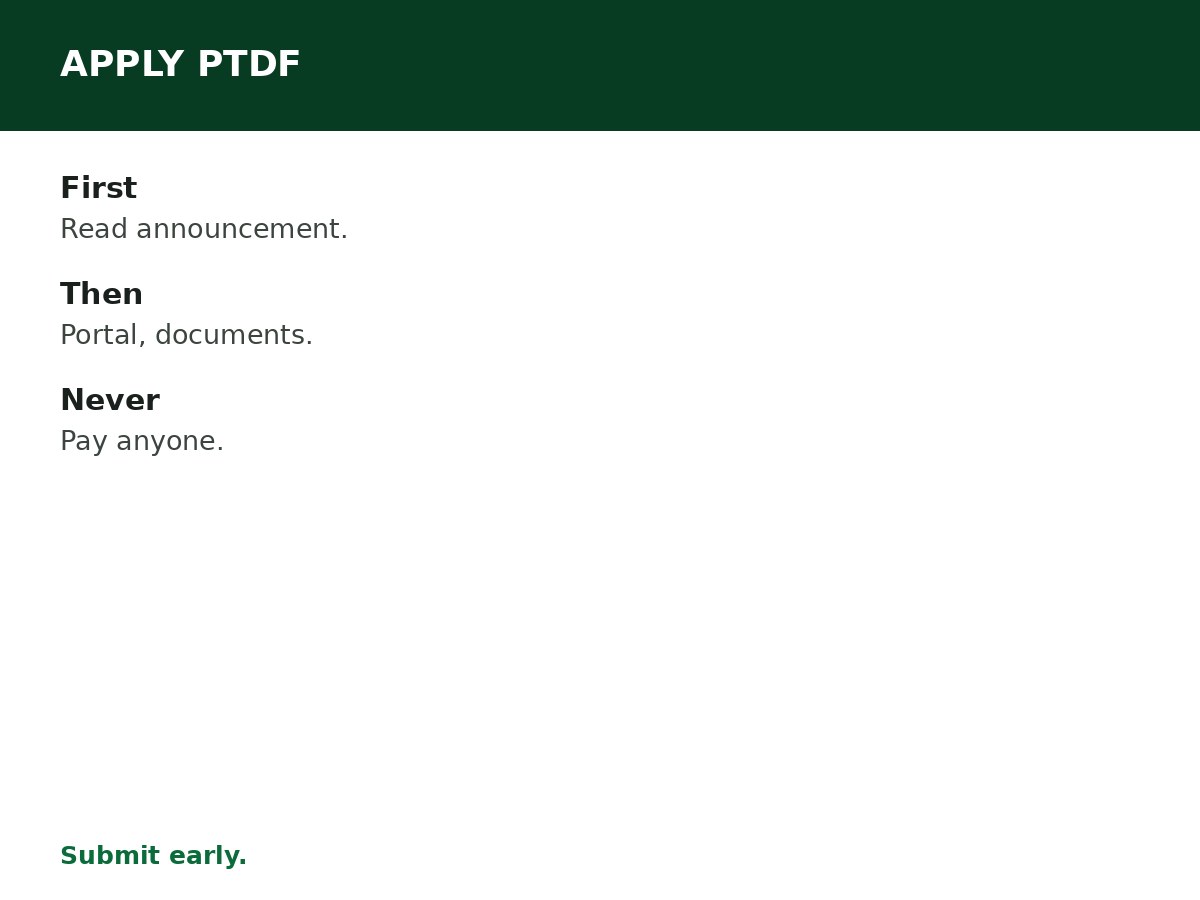
- Read the announcement — on the PTDF official page, for the current cycle.
- Create an account — on the PTDF official portal, with your own email and phone number. Never let an agent create your account.
- Fill the form — personal details, academic record, field, university, as the form states. Fill it yourself; errors from agents are your errors.
- Upload documents — identification, certificates, transcripts, references, study plan or proposal where required, passport for overseas. Upload clear, complete copies.
- Submit before the deadline — the cycle’s deadline, as the announcement states. Late applications are not considered.
- Complete screening — aptitude test, interview, or document verification, as the scheme states for the cycle. Prepare for the screening the scheme actually describes.
- Track results — through PTDF’s official channels. Do not pay anyone for results.
Common application mistakes
- Applying to the wrong scheme — in-country rules applied to an overseas application, or vice versa.
- Ineligible field or university — field or university not on the cycle’s lists. Check before applying, not after.
- Agent-filled forms — errors, mismatches, and missing documents from agent-filled forms. Fill it yourself.
- Late submission — the deadline is hard. Submit early; portal congestion near the deadline is common.
- Paying for anything — PTDF does not collect application fees to personal accounts. Any payment demand is a scam.
Related Guides & Next Steps
- Scholarships for Nigerian Students in 2026/2027
- PTDF Scholarship Approved Universities
- PTDF Scholarship Eligible Courses
- PTDF Overseas Scholarship Guide
Frequently asked questions
Where do I apply for PTDF? Through the PTDF official portal only — never through an agent, a personal account, or a link sent in a group.
What documents do I need for PTDF? Identification, certificates, transcripts, references, study plan or proposal where required, and passport for overseas — as the scheme states for the cycle. Check the cycle’s announcement.
Does PTDF have an aptitude test? As the scheme states for the cycle — some schemes include an aptitude test, interview, or document verification. Prepare for the screening the scheme actually describes.
Can an agent apply for PTDF for me? No — fill the form yourself. Errors from agents are your errors, and agents selling PTDF slots are running scams.
How do I know if I won a PTDF scholarship? Through PTDF’s official channels. Do not pay anyone for results.
Sources and last update
- Scholarship programmes named here are established programmes as reported; amounts, deadlines, and eligibility change every cycle — the official programme page for the current cycle governs, and no amount or deadline is asserted anywhere in this article, deliberately.
- Scholarship-vs-loan distinction from the NELFUND cluster guides (Batches 6–10): a scholarship is not repaid; NELFUND is a loan, repayable from 2 years after NYSC at 10% of income.
- Scam patterns from the fake-agents guide (Batch 12): application fees, guaranteed awards, and payment to personal accounts are red flags.
- No admission, award, or visa outcome is promised anywhere in this article.
Last updated: 24 October 2026. Guide — review every 3–6 months and on every scholarship-cycle update.

Written by Olaitan Ilori
Olaitan Ilori is the founder and lead researcher at CareerMedal. He provides verified, practical guides on Nigerian tertiary admissions (JAMB, CAPS, Post-UTME), NELFUND student finance, NYSC service-year survival, and early-career job placement.
View all guides by Olaitan Ilori →