
Government recruitment applications usually follow one pipeline — announcement, portal application, screening, shortlist, appointment — with agency variations, but no stage ever involves a fee, an agent, or a guaranteed outcome. This guide explains the standard pipeline, so applicants can recognise deviations as scams.
The standard pipeline
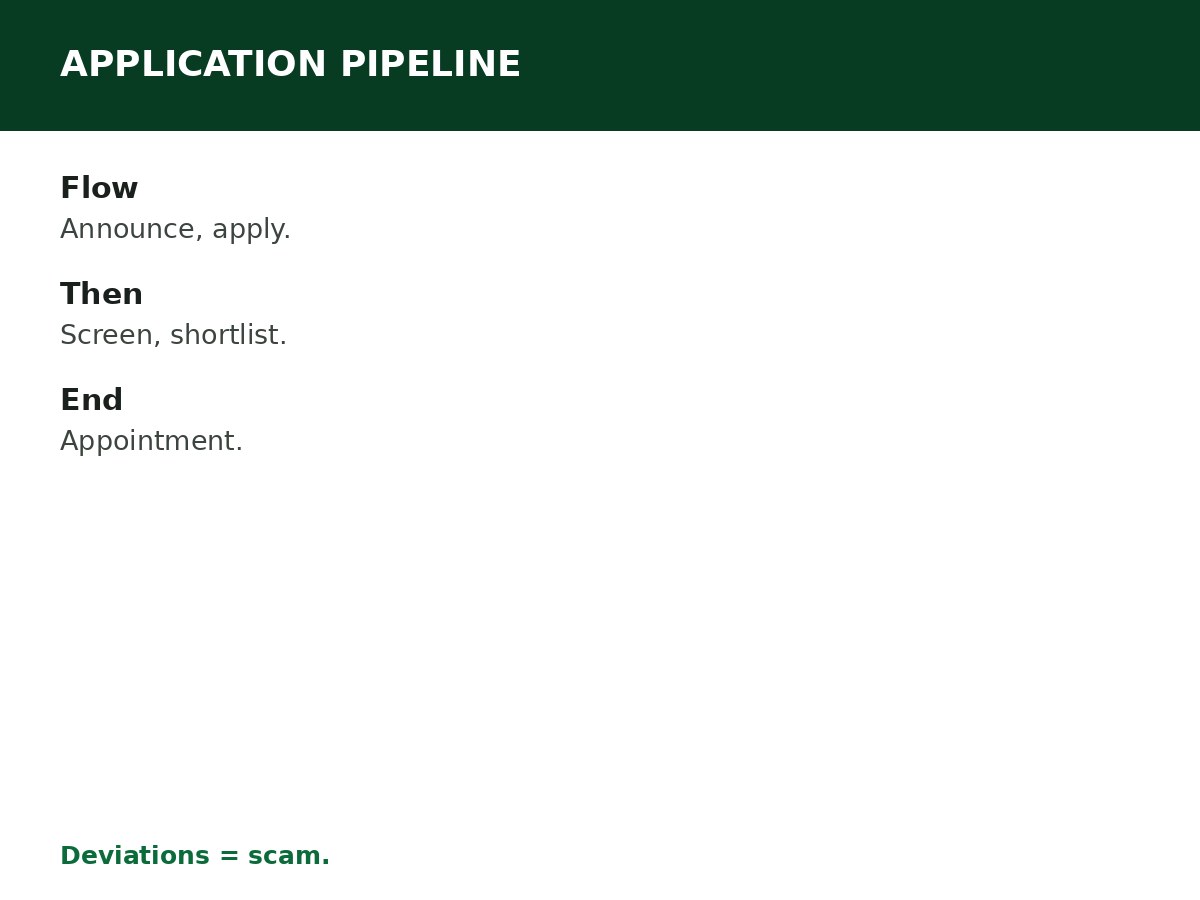
- Announcement — on official websites, portals, and national newspapers, as each agency states, with cadres, qualifications, grade levels, and deadlines.
- Portal application — free, through the official portal named in the announcement, with CV, certificates, NYSC status, and documents, before the deadline.
- Screening — aptitude tests, physical screening for uniformed services, interviews, and document verification, as the process states.
- Shortlists — published per stage, on official portals or channels, as each agency states, with next-stage instructions and deadlines.
- Appointment — for successful candidates, after final verification, with appointment letters issued through official channels. Appointment is earned through the pipeline, never bought, and never guaranteed before it.
How agencies vary
- Stages and order — some agencies test before screening, others screen before testing, as the process states. Read the specific announcement, not general pipelines, for exact order.
- Timelines — recruitment cycles range from weeks to many months, as the agency states. Long silences do not mean rejection, and short timelines do not mean scams, where officially announced.
- Cadre structures — officer, inspectorate, and assistant cadres, with different qualifications and screening, as the announcement states.
- Communication channels — portals, SMS, email, and official publications, as the agency states. Messages from unofficial numbers or personal emails are scams, whatever they claim.
Deviations that mean scam
- Fees at any stage — application, test, training, medical, placement, or appointment fees are scams. Government recruitment is free.
- Agents and ‘slots’ — anyone selling appointments, shortlist inclusion, or screening success is running a scam.
- Guaranteed outcomes — no genuine process guarantees appointment, shortlisting, or screening success before the process runs.
- Unofficial channels only — recruitments announced only in groups, through shortlinks, or by agents, never on official channels, are fake.
Related Guides & Next Steps
- Federal Government Recruitment 2026: How to Verify Openings
- Government Recruitment FAQs for Nigerian Applicants
- How to Report a Fake Recruitment Website
- Recruitment Portal vs Official Government Website
Frequently asked questions
How do government recruitment applications usually work? Announcement on official channels, free portal application before the deadline, screening (tests, physical screening, interviews, verification), shortlists per stage on official portals, and appointment for successful candidates after final verification.
How long do government recruitments take? Cycles range from weeks to many months, as the agency states. Long silences do not mean rejection, and short timelines do not mean scams, where officially announced.
Do all agencies follow the same pipeline? No — stages, order, timelines, and cadre structures vary by agency, as each announcement states. Read the specific announcement, not general pipelines, for exact order.
Are government recruitment applications free? Yes — applications are free, and every stage is free. Fees at any stage are scams.
What deviations mean a recruitment is fake? Fees at any stage, agents and ‘slots’, guaranteed outcomes before the process runs, and recruitments announced only in groups, through shortlinks, or by agents, never on official channels.
Sources and last update
- No agency is named as currently recruiting anywhere in this article, deliberately — recruitment windows open and close, and a frozen list misleads readers within months. Official portals and announcements, checked at application time, govern.
- No salary figure, vacancy count, or recruitment outcome is asserted anywhere in this article, deliberately. Official announcements and portals, checked at application time, govern.
- Scam patterns: ‘slot’ sellers, application fees, payment to personal accounts, and guaranteed appointments are red flags — government recruitment is free, and runs through official portals only.
- No appointment, shortlisting, or recruitment outcome is promised anywhere in this article.
Last updated: 24 October 2026. Guide — review every 3–6 months, and on every official recruitment announcement.

Written by Olaitan Ilori
Olaitan Ilori is the founder and lead researcher at CareerMedal. He provides verified, practical guides on Nigerian tertiary admissions (JAMB, CAPS, Post-UTME), NELFUND student finance, NYSC service-year survival, and early-career job placement.
View all guides by Olaitan Ilori →