

High-income skills are skills whose practitioners can command strong earnings — through employment, freelance, or business — because demand outstrips supply, or because the skill directly generates revenue. This guide explains what makes a skill high-income, which skill families qualify, and what it takes to reach high earnings, without asserting any income figure, ranking, or earnings guarantee, since earnings vary by skill, market, experience, and effort.
What makes a skill high-income
- Demand outstripping supply — skills employers and clients struggle to hire for, commanding stronger pay, as the market states.
- Revenue linkage — skills directly generating revenue (sales, marketing, software, design for business) command stronger pay than cost-centre skills, as the market states.
- Scarcity and specialisation — specialised skills, with fewer practitioners, command stronger pay than common skills, as the market states.
- Proof-based pay — high-income skills are judged by results, not by certificates. Portfolio and client results decide earnings, not qualifications alone.
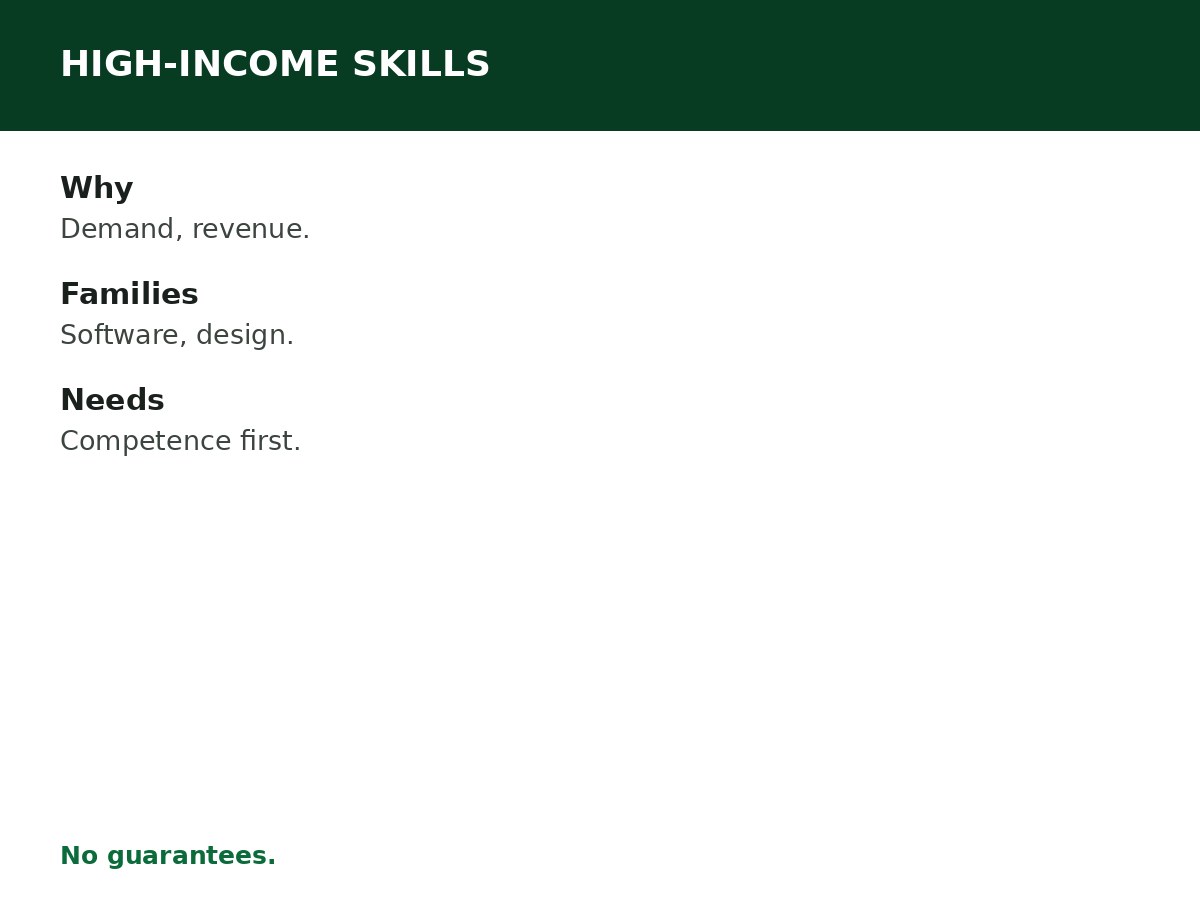
Skill families with high-income potential
- Software and data — coding, data analysis, data science, and cybersecurity, as the market states, judged by portfolio and projects.
- Design and product — UI/UX design, product design, and graphic design for business, as the market states, judged by portfolio.
- Marketing and sales — digital marketing, copywriting, and sales, as the market states, judged by revenue results.
- Specialised trades — specialised welding, electrical, solar, and automobile diagnostics, as the market states, judged by quality and reputation.
- No ranking asserted — skill families are grouped by type, not ranked by earnings. Earnings vary by skill, market, experience, and effort, and no official earnings ranking exists.
What high income actually requires
- Working competence first — months of daily practice and projects, toward working competence, before high earnings, as every field states. High income follows competence, not enrolment.
- Portfolio and reputation — finished work, client results, and references, built over time, decide earnings, not certificates alone.
- Markets and clients — local or remote markets, with paying clients, reached through outreach, referrals, and platforms, as the market states.
- Business skills alongside — pricing, negotiation, client management, and delivery, for freelance and self-employed high earners, as the market states.
High-income scams
- Guaranteed income claims — programmes guaranteeing income, or specific earnings, are scams. Earnings vary by skill, market, experience, and effort.
- Paid ‘high-income’ courses — courses charging for ‘high-income secrets’ without curriculum, projects, or assessment are scams or, at best, worthless.
- Pyramid schemes dressed as skills — ‘skills’ requiring recruitment of others, for earnings, are pyramid schemes, not skills.
Related Guides & Next Steps
- Federal Government TVET Programme 2026
- Best Digital Skills for Nigerian Students
- Best Technical Skills for Young Nigerians
- Skills You Can Learn Without a Degree
Frequently asked questions
What are high-income skills? Skills whose practitioners can command strong earnings — through employment, freelance, or business — because demand outstrips supply, or because the skill directly generates revenue.
Which skills have high-income potential in Nigeria? Software and data, design and product, marketing and sales, and specialised trades — grouped by type, not ranked by earnings, since earnings vary by skill, market, experience, and effort.
Do high-income skills guarantee high earnings? No — high income follows competence, portfolio, reputation, markets, and business skills, not enrolment. Programmes guaranteeing income are scams.
How long does it take to reach high earnings? Months of daily practice and projects, toward working competence, then portfolio and reputation building, over time — as every field states. No honest timeline guarantees high earnings.
Are paid ‘high-income secrets’ courses worth it? No — courses charging for ‘high-income secrets’ without curriculum, projects, or assessment are scams or, at best, worthless.
Sources and last update
- No programme is named as currently open anywhere in this article, deliberately — training windows open and close, and a frozen list misleads readers within months. Official programme channels, checked at application time, govern.
- No fee, stipend, or income figure is asserted anywhere in this article, deliberately. Official programme pages, checked at application time, govern.
- Scam patterns: training fees demanded for ‘free’ programmes, payment to personal accounts, and guaranteed jobs or income are red flags — verify every programme on official channels before applying or paying anything.
- No job, income, or training outcome is promised anywhere in this article.
Last updated: 24 October 2026. Guide — review every 3–6 months, and on every official programme announcement.

Written by Olaitan Ilori
Olaitan Ilori is the founder and lead researcher at CareerMedal. He provides verified, practical guides on Nigerian tertiary admissions (JAMB, CAPS, Post-UTME), NELFUND student finance, NYSC service-year survival, and early-career job placement.
View all guides by Olaitan Ilori →