

First Class, commonly in Nigeria, means graduating with a CGPA of 4.50–5.00 on the 5-point scale — the highest degree classification. This guide explains what it takes and what it means, distinct from the second-class-upper guide (which covers the next classification) and the improve-CGPA guide (which covers raising averages) — institution scales govern, where they differ.
What First Class commonly means
- CGPA range (commonly) — 4.50–5.00, on the 5-point scale, as institutions commonly state. Some institutions, use different scales, as institutions state — check your handbook.
- Highest classification — First Class, ranking above Second Class Upper, Second Class Lower, and Third Class, as institutions state.
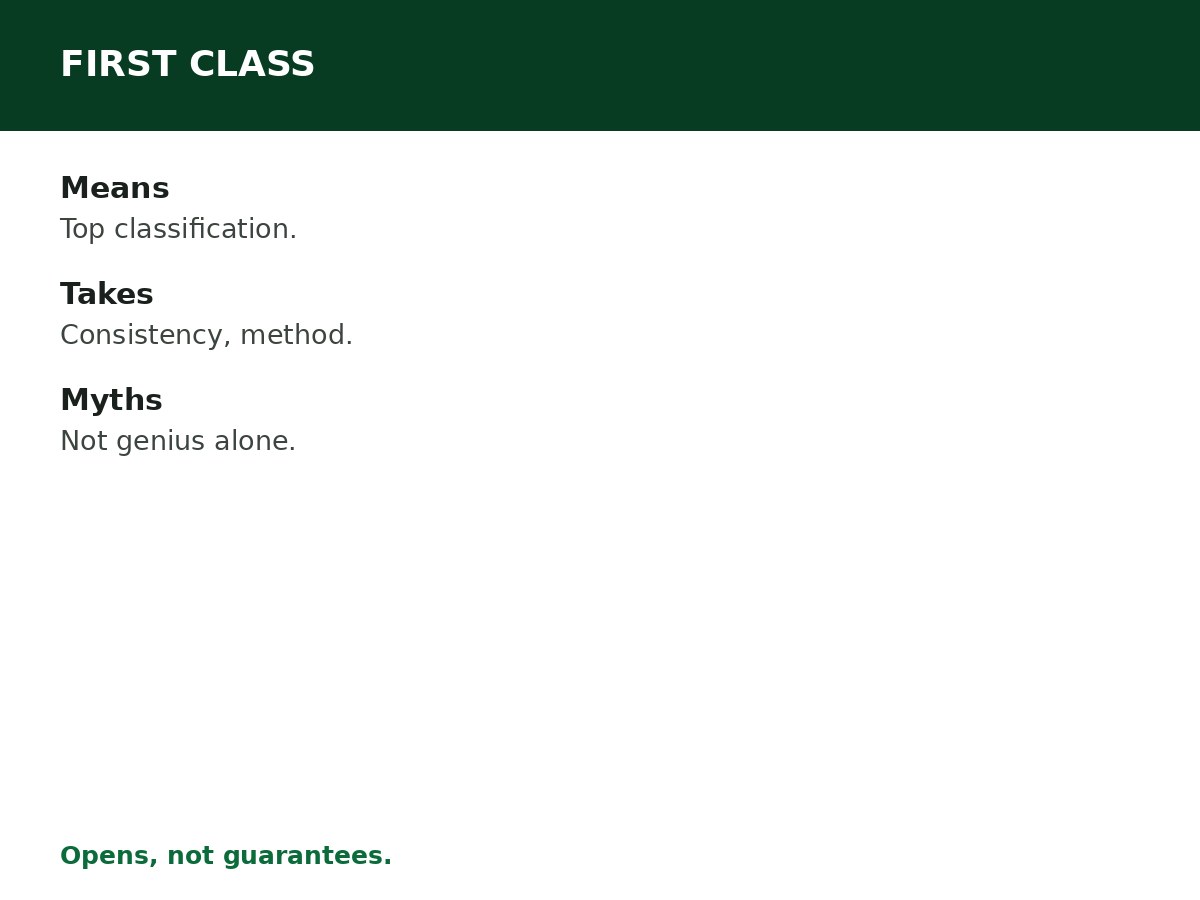
- Not a guarantee — First Class, opening doors, not guaranteeing jobs or admissions, as employers and institutions state. Skills, portfolios, and experience, mattering alongside, as the Jobs cluster covers.
What it takes
- Consistency from year one — consistent high grades, from early semesters, as students report, since CGPA, moving slowly later, as the CGPA guide covers.
- Strong study methods — recall, spacing, and practice, as the study-techniques guide covers, sustained daily, not crammed.
- Attendance and participation — lectures, tutorials, and assignments, attended and completed, as the method states, since continuous assessment, counting, as departments state.
- Balance and health — sleep, rest, and health, protected, as students report. Burnout, harming grades, as the method states.
First Class myths
- ‘First Class means genius’ — First Class, usually reflecting consistency, method, and effort, as students report, not genius alone.
- ‘First Class guarantees jobs’ — First Class, opening doors, not guaranteeing jobs, as employers state. Skills and experience, mattering alongside.
- ‘Only first-year matters’ — early semesters, mattering most, but later semesters, still counting, as the CGPA guide covers. Consistency, throughout, matters.
Related Guides & Next Steps
- Cost of Living for Nigerian University Students
- Second Class Upper Explained
- How to Improve Your CGPA
- CGPA Explained for Nigerian Students
Frequently asked questions
What is First Class in Nigeria? Commonly, graduating with a CGPA of 4.50–5.00 on the 5-point scale — the highest degree classification, as institutions commonly state. Institution scales govern, where they differ.
What does First Class take? Consistency from year one, strong study methods (recall, spacing, practice), attendance and participation, and balance with sleep and health — as students report and the study guides cover.
Does First Class guarantee a job? No — First Class opens doors, not guaranteeing jobs, as employers state. Skills, portfolios, and experience matter alongside, as the Jobs cluster covers.
Does only first year matter for First Class? No — early semesters matter most, but later semesters still count, as the CGPA guide covers. Consistency, throughout, matters.
Is First Class only for geniuses? No — First Class usually reflects consistency, method, and effort, as students report, not genius alone.
Sources and last update
- No grade, graduation, or academic outcome is promised anywhere in this article — results depend on study, department standards, and assessment, as institutions state.
- Grading scales, classifications, and graduation rules vary by institution — department and institution notices govern for each student, not this general guide.
- No paid app, service, or shortcut is recommended anywhere in this article — free tools are named by category, with current terms checked at use time.
Last updated: 24 October 2026. Guide — review every 6–12 months, and at the start of each academic session.

Written by Olaitan Ilori
Olaitan Ilori is the founder and lead researcher at CareerMedal. He provides verified, practical guides on Nigerian tertiary admissions (JAMB, CAPS, Post-UTME), NELFUND student finance, NYSC service-year survival, and early-career job placement.
View all guides by Olaitan Ilori →