

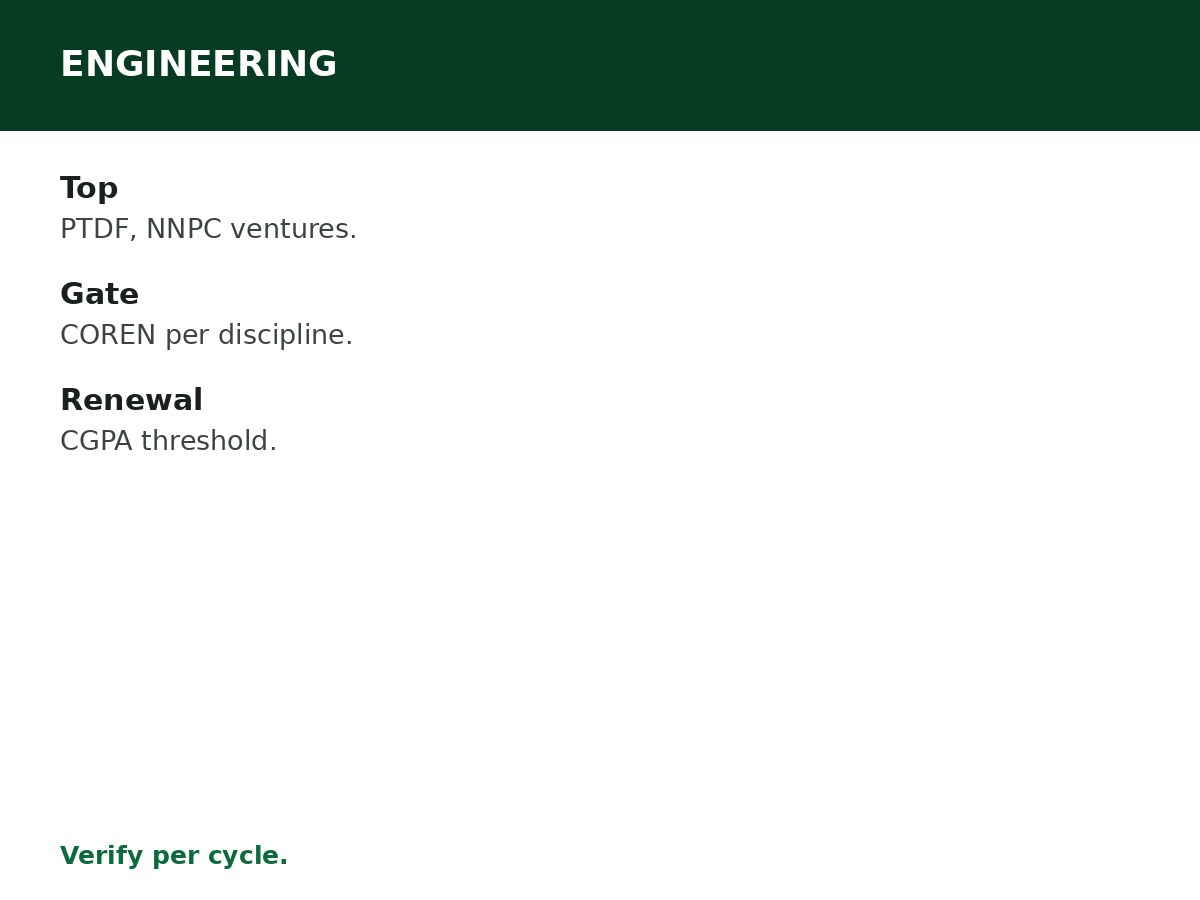
Engineering scholarships for Nigerian students come mostly from oil, gas, and energy companies — the industries that employ engineers — plus PTDF and foundation programmes. This guide names the established programmes, explains how they select, and tells you how to verify each one for the current cycle — because amounts, deadlines, and eligibility change every year, and no amount or deadline is asserted anywhere in this article, deliberately. One gate matters throughout: the engineering discipline must be COREN-recognised, per discipline, for the session.
Established programmes for engineering students
- PTDF Scholarships — for oil, gas, and related engineering fields, in Nigeria and abroad; the most directly engineering-focused government programme.
- NNPC joint-venture scholarships (Shell SPDC, Chevron/Agbami, TotalEnergies, SEPLAT) — undergraduate scholarships for engineering students, often targeted at host communities.
- MTN Foundation Scholarship — for science and technology students, including engineering.
- NLNG Scholarship — for Nigerian students, including engineering fields.
- DAAD Scholarships — for engineering study in Germany, including master’s and PhD.
- Commonwealth and Chevening Scholarships — for engineering study in the UK, at master’s and PhD levels.
How engineering scholarships select
- Field match — your engineering discipline must match the programme’s list (Civil, Mechanical, Electrical, Chemical, Petroleum, and others, as the programme states).
- COREN recognition — the discipline must be COREN-recognised, for the session. A scholarship for an unrecognised discipline is worth less than it looks.
- Grades — UTME score, O’Level grades, and (for continuing students) CGPA, as the programme states. Most corporate scholarships set a renewal CGPA threshold.
- Host community — some oil-company programmes target host communities. Your state of origin or institution location must match, where the programme states it.
How to apply, in order
- Shortlist by discipline, level, and eligibility (host community, CGPA).
- Verify COREN recognition for your discipline, for the session.
- Check the official programme page for the current cycle — amounts, deadlines, eligibility, renewal terms.
- Prepare documents early — admission letter, transcripts, results, identification.
- Apply through the official portal only, and protect the award by meeting the renewal threshold every session.
Related Guides & Next Steps
- Fully Funded Scholarships for Nigerians
- Scholarships for Nigerian Students in 2026/2027
- Scholarships for Computer Science Students
- Scholarships for Nursing Students
- Scholarships for Female Students in Nigeria
Frequently asked questions
Which engineering scholarships exist for Nigerians? PTDF, NNPC joint-venture scholarships (Shell SPDC, Chevron/Agbami, TotalEnergies, SEPLAT), MTN Foundation, NLNG, DAAD, Commonwealth, and Chevening — check each programme’s discipline list and current-cycle terms.
Does my engineering discipline need COREN recognition? Yes — engineering disciplines are COREN-recognised per discipline, for the session. Verify yours before applying; a scholarship for an unrecognised discipline is worth less than it looks.
Are engineering scholarships only for petroleum engineering? No — PTDF and oil-company programmes favour oil, gas, and related fields, but MTN Foundation, NLNG, DAAD, Commonwealth, and Chevening cover engineering broadly. Check each programme’s discipline list.
Do I need a high CGPA to keep an engineering scholarship? Most corporate scholarships set a CGPA threshold for renewal — an award can be lost if grades drop. Check the renewal terms before accepting.
How do I avoid engineering-scholarship scams? Apply through official portals only, never pay an application fee to a personal account, never trust a guaranteed award, and verify every programme on its official page.
Sources and last update
- Scholarship programmes named here are established programmes as reported; amounts, deadlines, and eligibility change every cycle — the official programme page for the current cycle governs, and no amount or deadline is asserted anywhere in this article, deliberately.
- Scholarship-vs-loan distinction from the NELFUND cluster guides (Batches 6–10): a scholarship is not repaid; NELFUND is a loan, repayable from 2 years after NYSC at 10% of income.
- Scam patterns from the fake-agents guide (Batch 12): application fees, guaranteed awards, and payment to personal accounts are red flags.
- No admission, award, or visa outcome is promised anywhere in this article.
Last updated: 24 October 2026. Guide — review every 3–6 months and on every scholarship-cycle update.

Written by Olaitan Ilori
Olaitan Ilori is the founder and lead researcher at CareerMedal. He provides verified, practical guides on Nigerian tertiary admissions (JAMB, CAPS, Post-UTME), NELFUND student finance, NYSC service-year survival, and early-career job placement.
View all guides by Olaitan Ilori →