
Most scholarship applications fail on avoidable mistakes — wrong programme, wrong stream, agent-filled forms, late submission, fake documents, or a single application with no backup. This guide lists the mistakes, explains why each one loses awards, and tells you what to do instead. It draws on every guide in the Scholarships cluster — read it alongside the specific programme guide you are applying to.
The mistakes, and what to do instead
- Applying to the wrong programme — field, level, or stream mismatch. Instead: check the programme’s field list, level, and stream before applying, not after.
- Applying to the wrong stream — PTDF in-country rules on an overseas application, FSB Nigerian Award rules on a BEA application, or vice versa. Instead: read the stream’s own guide and announcement.
- Agent-filled forms — errors, mismatches, and missing documents from agent-filled forms. Errors from agents are your errors. Instead: fill the form yourself.
- Late submission — the deadline is hard, and portal congestion near the deadline is common. Instead: submit early.
- Fake or forged documents — disqualifies you permanently, and can bar you from future programmes. Instead: submit only genuine documents; undocumented claims are rejected, but forged documents end your chances.
- Paying for anything — application fees to personal accounts, ‘processing’ fees, ‘guaranteed’ awards. Instead: never pay; genuine programmes are free to apply for, through official portals.
- A single application — one programme, no backup. Scholarships are competitive; a single application is not a strategy. Instead: apply to every programme you are eligible for.
- Ignoring renewal terms — corporate scholarships set CGPA thresholds; awards lapse when grades drop. Instead: check renewal terms before accepting, and protect the award every session.
- Confusing scholarship and loan — NELFUND is a loan, repayable; a scholarship is not repaid. Instead: know which you are applying for, and budget accordingly.
- Assuming a visa — a scholarship does not guarantee admission, and neither guarantees a visa. Instead: plan admission, scholarship, and visa as three separate processes.
- Generic personal statements — interchangeable with any applicant. Instead: write a specific, evidenced, programme-fitted statement (see the personal-statement guide).
- Ignoring the coverage list — ‘fully funded’ without a coverage list is a claim, not a fact. Instead: check what the award covers before accepting.
- Applying from a previous cycle’s details — amounts, deadlines, fields, and lists change every cycle. Instead: read the current cycle’s announcement on the official page.
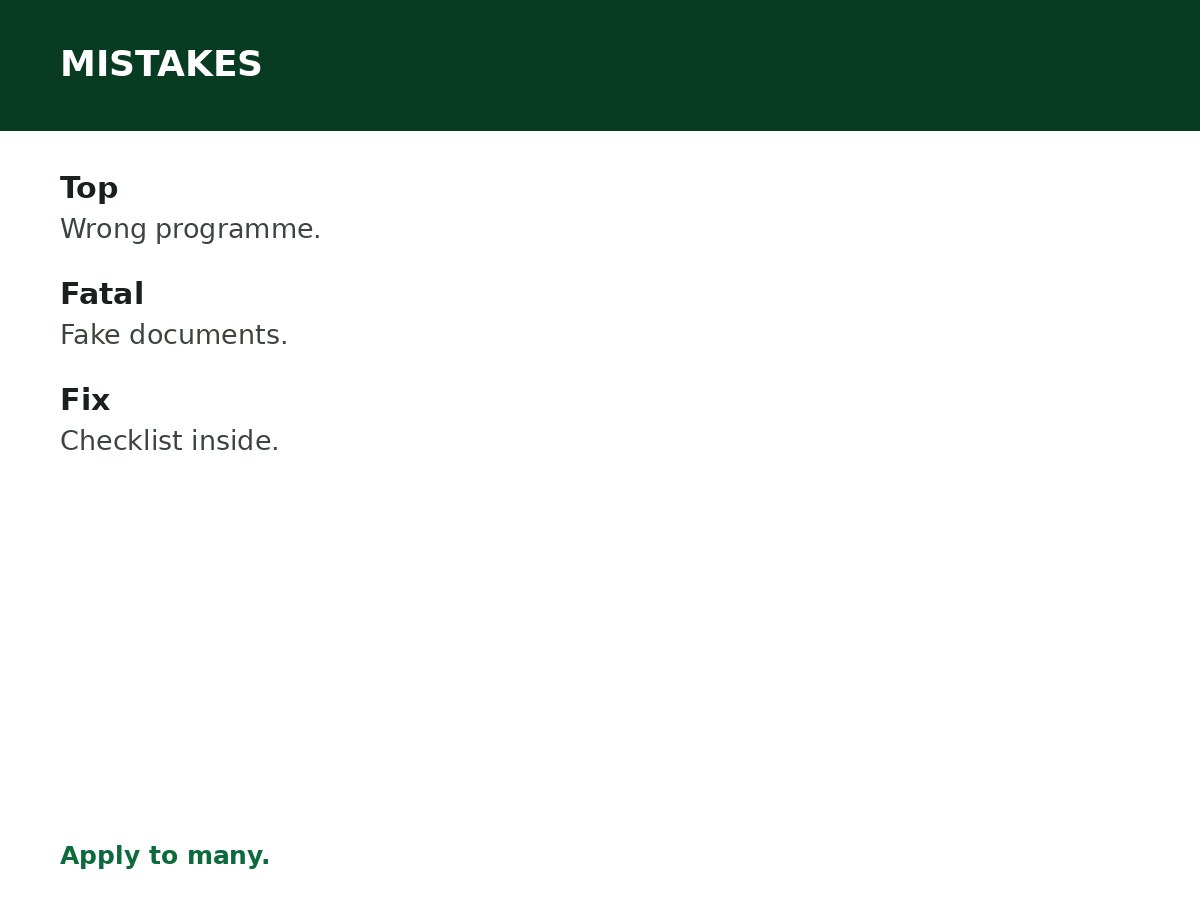
The pre-submit checklist
- [ ] Programme, stream, level, and field all match my profile.
- [ ] Current cycle’s announcement read, on the official page.
- [ ] Form filled by me, not an agent.
- [ ] Documents genuine, complete, and clearly uploaded.
- [ ] Personal statement specific, evidenced, and programme-fitted.
- [ ] Submitted before the deadline, with confirmation saved.
- [ ] Backup applications submitted to other eligible programmes.
- [ ] Renewal terms and coverage list checked before accepting any award.
Related Guides & Next Steps
- Scholarships for Nigerian Students in 2026/2027
- State Government Scholarships in Nigeria
- Fully Funded Scholarships for Nigerians
- How to Write a Scholarship Personal Statement
Frequently asked questions
What is the biggest scholarship application mistake? Applying to the wrong programme or stream — field, level, or stream mismatch wastes the entire application. Check eligibility before applying, not after.
Can an agent help my scholarship application? No — fill the form yourself. Errors from agents are your errors, and agents selling scholarship slots are running scams.
What happens if I submit fake documents? Disqualification, permanently, and possible barring from future programmes. Submit only genuine documents.
Should I apply to multiple scholarships? Yes — apply to every programme you are eligible for. Scholarships are competitive; a single application is not a strategy.
How do I avoid scholarship scams? Apply through official portals only, never pay an application fee to a personal account, never trust a guaranteed award, and verify every programme on its official page.
Sources and last update
- Scholarship programmes named here are established programmes as reported; amounts, deadlines, and eligibility change every cycle — the official programme page for the current cycle governs, and no amount or deadline is asserted anywhere in this article, deliberately.
- Scholarship-vs-loan distinction from the NELFUND cluster guides (Batches 6–10): a scholarship is not repaid; NELFUND is a loan, repayable from 2 years after NYSC at 10% of income.
- Scam patterns from the fake-agents guide (Batch 12): application fees, guaranteed awards, and payment to personal accounts are red flags.
- No admission, award, or visa outcome is promised anywhere in this article.
Last updated: 24 October 2026. Guide — review every 3–6 months and on every scholarship-cycle update.

Written by Olaitan Ilori
Olaitan Ilori is the founder and lead researcher at CareerMedal. He provides verified, practical guides on Nigerian tertiary admissions (JAMB, CAPS, Post-UTME), NELFUND student finance, NYSC service-year survival, and early-career job placement.
View all guides by Olaitan Ilori →