
A recruitment portal and an official government website are different tools with different roles — the website informs, the portal processes applications — and confusing them is how fake portals succeed. This guide compares the two directly, distinct from the portal-identification guide (which covers recognising genuine portals) and the fake-portal guide (which covers fake-portal defence).
The comparison
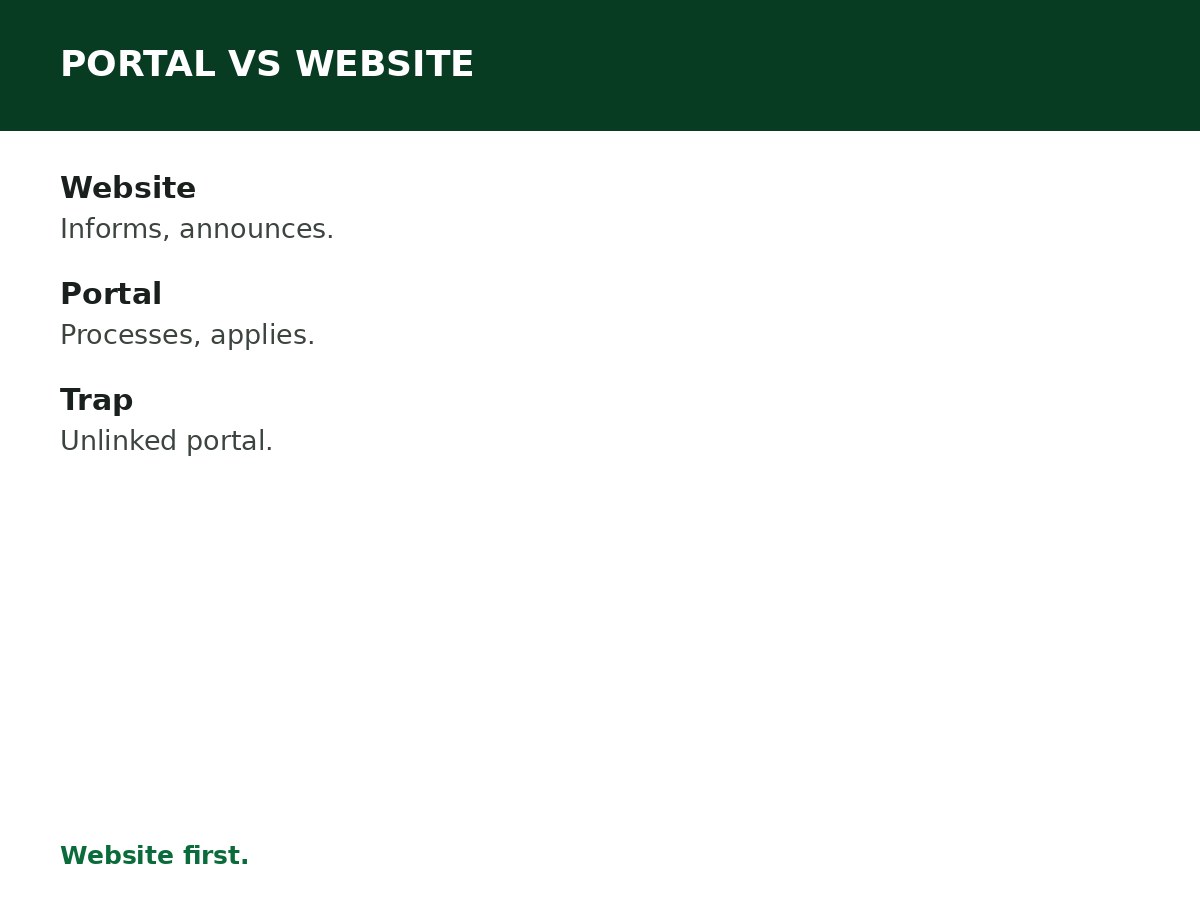
- Official website — the agency’s main site: mandate, leadership, news, announcements, and contact. Permanent, public, and always available. Recruitment announcements appear here first.
- Recruitment portal — a dedicated application platform: accounts, forms, uploads, status dashboards, and shortlists. Active during recruitment windows, linked from the official website.
- Relationship — the website links to the portal; the portal does not replace the website. A portal unlinked from the official website is suspect.
- Lifecycles — websites persist; portals open and close per recruitment. A portal still ‘open’ after its recruitment closed, or open without any announcement, is suspect.
When to use which
- Learning about an agency — official website: mandate, functions, news, and contacts.
- Checking whether recruitment is open — official website announcements, then the linked portal.
- Applying — recruitment portal, reached from the official website, never from groups or shortlinks.
- Checking status or shortlists — recruitment portal, typed directly or reached from the official website.
- Verifying anything — official website first, then the linked portal. Never a group, shortlink, or agent, alone.
Confusion traps
- Fake websites — cloned agency websites, with fake portal links, spreading in groups. Verify websites through official channels, typed directly, not through links.
- Portal-only claims — recruitments announced only on a portal, never on the official website, are suspect. Genuine recruitments are announced on official websites first.
- Website lookalikes — domains mimicking agency websites, with fake portal links. Compare domains character by character, from official channels.
Related Guides & Next Steps
- Federal Government Recruitment 2026: How to Verify Openings
- Government Recruitment FAQs for Nigerian Applicants
- How Government Recruitment Applications Usually Work
- How to Spot Fake Recruitment Shortlinks
Frequently asked questions
What is the difference between a recruitment portal and an official website? The official website is the agency’s main site with information and announcements; the recruitment portal is a dedicated application platform, linked from the official website during recruitment windows.
Which should I use to check if recruitment is open? Official website announcements first, then the linked portal. Genuine recruitments are announced on official websites first.
Should I apply through a portal unlinked from the official website? No — a portal unlinked from the official website is suspect. Reach portals only from official websites, typed directly.
Do recruitment portals stay open permanently? No — portals open and close per recruitment. A portal still ‘open’ after its recruitment closed, or open without any announcement, is suspect.
Can a fake website link to a fake portal? Yes — cloned agency websites with fake portal links spread in groups. Verify websites through official channels, typed directly, not through links.
Sources and last update
- No agency is named as currently recruiting anywhere in this article, deliberately — recruitment windows open and close, and a frozen list misleads readers within months. Official portals and announcements, checked at application time, govern.
- No salary figure, vacancy count, or recruitment outcome is asserted anywhere in this article, deliberately. Official announcements and portals, checked at application time, govern.
- Scam patterns: ‘slot’ sellers, application fees, payment to personal accounts, and guaranteed appointments are red flags — government recruitment is free, and runs through official portals only.
- No appointment, shortlisting, or recruitment outcome is promised anywhere in this article.
Last updated: 24 October 2026. Guide — review every 3–6 months, and on every official recruitment announcement.

Written by Olaitan Ilori
Olaitan Ilori is the founder and lead researcher at CareerMedal. He provides verified, practical guides on Nigerian tertiary admissions (JAMB, CAPS, Post-UTME), NELFUND student finance, NYSC service-year survival, and early-career job placement.
View all guides by Olaitan Ilori →