
The PTDF Overseas Scholarship funds study abroad — at approved partner universities, in oil, gas, and related fields. It is distinct from the In-Country Scholarship (study in Nigeria, different universities, different process), and this guide covers only the overseas scheme. Amounts, deadlines, eligible courses, and approved universities change every cycle, and no amount, deadline, course list, or university list is asserted anywhere in this article, deliberately. The PTDF official page for the current cycle is the only reliable source for those details. No admission, award, or visa outcome is promised anywhere in this article.
What the overseas scheme covers
- Study abroad — at approved partner universities, as the cycle’s approved-universities list states.
- Tuition, living, and travel support — as the scheme’s coverage list states for the cycle. Check what the scheme covers before applying — coverage varies by cycle.
- Levels — as the scheme states for the cycle (master’s and PhD most commonly; undergraduate where offered). Not every level runs every cycle.
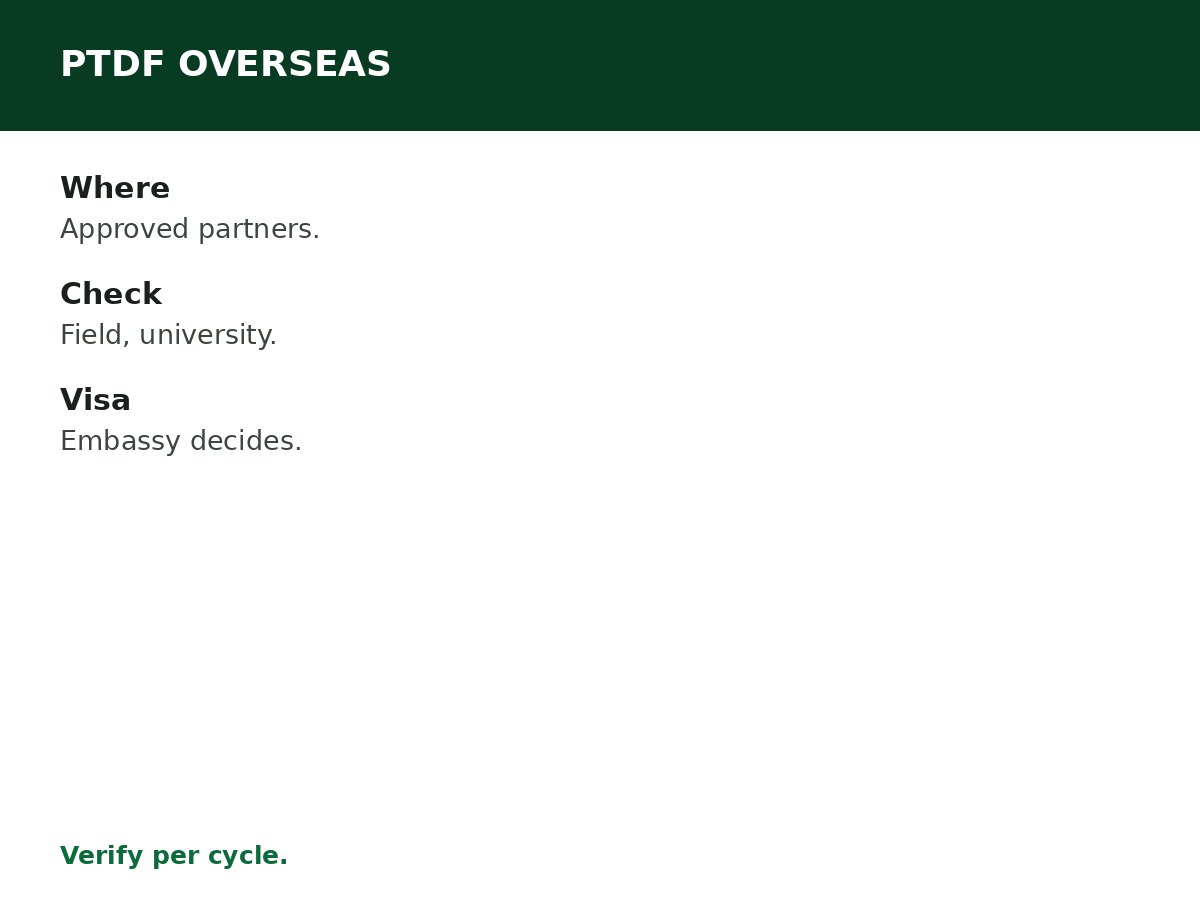
Requirements, in general
- Nigerian citizenship, as the scheme states.
- Field match — your field must be on the cycle’s eligible-courses list (see the eligible-courses guide).
- Admission to an approved partner university — or application in parallel, as the scheme requires.
- Academic record — degree class and transcripts, as the scheme states. Overseas schemes set strong academic thresholds.
- Language proof — where the destination requires it (IELTS, alternative test, or MOI letter where the programme accepts it). Check each destination’s requirement.
- Documents — identification, certificates, transcripts, references, study plan or research proposal where required, passport.
How to apply, in general
- Read the cycle’s announcement on the PTDF official page — overseas scheme, levels, eligible courses, approved universities, deadlines.
- Confirm your field is eligible and your university is approved, for this cycle.
- Secure admission (or apply in parallel, as the scheme requires).
- Prepare documents early, including language proof where required.
- Apply through the PTDF official portal only.
- Complete any screening the scheme states for the cycle.
- Apply for the visa only after admission and funding are confirmed, through the official embassy process.
Overseas vs in-country: the distinction that matters
Overseas means abroad: higher costs, visa required, international exposure, and study at partner universities abroad. In-country means Nigeria: lower costs, no visa, and study at Nigerian universities. The schemes have different approved-university lists, different coverage, and different processes — do not apply the overseas rules to an in-country application, or vice versa.
Related Guides & Next Steps
- Scholarships for Nigerian Students in 2026/2027
- How to Apply for PTDF Scholarship
- PTDF Scholarship Approved Universities
- PTDF In-Country Scholarship Guide
Frequently asked questions
What is the PTDF Overseas Scholarship? PTDF funding for study abroad, at approved partner universities, in oil, gas, and related fields. It is distinct from the In-Country Scholarship.
Which universities are approved for PTDF overseas? The cycle’s approved-universities list, published by PTDF for the cycle — no list is asserted here, deliberately, because it changes every cycle. Check the PTDF official page for the current cycle.
Which courses are eligible for PTDF overseas? The cycle’s eligible-courses list, published by PTDF for the cycle — oil, gas, energy, engineering, geosciences, environmental, and related fields dominate. Check the PTDF official page for the current cycle.
Does a PTDF overseas award guarantee a visa? No. The visa is decided by the destination country’s embassy on its own criteria. No scholarship guarantees a visa.
Does PTDF overseas charge an application fee? PTDF does not collect application fees to personal accounts. A fee demand to a personal account is a scam.
Sources and last update
- Scholarship programmes named here are established programmes as reported; amounts, deadlines, and eligibility change every cycle — the official programme page for the current cycle governs, and no amount or deadline is asserted anywhere in this article, deliberately.
- Scholarship-vs-loan distinction from the NELFUND cluster guides (Batches 6–10): a scholarship is not repaid; NELFUND is a loan, repayable from 2 years after NYSC at 10% of income.
- Scam patterns from the fake-agents guide (Batch 12): application fees, guaranteed awards, and payment to personal accounts are red flags.
- No admission, award, or visa outcome is promised anywhere in this article.
Last updated: 24 October 2026. Guide — review every 3–6 months and on every scholarship-cycle update.

Written by Olaitan Ilori
Olaitan Ilori is the founder and lead researcher at CareerMedal. He provides verified, practical guides on Nigerian tertiary admissions (JAMB, CAPS, Post-UTME), NELFUND student finance, NYSC service-year survival, and early-career job placement.
View all guides by Olaitan Ilori →