
Post-UTME is each Nigerian university’s own screening of UTME candidates, run after JAMB’s exam and before admission: it checks that you chose the institution, meet its minimum cut-off, hold the required O’Level credits, and — depending on the institution’s format — pass its exam, its O’Level aggregate ranking, or its physical document screening. Passing Post-UTME does not itself admit you; it qualifies you for the institution’s admission proposal to JAMB on CAPS.
“Post-UTME” is often used loosely for all three formats. The format your institution runs decides what you must prepare, what you must pay, and what score decides your fate — so the first question about any Post-UTME is always: which format, this session?
Requirements: who can sit for Post-UTME
- First-choice status, in most cases. Institutions screen candidates who chose them as first choice on JAMB. If the institution is not your first choice, complete a change of institution (JAMB, via an accredited CBT centre) before the screening window closes.
- Minimum UTME cut-off. Each institution sets its own minimum for screening consideration (2026 bands: 150 floor to 220 top). Meeting the minimum qualifies you to be screened; departmental cut-offs for your course run higher for competitive courses.
- O’Level requirements. Five credits including English (and Mathematics for most courses), in course-relevant subjects, in not more than two sittings (with course-specific one-sitting exceptions). Awaiting-result candidates may screen at institutions that permit it, with upload on CAPS required before admission is finalised.
- Correct UTME subject combination for the course, as stated in the JAMB brochure. A wrong combination disqualifies you at screening, regardless of score.
- Screening form and fee, via the official portal only. The fee varies by institution and session — no national figure is asserted here. Pay only on the institution’s portal, with a receipt.
The three screening formats
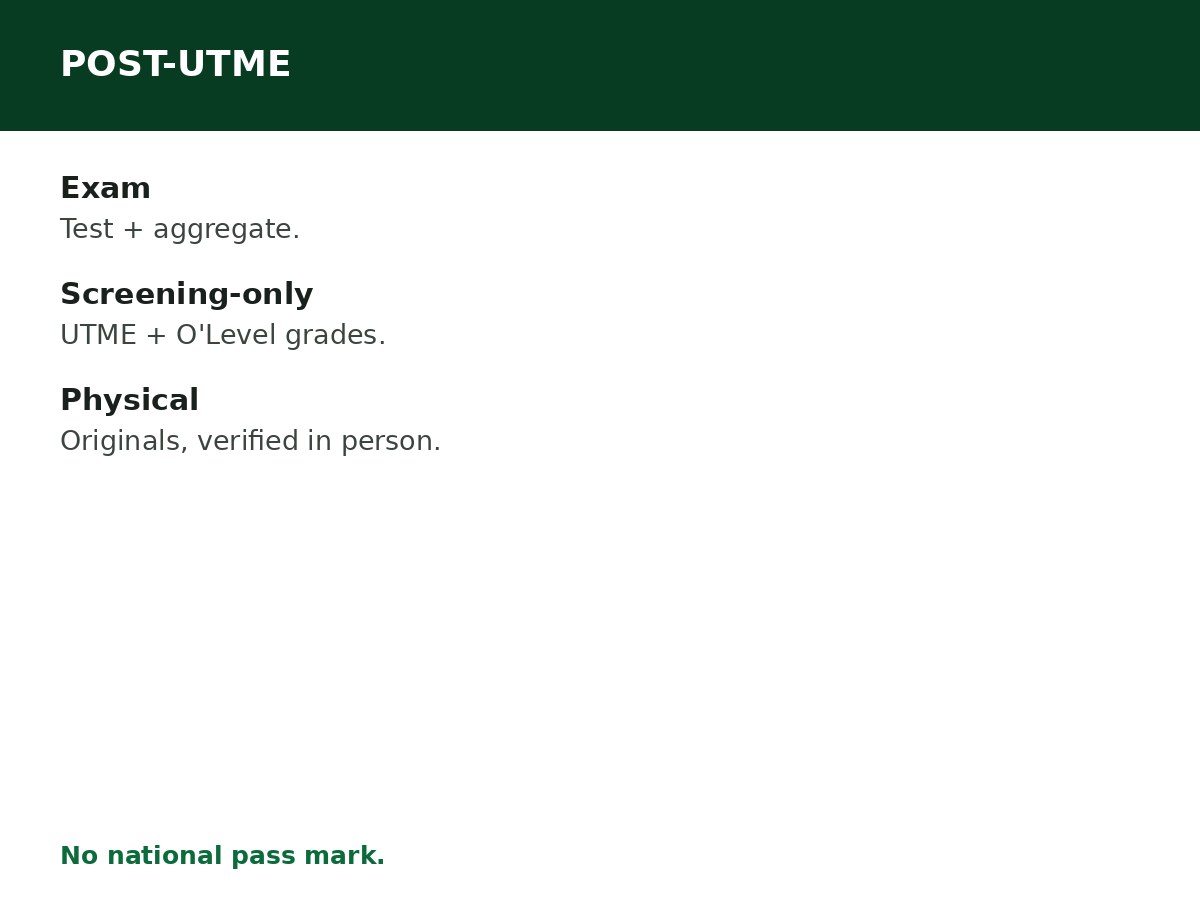
Exam format. A written test, usually in UTME subjects (sometimes with additional sections), at a venue on a date, with a result that feeds your aggregate. Preparation: subject revision with past questions under timed conditions. Your exam score can lift a modest UTME aggregate — or sink a strong one.
Screening-only format. No exam. Your aggregate is computed from your UTME score and O’Level grades. Preparation: complete, accurate document uploads, because your O’Level grades are your screening score. Weak O’Level grades cannot be compensated by exam performance that does not exist.
Physical screening format. Document verification in person, sometimes combined with an exam or interview. Preparation: originals plus photocopies, and readiness to explain your application details. Discrepancies found at physical screening — name mismatches, missing documents, fraudulent credentials — end the application immediately.
Some institutions combine formats (for example, an exam plus physical verification). The institution’s screening notice for the session states its format — check it, rather than assuming last session’s format.
From screening to admission
- Screening result published on the institution’s portal (exam score, aggregate, or verification outcome, as applicable).
- Departmental ranking by aggregate, against departmental cut-offs and available places.
- Institution proposal to JAMB on CAPS — reflected as “Admission in Progress” until JAMB approves.
- JAMB approval on CAPS — “Admitted”, with institution and course shown.
- Your acceptance on CAPS, promptly, before expiry — then admission letter, institution list confirmation, acceptance fee, and clearance.
A strong screening result that is not followed by CAPS acceptance is not an admission. A CAPS offer that you do not accept, before expiry, is not an admission either. Both halves must happen.
Related Guides & Next Steps
- How to Apply for Post-UTME Successfully
- How to Prepare for University Screening
- How University Admission Works in Nigeria
- 2026/2027 University Admission Guide for Nigerian Students
- University Admission Questions Students Ask Most
Frequently asked questions
What is Post-UTME? Each university’s own screening of UTME candidates, after JAMB’s exam and before admission — in exam, screening-only, or physical format, as the institution runs it.
Do all universities conduct Post-UTME? Almost all run some form of screening, but the format varies: some run exams, some run screening-only aggregates, some run physical verification. A small number of institutions (notably open universities, and some private institutions’ screening processes) do not run a traditional Post-UTME exam — see the no-screening guide.
What score do I need to pass Post-UTME? There is no national pass mark. Each institution and department sets its own effective cut-off from the aggregate ranking and available places, per session. Your screening result is judged against your department’s competition, not against a fixed threshold.
Can I write Post-UTME for multiple institutions? You can screen at institutions that consider you — in practice, first-choice institutions, within their windows. Each screening is separate (separate form, fee, and format), and JAMB processes one admission at a time through CAPS.
What happens if I fail Post-UTME? You are not proposed for admission by that institution for that session. Your options are: supplementary lists (if the institution runs them and places free up), a change of institution or course to an institution still screening, or a fresh UTME in the next session.
Sources and last update
- Post-UTME requirements, formats, and screening-to-admission sequence from JAMB’s admission process and institution screening practices, as compiled across the cluster’s guides.
- 2026 cut-off band range (150–220) from JAMB’s 2026 policy figures as reported.
- No national pass mark or screening fee is asserted — both are institution- and session-specific.
Last updated: 24 October 2026. Guide — review every admission session and on every JAMB policy update.

Written by Olaitan Ilori
Olaitan Ilori is the founder and lead researcher at CareerMedal. He provides verified, practical guides on Nigerian tertiary admissions (JAMB, CAPS, Post-UTME), NELFUND student finance, NYSC service-year survival, and early-career job placement.
View all guides by Olaitan Ilori →