
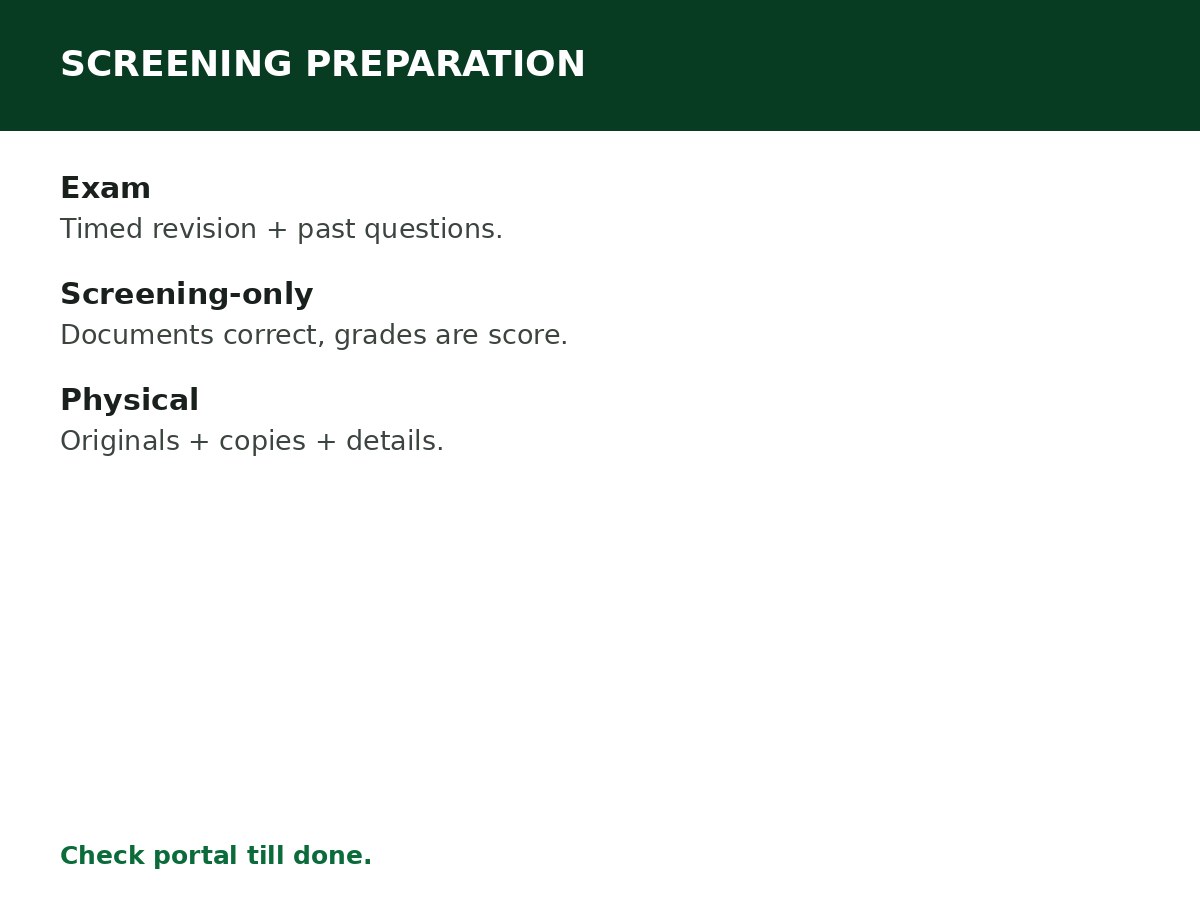
Prepare for university screening by preparing for the format your institution actually runs: for an exam-format screening, revise the relevant subjects with past questions under timed conditions; for a screening-only process, make your documents complete, accurate, and uploaded correctly, because your O’Level grades are your screening score; for physical screening, bring originals plus photocopies and know your details. Preparing for the wrong format is the commonest wasted preparation.
Screening is not a second UTME. It is the institution’s own assessment, on its own terms, and its weight in your aggregate varies by institution. Generic “screening preparation” that ignores your institution’s format is not preparation.
First: confirm your institution’s format
- Exam format: a written test (often in UTME subjects, sometimes including general knowledge or institution-specific sections), at a venue, on a date, with a result that feeds your aggregate.
- Screening-only format: no exam — your aggregate is computed from your UTME score and O’Level grades. Your preparation is document accuracy and grade strength, not exam revision.
- Physical screening format: document verification in person, sometimes combined with an exam or an interview. Your preparation is originals, photocopies, and readiness to answer questions about your application.
- Confirm on the institution’s official portal for the session — formats change between sessions, and last session’s format is not this session’s guarantee.
For exam-format screening
- Revise your UTME subjects for the course, with emphasis on the subjects the institution tests (check the screening notice — some institutions test all four UTME subjects, others test a subset).
- Use past questions from the institution’s screening, where available, under timed conditions. Past questions reveal the institution’s style (speed, depth, question types) better than generic revision.
- Practise speed and accuracy together. Screening exams are often time-pressured; a correct answer you run out of time to reach is worth nothing. Timed practice is the difference between knowing the material and scoring on it.
- Know the logistics: venue, date, time, required documents (acknowledgement slip, JAMB result slip, identification), and permitted materials. Arrive early — late arrival at a screening exam is usually disallowed, not accommodated.
- Do not pay for “screening runs” or leaked questions. Leaked questions are usually fake, and examination malpractice consequences follow the candidate.
For screening-only processes
- Your O’Level grades are your screening score. Distinctions in your five required subjects matter most. There is no exam to compensate for weak grades — which is why choosing a screening-only institution with weak O’Level grades is a poor strategy.
- Upload documents correctly: JAMB result, O’Level result(s) with exam body, year, and sitting correctly entered, birth certificate, and any other required documents. A mis-entered result is treated as a missing result.
- Upload O’Level results on CAPS as well — the institution’s portal upload and the CAPS upload are separate, and both are required for admission to be finalised.
- Check your aggregate, where the institution publishes its formula. Knowing how UTME and O’Level grades are weighted tells you whether your profile is competitive for your department — and whether a different institution’s format would suit you better.
For physical screening
- Bring originals plus photocopies of every document: JAMB result slip, O’Level results, birth certificate, local government identification, admission acknowledgement, and payment receipts.
- Know your details: JAMB number, course, subjects, grades, and application history. Screening officers ask about discrepancies — a candidate who cannot explain their own application looks like a candidate whose application is not their own.
- Dress and conduct: present yourself as a serious candidate. Physical screening includes an impression, whether or not it is formally scored — and impersonation or document fraud discovered at physical screening ends the application immediately.
Common screening mistakes (and how to avoid them)
- Preparing for an exam that does not exist (screening-only institution) or neglecting documents for an exam that does (exam institution with document verification). Confirm the format first.
- Missing the screening date or venue because you checked the portal once and never again. Check the portal regularly until screening is complete — dates and venues change.
- Incomplete uploads — a missing O’Level result, a wrong sitting entry, or an unuploaded CAPS result. Check both portals (institution and CAPS) after uploading, and confirm each upload shows correctly.
- Name mismatches between JAMB, O’Level, and NIN records. Resolve mismatches at the source (NIMC, exam body, JAMB correction) before screening, not during it.
- Paying an intermediary for screening “assistance”, “confirmation”, or “runs”. Screening is processed on the official portal and on CAPS — intermediaries add risk, not advantage.
Related Guides & Next Steps
- How to Apply for Post-UTME Successfully
- Universities With No Post-UTME Screening
- University Screening Mistakes That Can Cost You Admission
- How University Admission Works in Nigeria
- 2026/2027 University Admission Guide for Nigerian Students
Frequently asked questions
How do I prepare for Post-UTME? Confirm your institution’s format first (exam, screening-only, or physical), then prepare for that format: timed subject revision with past questions for exams; complete, accurate documents for screening-only; originals plus photocopies and detail readiness for physical screening.
Are past questions useful for screening? Yes, for exam-format screening — they reveal the institution’s style, speed, and depth. They are not useful for screening-only processes, where O’Level grades decide.
What documents do I need for screening? JAMB result slip, O’Level results, birth certificate, local government identification where required, acknowledgement slip, and payment receipts — plus originals for physical screening. The institution’s screening notice governs.
What if I miss my screening date? Contact the admission office immediately. Some institutions run a mop-up, most do not, and a missed screening usually means waiting for the next session or applying elsewhere.
Can I prepare for screening without knowing the format? No, not effectively. Format determines preparation — confirm it on the institution’s official portal for the session before you start preparing.
Sources and last update
- Screening preparation method (format-first, exam revision with past questions under timed conditions, screening-only document accuracy, physical originals and detail readiness, common mistakes) from institution screening practices, as compiled by CareerMedal.
- Format variation and change-between-sessions warning from institution screening practices as reported across guides.
- No institution-specific screening syllabus, date, or aggregate formula is asserted — those are institution- and session-specific and must be confirmed on the portal.
Last updated: 24 October 2026. Guide — review every admission session and on every institution screening-policy update.

Written by Olaitan Ilori
Olaitan Ilori is the founder and lead researcher at CareerMedal. He provides verified, practical guides on Nigerian tertiary admissions (JAMB, CAPS, Post-UTME), NELFUND student finance, NYSC service-year survival, and early-career job placement.
View all guides by Olaitan Ilori →