

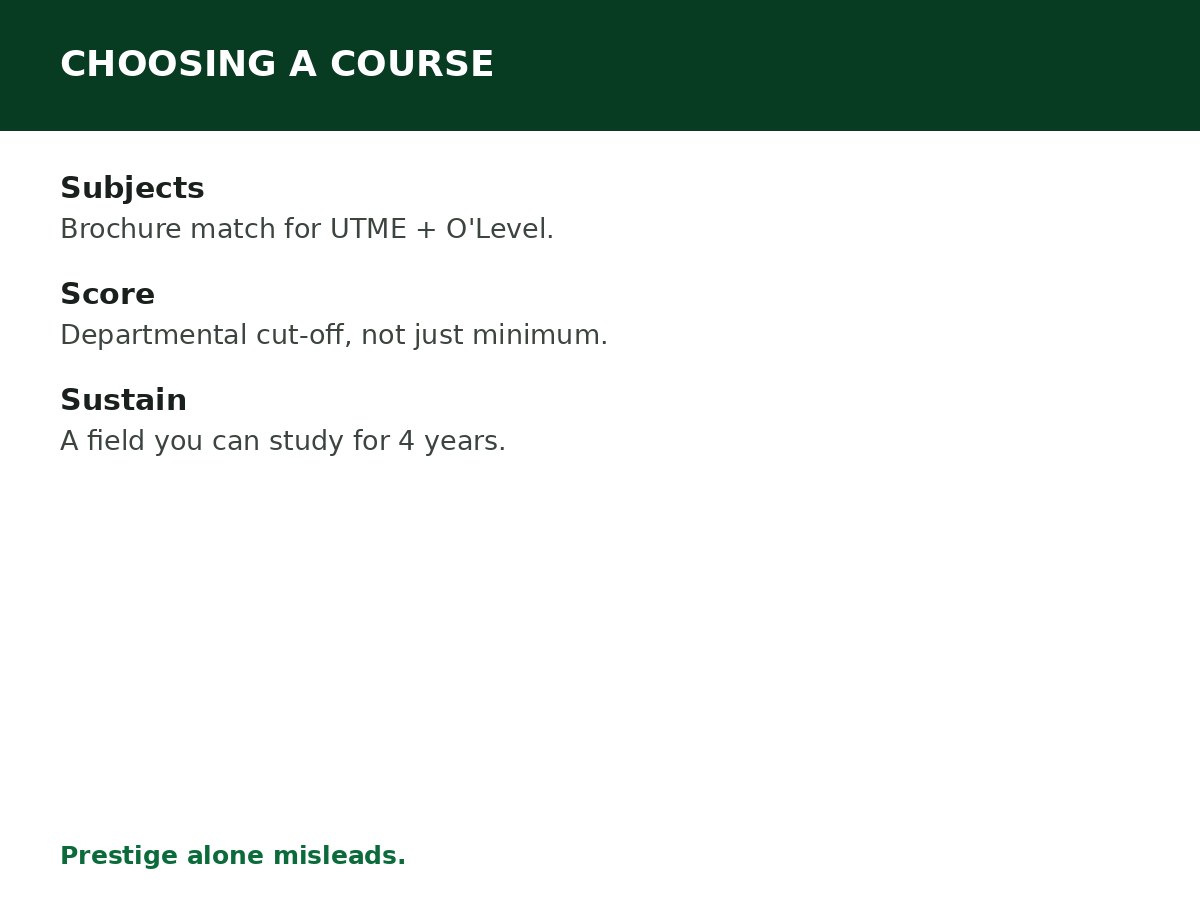
Choose a course after JAMB by matching three things: your UTME subjects and score (which courses your combination and score actually qualify you for), your O’Level credits (which courses your five credits, in the required subjects, cover), and a field you can sustain for four years and after graduation. A course chosen on prestige alone, or on a friend’s choice, is the commonest reason students seek a change of course a year later.
Your JAMB result does not choose your course for you — but it does narrow the field, and ignoring that narrowing is how candidates end up screened out for a course they never qualified for.
Step 1: What your UTME combination qualifies you for
- Check the JAMB brochure for each course you are considering. The brochure states the required UTME subjects and O’Level subjects for that course, at each institution. A course whose required UTME subject you did not write is not available to you this session, however strong your score.
- Check the subject combination guide for the major courses, and confirm against the current brochure — brochure requirements change, and the brochure for the current session governs.
- Score vs departmental cut-off: your UTME score qualifies you for a course only if it meets that course’s departmental cut-off at your chosen institution, not just the institution’s minimum. A 240 that misses Medicine’s departmental cut-off at one institution may comfortably meet another course’s cut-off at the same institution.
Step 2: What your O’Level credits cover
- Five credits including English and, for most courses, Mathematics, in the course-relevant subjects, in not more than two sittings (with course-specific one-sitting exceptions for competitive programmes).
- Map your credits to courses, not just to institutions. A candidate with strong Science credits and weak Arts credits has a different course field open than a candidate with the reverse — regardless of UTME score.
- Awaiting results: if one sitting is awaiting, your course choice must still be covered by the credits you will have when results are released — a course requiring a subject you have not passed, and will not pass, is not a realistic choice.
Step 3: What you can sustain
- Interest and aptitude, honestly assessed. Four years in a course you dislike is a long time, and a change of course after admission is possible but costly (see the change-of-course-after-admission guide). Choose a field you can study, not just a title you can announce.
- Career reality, not career fantasy. Check what graduates of that course actually do — employment, professional licensing, postgraduate routes — and whether that path requires further qualifications (for example, professional exams or a postgraduate degree) beyond the first degree.
- Institution strength in that field. An institution can be strong overall and weak in your specific course, or vice versa. Check the department, not just the institution — staffing, facilities, accreditation, and graduate outcomes for that course.
Step 4: Decide, with a realistic shortlist
- List courses your UTME combination + O’Level credits qualify you for.
- Filter by departmental cut-off you meet at institutions you can afford.
- Rank the survivors by interest, aptitude, and career reality.
- Set your JAMB choices accordingly, and use the change-of-course window (on JAMB, before admission) if your first choice proves unrealistic — that window is far cheaper than a post-admission transfer.
Related Guides & Next Steps
- Can You Change Your Course After Admission?
- How to Choose a University in Nigeria
- JAMB Subject Combination Guide for All Major Courses
- How University Admission Works in Nigeria
- 2026/2027 University Admission Guide for Nigerian Students
Frequently asked questions
Can I choose any course after JAMB, regardless of my subjects? No. Your UTME subject combination and O’Level subjects must match the course’s brochure requirements. A mismatch disqualifies you at screening, regardless of score.
Should I choose a course based on my JAMB score alone? No — score is one of three matches (subjects, O’Level credits, score vs departmental cut-off), plus interest and career reality. Score alone chooses nothing.
What if I chose the wrong course? Before admission, use JAMB’s change-of-course window (see the change-of-course guide). After admission, a change is an institutional intra-university transfer, with CGPA, vacancy, and Senate-approval conditions — a harder route.
Is a “hot” course always the best choice? No. Oversubscribed courses have the highest departmental cut-offs and the fiercest competition. A less oversubscribed course in a related field, at an institution you can enter, is often the smarter choice.
Can I change my course after I have been admitted? Yes, through your institution’s internal transfer process — not through JAMB’s pre-admission change window. See the change-of-course-after-admission guide for the conditions.
Sources and last update
- Course-choice method (brochure match, O’Level mapping, departmental cut-off, interest/career reality, department check) is CareerMedal’s own method, applied to JAMB’s admission system.
- Brochure requirements, subject-combination rules, sitting rules, and change windows cross-checked against JAMB’s process and the cluster’s guides.
Last updated: 24 October 2026. Guide — review every admission session and on every JAMB brochure update.

Written by Olaitan Ilori
Olaitan Ilori is the founder and lead researcher at CareerMedal. He provides verified, practical guides on Nigerian tertiary admissions (JAMB, CAPS, Post-UTME), NELFUND student finance, NYSC service-year survival, and early-career job placement.
View all guides by Olaitan Ilori →