
Budget your NELFUND upkeep payment by starting from the amount you actually receive, not the amount you hoped for: confirm the monthly figure on your portal, multiply by the active session months you will actually be paid for, subtract your fixed costs first (rent, food, transport), and keep a small buffer for the month a payment arrives late. Upkeep is a living allowance, not a salary — the budget that works is the one that survives a late payment.
This is the budgeting guide promised in the upkeep explainer. It is CareerMedal’s budgeting method applied to NELFUND’s actual payment structure — not a promise about amounts, which vary by session and must be confirmed on the portal.
Step 1: Know what you are actually budgeting
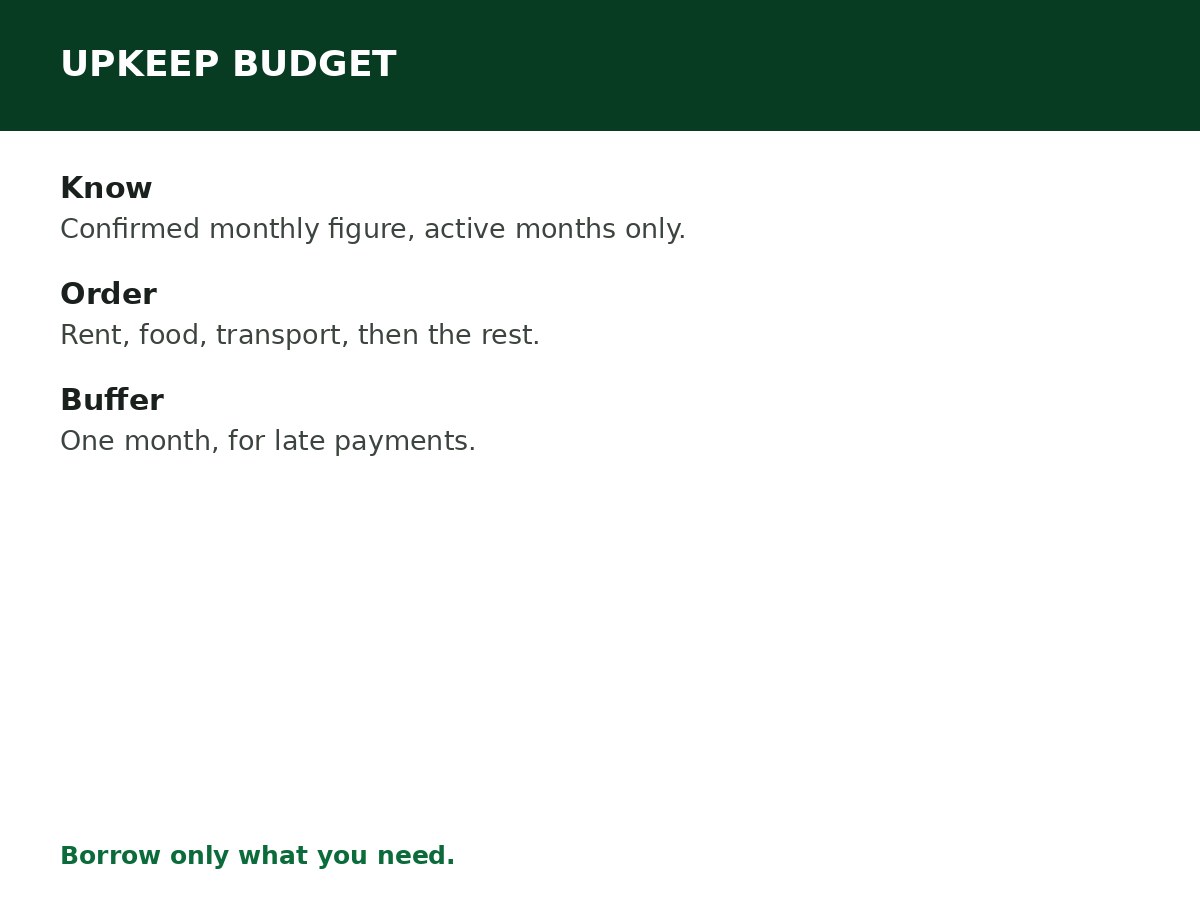
- Monthly figure: confirm it on your portal for your session. Guides report ₦20,000/month in 2026 guides, with earlier guides reporting ₦15,000/month — do not budget from a guide alone, and do not budget from a friend’s figure at a different institution.
- Active months: upkeep runs during your active academic session and stops at session end. Count only the months your institution’s calendar shows as active for your session, and remember that applying mid-session gives you only what is left of that session (no retrospective payments).
- Session total, honestly: monthly figure × active months you will actually be paid for. That is your upkeep budget for the session — not a monthly figure × 12, and not a figure that includes months before your application.
Worked example (illustrative, using the 2026 reported figure): ₦20,000 × 8 active months = ₦160,000 for the session. If your session has 10 active months, it is ₦200,000. If you applied mid-session with 5 active months left, it is ₦100,000. Change the monthly figure to your confirmed figure and the months to your calendar, and the method holds.
Step 2: Fixed costs first
Allocate in this order, because these are the costs that cause crises when they are short:
- Rent/hostel — the largest fixed cost. If your upkeep alone does not cover rent, that gap must be filled from another source (family, scholarship, work) before the session starts, not discovered mid-session. See the accommodation guide for the two funding routes.
- Food — daily, non-negotiable, and the easiest cost to underestimate. Price it from what you actually spend in a week, not from a round number.
- Transport — to campus and back, priced from your actual route, not from a generic figure.
- Data and airtime — small individually, large cumulatively, and essential for portal access, coursework, and communication.
- Course costs — handouts, printing, practical materials, field costs, where your course requires them.
Whatever remains after fixed costs is your discretionary budget: books beyond course requirements, clothing, social spending, and savings. If nothing remains, that is information, not failure — it tells you the gap you need to fill from another source, before the session’s costs arrive.
Step 3: Survive a late payment
Upkeep payments can be delayed — by verification, bank mismatches, reconciliation, or portal issues. A budget that assumes payment on the first of every month will break in the month a payment arrives late. Build in:
- A one-month buffer, if you can. One month’s fixed costs held back from an early payment, or from another source, so a late payment is an inconvenience rather than a crisis.
- A priority order for a short month. If a payment is late, pay rent and food first, transport second, and defer everything else. Do not borrow at high interest to cover a NELFUND delay — the delay is temporary, and high-interest debt is not.
- A check, not a panic. If a payment is late, check your dashboard’s upkeep component status, your bank details, and your institution’s calendar verification, in that order, before concluding there is a fault — see the upkeep payments guide.
Step 4: Do not borrow upkeep you do not need
Upkeep is the part of NELFUND you can most easily reduce or skip. Every naira of upkeep you receive is a naira you repay, at 10% of your income from two years after NYSC. If family support, a scholarship, or part-time work covers your living costs, consider requesting institutional charges only, and skipping upkeep — or requesting it for the months you genuinely need it, rather than by default. The cheapest loan is the one you did not take.
Related Guides & Next Steps
- Can NELFUND Pay for Accommodation?
- How NELFUND Upkeep Payments Work
- NELFUND Upkeep Loan Explained
- NELFUND Student Loan Requirements
- NELFUND Student Loan 2026/2027: Complete Guide
Frequently asked questions
How much upkeep will I receive? Confirm the monthly figure on your portal for your session. Guides report ₦20,000/month in 2026 guides, with earlier guides reporting ₦15,000/month — do not budget from a guide alone.
How many months of upkeep will I receive? For your active session months, as shown by your institution’s academic calendar — and only from your application onwards, not retrospectively.
What should I prioritise if my upkeep is late? Rent and food first, transport second, everything else deferred. Check your dashboard, bank details, and institution verification before assuming a fault.
Should I take upkeep if I already have family support? Only if you need it. Upkeep is repayable — borrowing what you do not need means repaying money you did not need, at 10% of your future income.
Can I save part of my upkeep? Yes — and a one-month buffer is the single most useful thing to save for, because it turns a late payment from a crisis into an inconvenience.
Sources and last update
- Budgeting method (confirmed figure × active months, fixed-first allocation, late-payment buffer, borrow-only-what-you-need) is CareerMedal’s own method, applied to NELFUND’s payment structure (session-bound, calendar-dependent, no retrospective payments).
- Upkeep amount conflict carried forward with confirm-on-portal instruction. Worked examples use the 2026 reported figure explicitly as illustrative, with the method stated to hold for any confirmed figure.
Last updated: 24 October 2026. Guide — review every session and on every NELFUND guideline update.

Written by Olaitan Ilori
Olaitan Ilori is the founder and lead researcher at CareerMedal. He provides verified, practical guides on Nigerian tertiary admissions (JAMB, CAPS, Post-UTME), NELFUND student finance, NYSC service-year survival, and early-career job placement.
View all guides by Olaitan Ilori →