

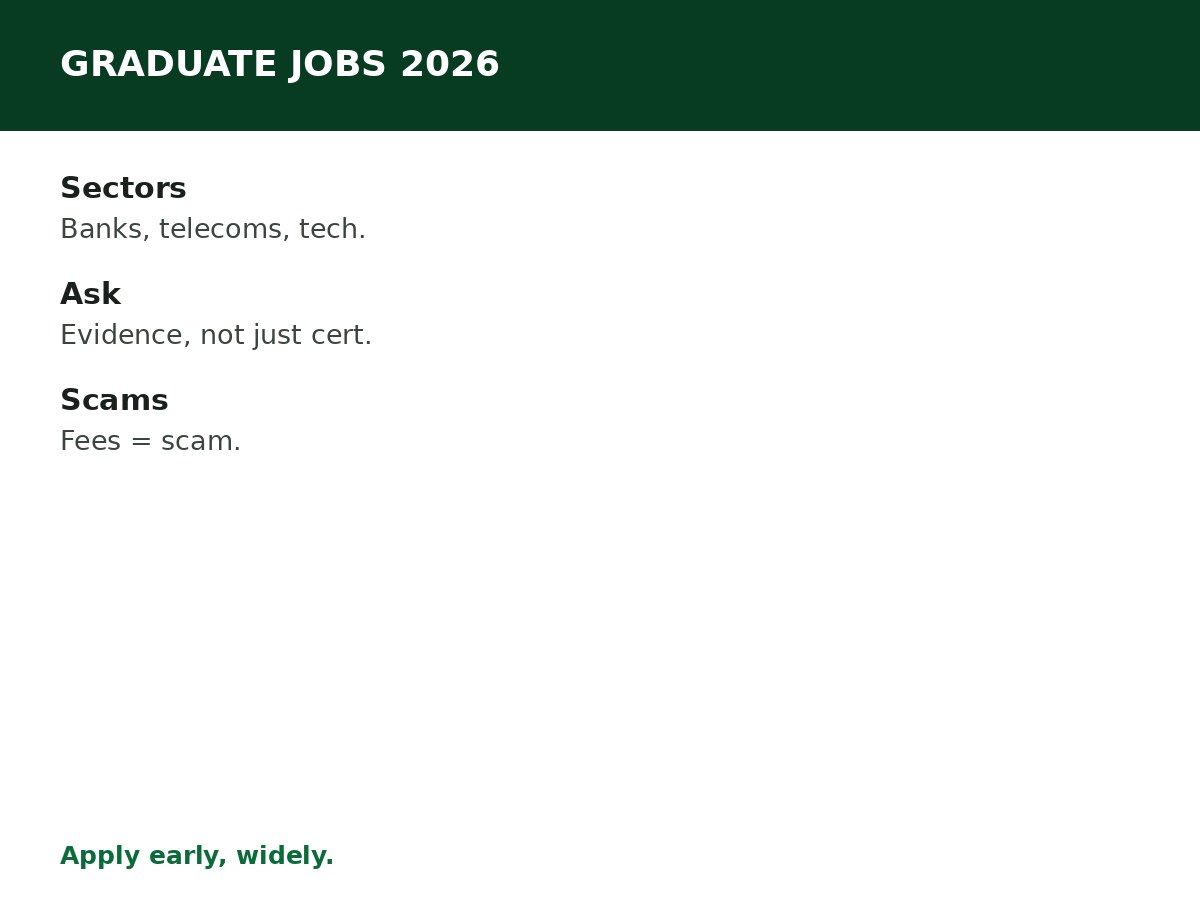
Graduate jobs in Nigeria in 2026 follow the same structure every year: banks, telecoms, oil and gas, FMCG, NGOs, government, and tech hire fresh graduates into entry-level, trainee, and internship pipelines — and the graduates who land them are usually the ones who applied early, applied widely, and could show evidence beyond their certificate. This is the 2026 hub: the market as it stands, the sectors hiring, and the strategy that works. No salary figure, vacancy count, or hiring outcome is asserted anywhere in this article, deliberately — the market moves too fast for frozen numbers.
The 2026 market, in brief
- Banks and financial services — among the largest graduate employers, through trainee programmes and entry-level hiring.
- Telecoms and tech — steady graduate hiring, with skills (data, software, digital) mattering as much as degree class.
- Oil, gas, and FMCG — competitive, structured trainee pipelines, with long recruitment cycles.
- NGOs and development — project-based hiring, where field experience and volunteer work count heavily.
- Government — recruitment runs through official portals and announcements, on its own timetable, with its own process (see the Government Recruitment cluster).
- Teaching and healthcare — steady demand, with professional registration gates (TRCN for teachers, professional bodies for health workers) that matter more than in other sectors.
What employers actually ask for
- A completed degree or HND, plus NYSC discharge, exemption, or exclusion — the standard graduate baseline. Without it, most graduate roles are closed (see the NYSC cluster).
- Evidence beyond the certificate — internships, SIWES, volunteer work, projects, and portfolios. A certificate alone rarely wins a competitive role.
- Skills that transfer — communication, data handling, digital tools, and customer-facing ability, stated with evidence, not adjectives.
- Willingness to start at entry level — graduates who hold out for senior titles stay unemployed longer than graduates who enter, learn, and rise.
The strategy that works in 2026
- Apply early and widely — trainee and graduate pipelines open months before start dates. Late applications miss closed windows.
- Target sectors, not just titles — a graduate trainee programme in one sector often beats a vague ‘officer’ title in another.
- Build evidence while applying — internships, volunteer work, freelance projects, and certifications fill the experience gap that blocks fresh graduates.
- Verify every vacancy — fake recruitment is the biggest risk in the Nigerian job market. Verify employer, portal, and contact before applying (see the verification guides).
- Prepare for aptitude tests and interviews — most structured pipelines screen with tests before interviews. Practise, don’t wing it.
Scams in the 2026 graduate market
- Application or training fees — legitimate employers do not charge to apply.
- Guaranteed jobs — no genuine employer guarantees a job before selection.
- Personal-account payments — any payment demand to a personal account is a scam.
- Fake portals — verify the employer’s official career page, typed directly, before applying.
Related Guides & Next Steps
- Entry-Level Jobs in Nigeria
- Jobs for Fresh Graduates in Nigeria
- Government Jobs vs Private Sector Jobs in Nigeria
Frequently asked questions
What jobs can a fresh graduate get in Nigeria? Entry-level roles, graduate trainee programmes, and internships across banks, telecoms, oil and gas, FMCG, NGOs, government, tech, teaching, and healthcare — see the sector guides in this cluster.
Do I need NYSC to get a graduate job? Yes, for most graduate roles — employers ask for NYSC discharge, exemption, or exclusion as the standard graduate baseline.
When do graduate trainee programmes open? Months before start dates, on each employer’s own timetable — apply early and widely, and track employer career pages directly.
How many jobs should a fresh graduate apply for? Widely — competitive pipelines reject most applicants, so a narrow application set is not a strategy. Apply to every role you genuinely qualify for.
Are there fake graduate jobs in Nigeria? Yes, extensively — application fees, guaranteed jobs, personal-account payments, and fake portals are the red flags. Verify every vacancy before applying.
Sources and last update
- Job market conditions, salaries, and vacancy availability change constantly — no salary figure, vacancy count, or hiring outcome is asserted anywhere in this article, deliberately. Employer career pages and reputable job boards, checked at application time, govern.
- Scam patterns: application fees, training fees, payment to personal accounts, and guaranteed jobs are red flags — legitimate employers do not charge to apply.
- No job, internship, or trainee-place outcome is promised anywhere in this article.
Last updated: 24 October 2026. Guide — review every 3–6 months, and on major labour-market shifts.

Written by Olaitan Ilori
Olaitan Ilori is the founder and lead researcher at CareerMedal. He provides verified, practical guides on Nigerian tertiary admissions (JAMB, CAPS, Post-UTME), NELFUND student finance, NYSC service-year survival, and early-career job placement.
View all guides by Olaitan Ilori →