

Graduate trainee programmes are structured employer pipelines: 6 to 24 months of rotations, classroom training, mentoring, and assessment, ending — for successful trainees — in a permanent role. They are the most competitive graduate door in Nigeria, and the most rewarding for those who enter. This guide explains how they work, how selection runs, and how to compete.
How trainee programmes work
- Rotations — trainees rotate through departments, learning the business end to end, rather than sitting in one role.
- Classroom training — formal training blocks, alongside on-the-job learning, as the programme states.
- Mentoring and assessment — mentors, periodic assessments, and a final evaluation, deciding permanent placement.
- Cohort hiring — trainees join as a cohort, on a fixed start date, after a competitive selection cycle.
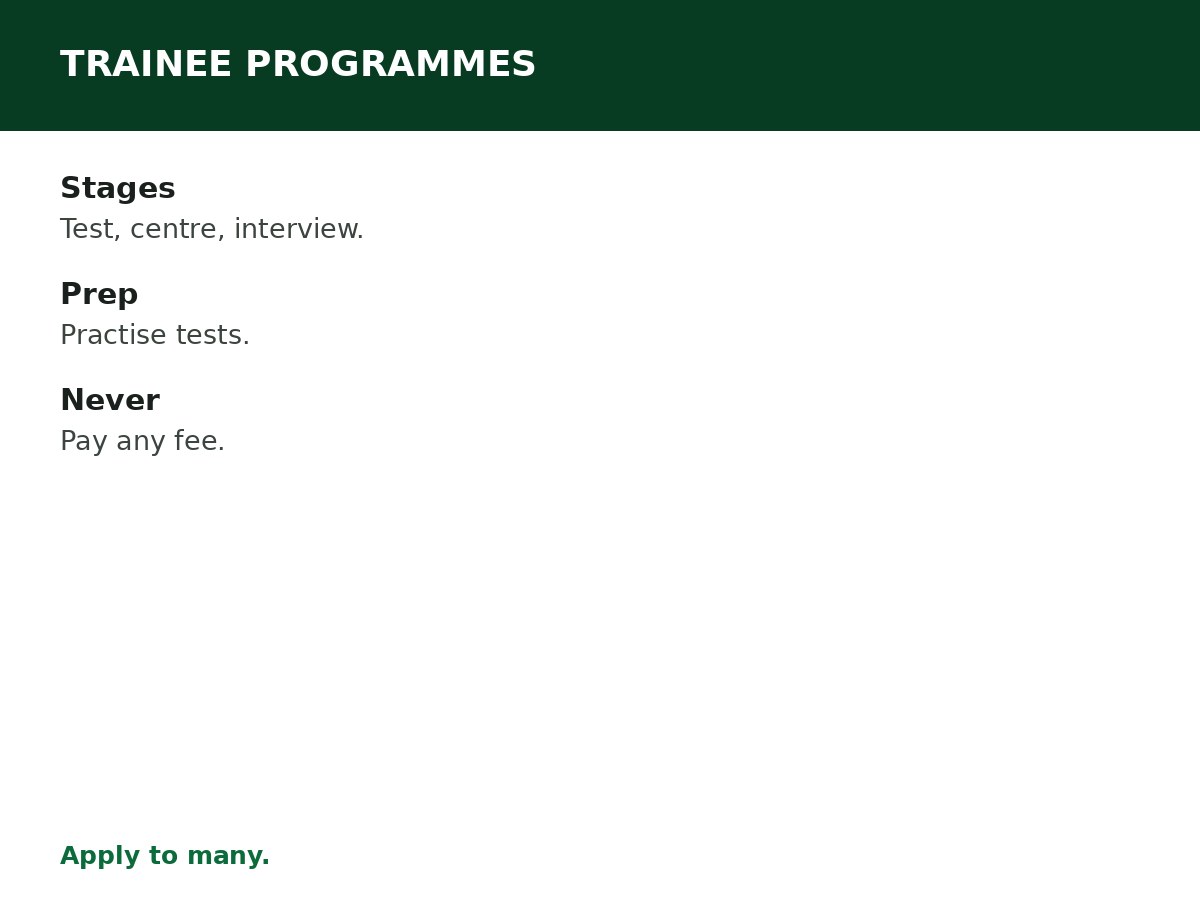
How selection runs
- Application — online, on the employer’s career page, during the programme’s window.
- Aptitude test — numerical, verbal, and logical reasoning, as the employer states. Most applicants fall here.
- Assessment centre or group exercise — teamwork, presentation, and case exercises, for shortlisted candidates.
- Interview — panel or individual interviews, for finalists.
- Offer and onboarding — for successful trainees, with a fixed start date.
How to compete
- Practise aptitude tests — before applying, not after shortlisting. Test practice is the highest-return preparation for trainee pipelines.
- Know the employer — sector, products, recent news, and values, for assessment centres and interviews.
- Show evidence, not adjectives — internships, projects, leadership roles, and volunteer work, stated with results.
- Apply to many programmes — trainee pipelines are competitive; a single application is not a strategy.
Trainee programme scams
- Fees at any stage — application, test, training, or placement fees are scams. Legitimate programmes charge nothing.
- Fake programmes — verify the employer’s career page, typed directly, before applying. Programmes advertised only in groups are suspect.
- Guaranteed placement — no genuine programme guarantees placement before selection.
Related Guides & Next Steps
- Graduate Jobs in Nigeria 2026
- Companies Hiring Fresh Graduates
- Banking Jobs for Fresh Graduates
- Paid Internships in Nigeria
Frequently asked questions
What is a graduate trainee programme? A structured employer pipeline — typically 6–24 months of rotations, classroom training, mentoring, and assessment — ending, for successful trainees, in a permanent role.
How do I get into a graduate trainee programme? Apply on the employer’s career page during the window, pass the aptitude test, assessment centre, and interview stages, and receive an offer for the cohort start date.
How long do graduate trainee programmes last? Typically 6 to 24 months, as the programme states, with rotations, training, mentoring, and assessment.
Are graduate trainee programmes paid? Yes — trainees are paid employees during the programme, as the employer states. Unpaid ‘trainee’ schemes are not genuine trainee programmes.
Should I pay to join a trainee programme? No — fees at any stage (application, test, training, placement) are scams. Legitimate programmes charge nothing.
Sources and last update
- Job market conditions, salaries, and vacancy availability change constantly — no salary figure, vacancy count, or hiring outcome is asserted anywhere in this article, deliberately. Employer career pages and reputable job boards, checked at application time, govern.
- Scam patterns: application fees, training fees, payment to personal accounts, and guaranteed jobs are red flags — legitimate employers do not charge to apply.
- No job, internship, or trainee-place outcome is promised anywhere in this article.
Last updated: 24 October 2026. Guide — review every 3–6 months, and on major labour-market shifts.

Written by Olaitan Ilori
Olaitan Ilori is the founder and lead researcher at CareerMedal. He provides verified, practical guides on Nigerian tertiary admissions (JAMB, CAPS, Post-UTME), NELFUND student finance, NYSC service-year survival, and early-career job placement.
View all guides by Olaitan Ilori →