

Entry-level jobs are roles designed for people with little or no work experience: the employer trains you, the title is junior, and the requirements are a degree, HND, or OND plus basic skills — not years of experience. This guide explains what counts as entry level, where these roles sit, and how to compete for them without experience.
What counts as entry level
- Designed for beginners — job descriptions ask for 0–2 years of experience, or ‘fresh graduates welcome’, not 5 years and a track record.
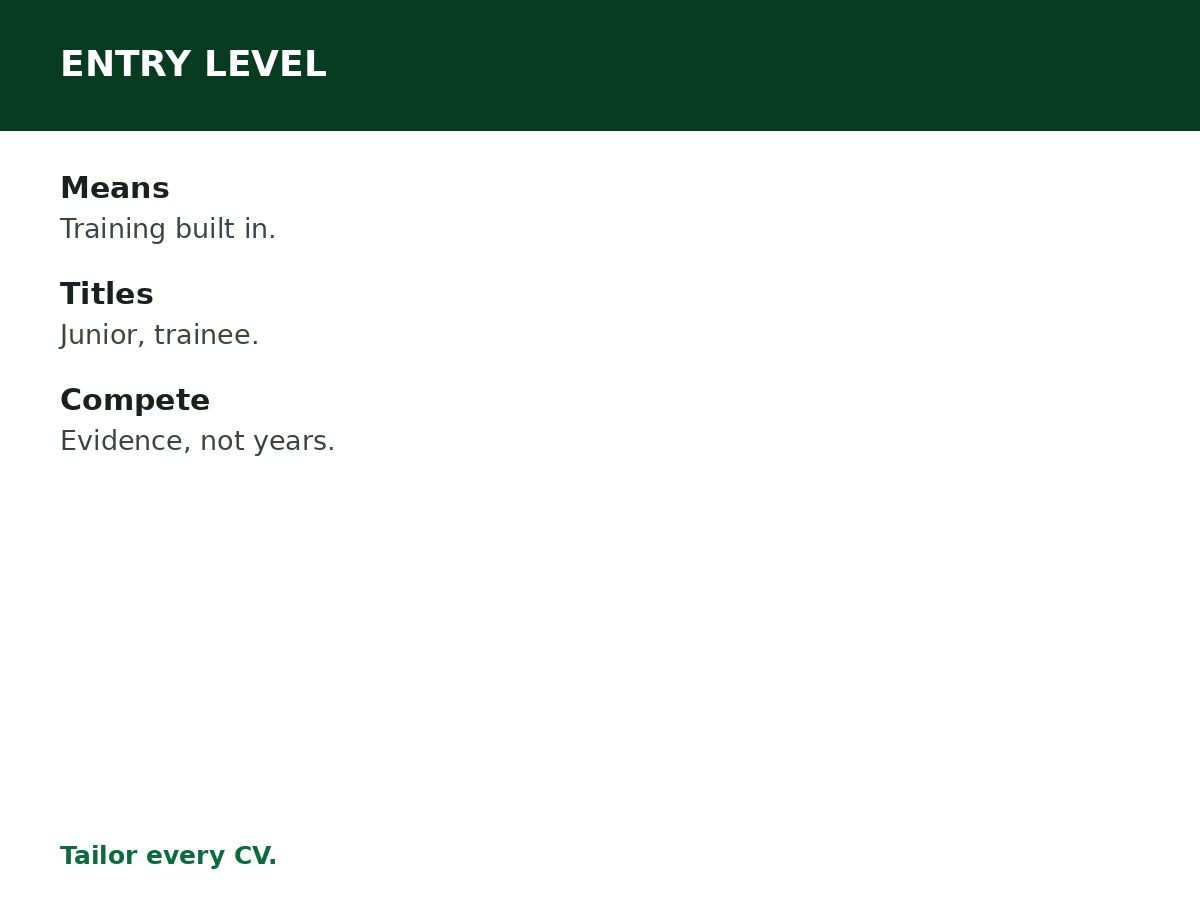
- Training built in — onboarding, mentoring, and probation periods are part of the role, not extras.
- Junior titles — officer, associate, analyst (junior), assistant, trainee, and graduate roles, as each employer titles them.
- Not the same as ‘any job’ — a role asking for 3+ years, a professional licence, or a portfolio of shipped work is not entry level, whatever the title says.
Where entry-level roles sit
- Banks — entry-level banking officers, customer service, and trainee pipelines.
- Telecoms and tech — junior support, sales, data, and engineering roles.
- FMCG and manufacturing — sales, supply chain, and management trainee pipelines.
- NGOs — programme assistants, field officers, and data roles.
- Government — junior administrative and officer cadres, through official recruitment.
- Schools and hospitals — teaching and junior health roles, with professional registration gates where applicable.
How to compete without experience
- Show evidence, not experience — SIWES, internships, volunteer work, class projects, and freelance work all count as evidence.
- Show skills with proof — a data project, a writing sample, a sales record, or a certificate with a practical component beats a bare claim.
- Tailor every application — a generic CV sent everywhere loses to a tailored CV sent to roles you genuinely fit.
- Prepare for tests — aptitude tests screen most structured entry-level pipelines. Practise before applying, not after shortlisting.
Related Guides & Next Steps
Frequently asked questions
What is an entry-level job? A role designed for people with little or no work experience — 0–2 years asked, training built in, junior title, employer trains you.
Can I get an entry-level job without experience? Yes — that is what entry level means. Compete with evidence (SIWES, internships, volunteer work, projects) rather than years of experience.
What is the difference between entry-level and graduate trainee? Entry level is a job level; graduate trainee is a structured programme. Trainee programmes are a subset of entry-level hiring, with rotations and formal training.
Do entry-level jobs require NYSC? Most graduate entry-level roles do — employers ask for NYSC discharge, exemption, or exclusion as the standard baseline.
How do I know a job is truly entry level? Check the requirements: 0–2 years asked, ‘fresh graduates welcome’, training built in. A role asking for 3+ years or a licence is not entry level, whatever the title says.
Sources and last update
- Job market conditions, salaries, and vacancy availability change constantly — no salary figure, vacancy count, or hiring outcome is asserted anywhere in this article, deliberately. Employer career pages and reputable job boards, checked at application time, govern.
- Scam patterns: application fees, training fees, payment to personal accounts, and guaranteed jobs are red flags — legitimate employers do not charge to apply.
- No job, internship, or trainee-place outcome is promised anywhere in this article.
Last updated: 24 October 2026. Guide — review every 3–6 months, and on major labour-market shifts.

Written by Olaitan Ilori
Olaitan Ilori is the founder and lead researcher at CareerMedal. He provides verified, practical guides on Nigerian tertiary admissions (JAMB, CAPS, Post-UTME), NELFUND student finance, NYSC service-year survival, and early-career job placement.
View all guides by Olaitan Ilori →