
A fully funded scholarship covers the full cost of study: tuition, living costs, and usually travel — and sometimes insurance, books, and research costs. The key word is ‘usually’: fully funded does not always mean every cost, and the exact coverage varies by programme. This guide explains what fully funded means, names the established fully funded programmes for Nigerians, and tells you how to verify coverage for the current cycle — because coverage, amounts, and deadlines change every year, and no amount or deadline is asserted anywhere in this article, deliberately.
What fully funded usually covers
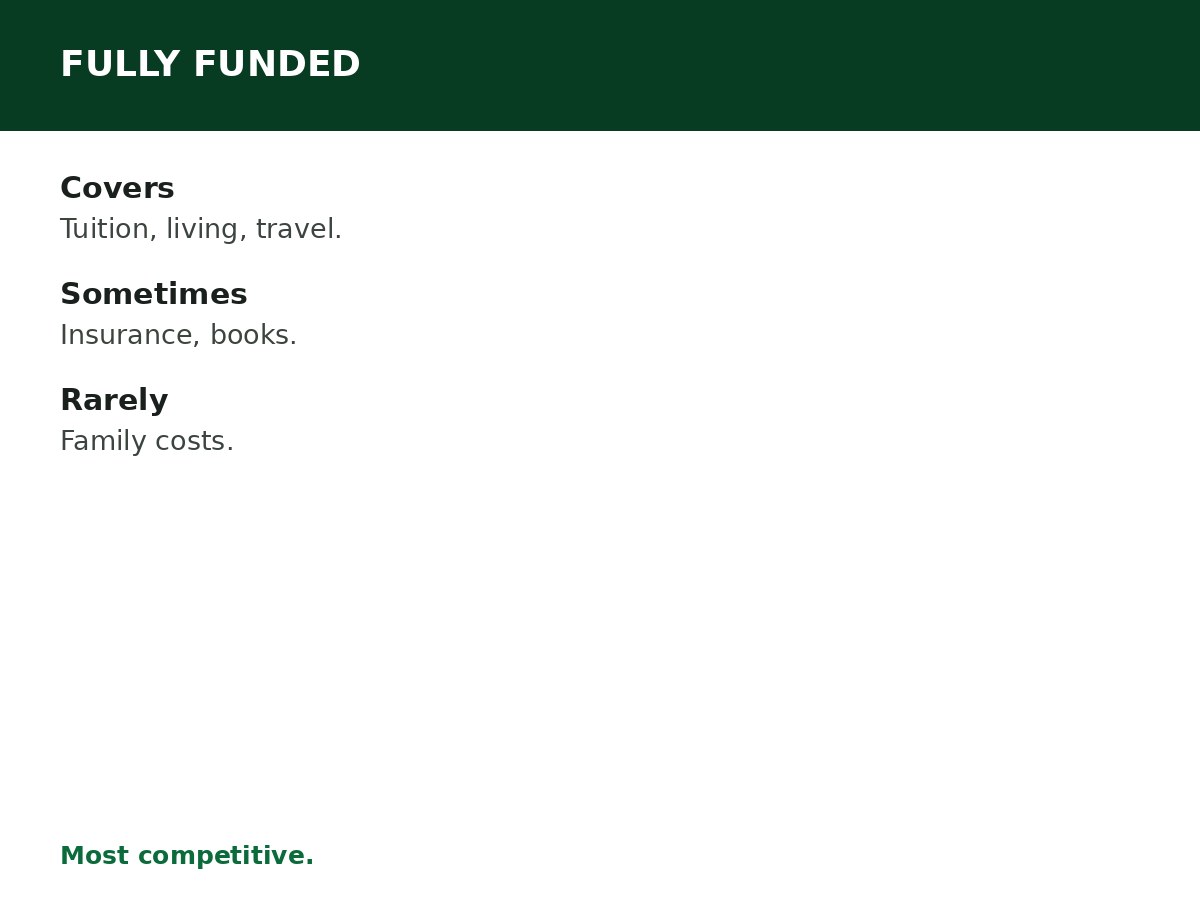
- Tuition fees — paid in full, directly to the institution.
- Living costs — a stipend (monthly or termly) for accommodation, feeding, and personal costs.
- Travel — return airfare, for study-abroad programmes.
- Sometimes: health insurance, books and materials, research costs, and visa costs.
- Rarely: family costs, or costs beyond the programme’s stated duration. Always check the programme’s coverage list — ‘fully funded’ without a coverage list is a claim, not a fact.
Established fully funded programmes for Nigerians
- Commonwealth Scholarships — fully funded, for study in the UK.
- Chevening Scholarships — fully funded, for master’s study in the UK.
- DAAD Scholarships — fully funded, for study in Germany.
- Erasmus Mundus — fully funded joint master’s programmes in Europe.
- MEXT Scholarships — fully funded, for study in Japan.
- Mastercard Foundation Scholars Programme — fully funded, at partner universities in Africa and abroad.
- PTDF Scholarships — fully funded, for oil, gas, and related fields, in Nigeria and abroad.
- NLNG Scholarships — fully funded, for Nigerian students, in Nigeria and abroad.
Fully funded vs partial: the comparison that matters
A partial scholarship that covers tuition only still leaves living costs, travel, and materials to you — which can exceed the tuition itself, especially abroad. Before choosing between a fully funded and a partial award, compare the full cost of study against what each award covers. A fully funded award at a cheaper-destination university can beat a partial award at an expensive-destination university.
How to apply, in order
- Shortlist fully funded programmes by level, field, and destination.
- Check the official programme page for the current cycle — coverage, amounts, deadlines, eligibility.
- Prepare documents early — transcripts, certificates, references, language proof where required.
- Apply through the official portal only.
- Have a backup: fully funded programmes are the most competitive awards available; apply to partial awards and other programmes in parallel.
Related Guides & Next Steps
- How University Admission Works in Nigeria
- Scholarships for Nigerian Students in 2026/2027
- Undergraduate Scholarships for Nigerian Students
- Masters Scholarships for Nigerians
Frequently asked questions
What does fully funded mean? Tuition, living costs, and usually travel — and sometimes insurance, books, and research costs. Always check the programme’s coverage list; ‘fully funded’ without a coverage list is a claim, not a fact.
Are fully funded scholarships harder to get? Yes — they are the most competitive awards available. Apply to partial awards and other programmes in parallel; do not rely on a single fully funded application.
Do fully funded scholarships cover family costs? Rarely. Most fully funded awards cover the student only. Check the programme’s coverage list before assuming family coverage.
Is a fully funded scholarship repaid? No. A scholarship is not repaid. NELFUND is a loan, repayable from 2 years after NYSC at 10% of income — do not confuse the two.
How do I verify a fully funded scholarship? On the programme’s official page for the current cycle: coverage list, amounts, deadlines, and eligibility. Never trust a coverage claim from a group, an agent, or a forwarded message.
Sources and last update
- Scholarship programmes named here are established programmes as reported; amounts, deadlines, and eligibility change every cycle — the official programme page for the current cycle governs, and no amount or deadline is asserted anywhere in this article, deliberately.
- Scholarship-vs-loan distinction from the NELFUND cluster guides (Batches 6–10): a scholarship is not repaid; NELFUND is a loan, repayable from 2 years after NYSC at 10% of income.
- Scam patterns from the fake-agents guide (Batch 12): application fees, guaranteed awards, and payment to personal accounts are red flags.
- No admission, award, or visa outcome is promised anywhere in this article.
Last updated: 24 October 2026. Guide — review every 3–6 months and on every scholarship-cycle update.

Written by Olaitan Ilori
Olaitan Ilori is the founder and lead researcher at CareerMedal. He provides verified, practical guides on Nigerian tertiary admissions (JAMB, CAPS, Post-UTME), NELFUND student finance, NYSC service-year survival, and early-career job placement.
View all guides by Olaitan Ilori →