
Common job interview questions in Nigeria are the questions Nigerian employers ask most — about background, strengths, weaknesses, motivation, and scenarios — with answers judged on relevance, evidence, and honesty. This guide lists common questions by type, with answer approaches, distinct from the specific-question guides (which cover individual questions in depth) and the prepare-for-interview guide (which covers preparation).
Questions by type
- Background — ‘Tell me about yourself’, ‘Walk me through your CV’, ‘Why did you choose your course?’ — answered with present-past-future structure, relevance, and evidence, as the specific guides cover.
- Strengths and weaknesses — ‘What are your strengths?’, ‘What is your greatest weakness?’ — strengths with evidence, weaknesses with honest improvement steps, not clichés.
- Motivation — ‘Why do you want this job?’, ‘Why should we hire you?’, ‘Where do you see yourself in 5 years?’ — role-specific reasons, with evidence, not generic praise, as the specific guides cover.
- Scenario and competency — ‘Tell me about a time you handled a difficult situation’, ‘Describe a team project’ — STAR structure (Situation, Task, Action, Result), with honest examples, as employers state.
- Practical — ‘What is your expected salary?’, ‘When can you start?’, ‘Do you have questions for us?’ — researched, flexible, and prepared answers, as the specific guides cover.
Answer approaches
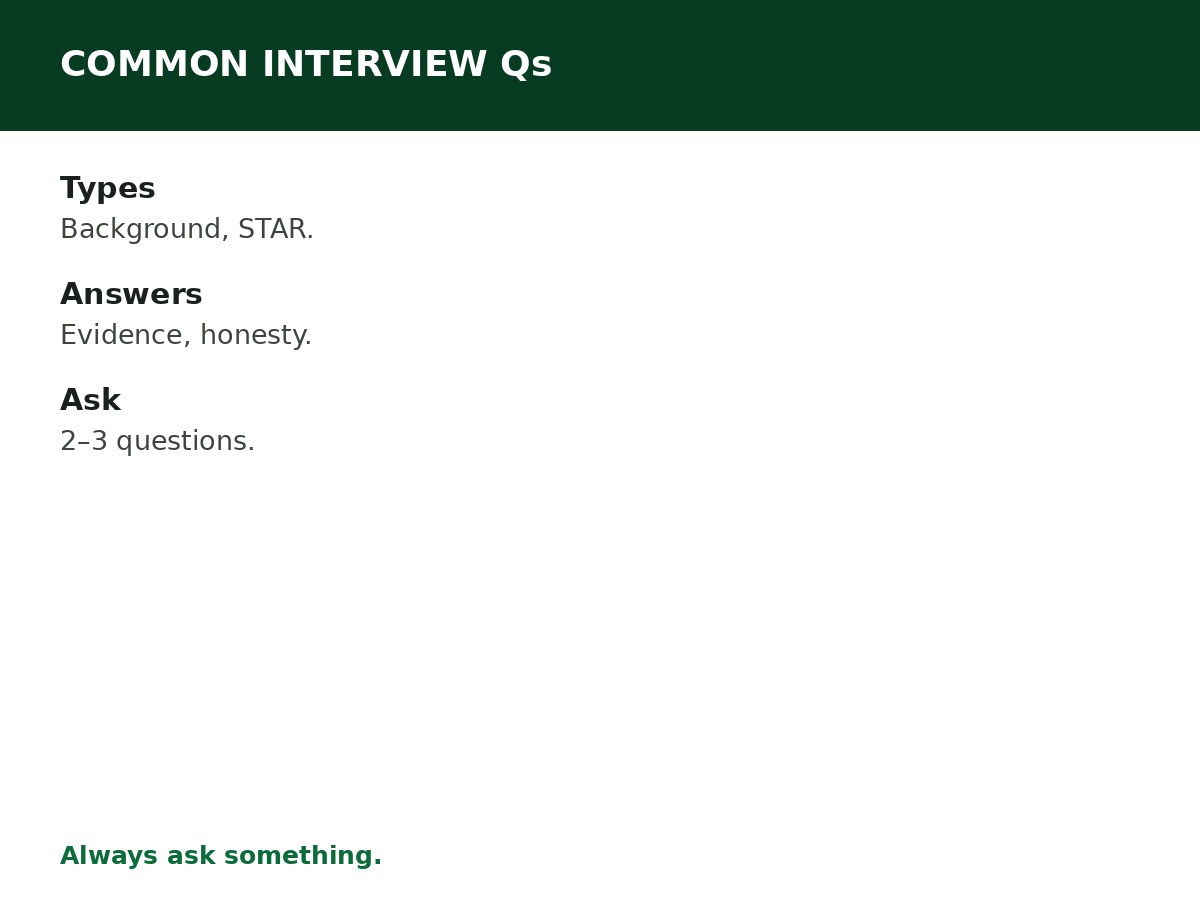
- STAR for scenarios — Situation, Task, Action, Result, in order, with honest examples, for competency questions, as employers state.
- Evidence over adjectives — skills and strengths, demonstrated by projects, internships, and results, not adjectives alone.
- Role-specific reasons — motivation and fit, linked to this employer and role, specifically, not generic praise.
- Honest weaknesses — real weaknesses, with improvement steps, not disguised strengths (‘I work too hard’), which interviewers recognise as evasive.
Questions to ask employers
- Role and team — ‘What does success look like in this role?’, ‘How is the team structured?’, for role clarity.
- Growth and training — ‘What training and growth opportunities exist?’, for career planning.
- Next steps — ‘What are the next steps in the process?’, for timeline clarity.
- Always ask something — no questions, at interview close, signals disinterest, as interviewers state. Prepare 2–3 questions, before every interview.
Interview mistakes
- Generic answers for every role — one generic answer set, for every employer, losing to tailored answers, matching each role.
- Invented examples — invented scenarios, projects, or results, failing follow-up questions and reference checks.
- No preparation — unprepared answers, rambling, and no questions, costing interviews, whatever the CV.
- Negative talk about past employers — criticising past employers, schools, or colleagues, signalling risk, as interviewers state. State facts neutrally, where asked.
Related Guides & Next Steps
- How to Write a CV With No Work Experience
- How to Prepare for a Job Interview
- How to Dress for a Job Interview
- How to Answer What Is Your Expected Salary?
Frequently asked questions
What are common job interview questions in Nigeria? Background, strengths and weaknesses, motivation, scenario/competency, and practical questions — about background, strengths, motivation, scenarios, salary, availability, and questions for employers.
How should I answer scenario questions? With STAR structure (Situation, Task, Action, Result), in order, with honest examples, as employers state.
How should I answer weakness questions? With real weaknesses, and honest improvement steps, not disguised strengths (‘I work too hard’), which interviewers recognise as evasive.
Should I ask questions at the end of an interview? Yes — always ask something. No questions, at interview close, signals disinterest, as interviewers state. Prepare 2–3 questions, before every interview.
Should I criticise past employers in interviews? No — criticising past employers, schools, or colleagues, signals risk, as interviewers state. State facts neutrally, where asked.
Sources and last update
- No salary figure, vacancy count, or hiring outcome is asserted anywhere in this article, deliberately — employer career pages and reputable boards, checked at application time, govern.
- No company is named as currently hiring anywhere in this article, deliberately — hiring windows open and close; employer career pages govern.
- Scam patterns: fees for jobs, payment to personal accounts, guaranteed jobs or shortlisting, and interview coaching selling fake experience are red flags — verify every employer on official channels before applying or paying anything.
- No job, shortlisting, salary, or hiring outcome is promised anywhere in this article.
Last updated: 24 October 2026. Guide — review every 6–12 months, and on every major hiring-platform change.

Written by Olaitan Ilori
Olaitan Ilori is the founder and lead researcher at CareerMedal. He provides verified, practical guides on Nigerian tertiary admissions (JAMB, CAPS, Post-UTME), NELFUND student finance, NYSC service-year survival, and early-career job placement.
View all guides by Olaitan Ilori →