
Dressing for a job interview means dressing professionally, neatly, and appropriately for the employer and sector — so appearance supports, never distracts from, your answers. This guide covers interview dress specifically, distinct from the prepare-for-interview guide (which covers overall preparation) and the workplace guides (which cover workplace conduct).
General interview dress rules
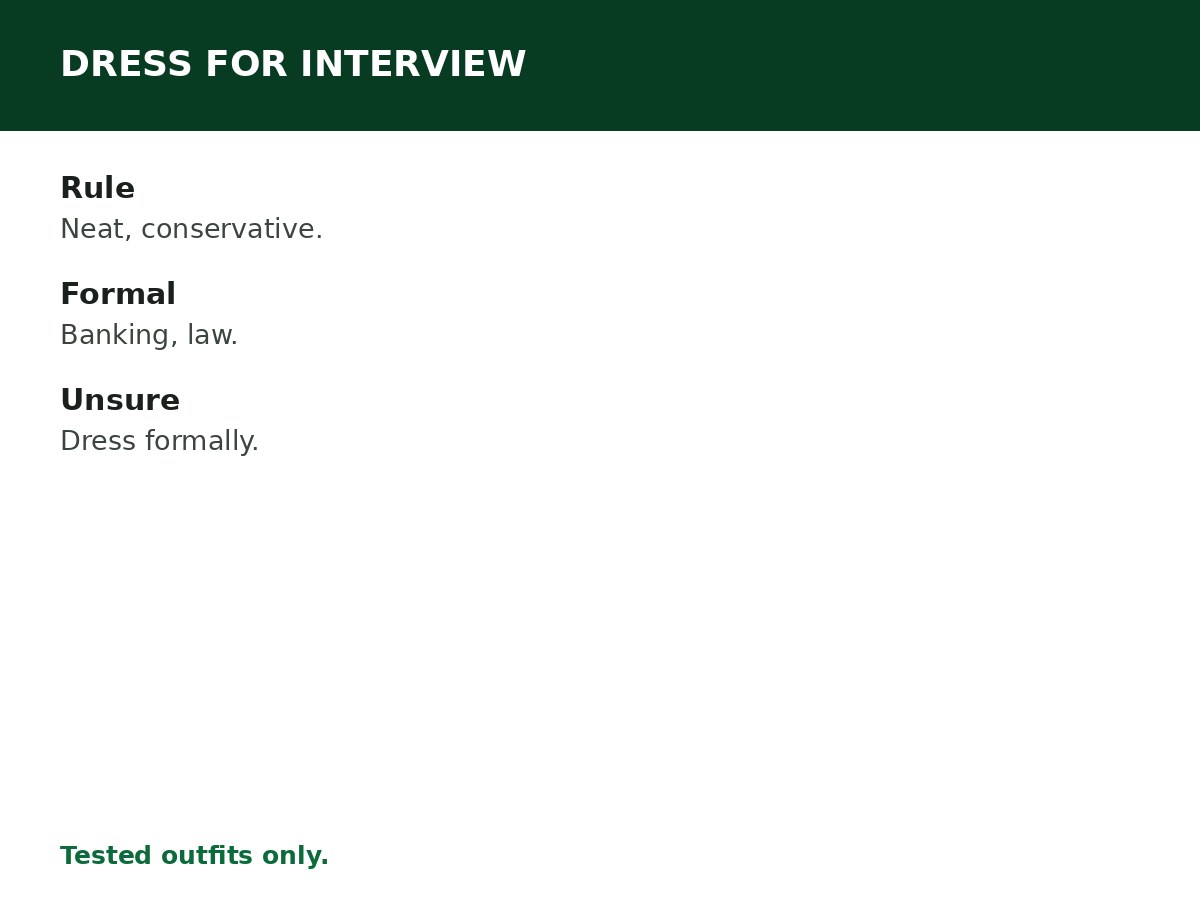
- Professional and neat — clean, pressed, well-fitting clothes, as employers state, for professional impressions, whatever the sector.
- Sector-appropriate — formal sectors (banking, law, government) expect formal dress; creative and tech sectors allow smart-casual, as the market states, matched to the employer, not assumed.
- Conservative over flashy — muted colours, minimal patterns, and modest styles, for interviewer focus on answers, not appearance.
- Grooming and hygiene — neat hair, clean nails, and fresh presentation, as employers state, for professional impressions.
Dress by sector (guidance, not rules)
- Formal sectors — suit or formal attire, for banking, law, government, and corporate roles, as the market states.
- Business sectors — smart shirt, trousers or skirt, and formal shoes, for business, administrative, and professional roles.
- Creative and tech sectors — smart-casual (neat shirt, trousers, clean shoes), for creative, tech, and startup roles, as the market states, still neat, never casual.
- When unsure, dress formally — formal dress, where sector norms are unclear, is safer than underdressing, as interviewers state.
Dress mistakes
- Casual dress — jeans, trainers, and casual tops, for formal interviews, signalling disrespect, as interviewers state.
- Overpowering scents and accessories — strong perfumes, loud jewellery, and distracting accessories, diverting interviewer attention.
- Wrinkled or stained clothes — wrinkled, stained, or ill-fitting clothes, signalling carelessness, whatever the answers.
- New, untested outfits — new outfits, worn first at interviews, risking discomfort and distraction. Wear tested, comfortable outfits, for interview day.
Virtual interview dress
- Dress fully, not just top-half — full professional dress, for virtual interviews, as interviewers state, since standing or camera shifts expose partial dress.
- Background and lighting — neat background, good lighting, and camera framing, for professional virtual impressions, as the market states.
- Technology checked — connection, camera, and microphone, tested before virtual interviews, as the prepare guide covers.
Related Guides & Next Steps
- How to Write a CV With No Work Experience
- How to Answer Why Should We Hire You?
- How to Explain a Career Gap in an Interview
- How to Prepare for a Job Interview
Frequently asked questions
How should I dress for a job interview? Professionally, neatly, and appropriately for the employer and sector — clean, pressed, well-fitting clothes, conservative over flashy, with neat grooming, so appearance supports, never distracts from, answers.
Should I wear a suit to every interview? No — formal sectors (banking, law, government) expect formal dress; creative and tech sectors allow smart-casual, as the market states, matched to the employer, not assumed. When unsure, dress formally.
What dress mistakes cost interviews? Casual dress for formal interviews, overpowering scents and accessories, wrinkled or stained clothes, and new, untested outfits, worn first at interviews.
Should I dress fully for virtual interviews? Yes — full professional dress, for virtual interviews, as interviewers state, since standing or camera shifts expose partial dress.
What if I am unsure about dress code? Dress formally — formal dress, where sector norms are unclear, is safer than underdressing, as interviewers state.
Sources and last update
- No salary figure, vacancy count, or hiring outcome is asserted anywhere in this article, deliberately — employer career pages and reputable boards, checked at application time, govern.
- No company is named as currently hiring anywhere in this article, deliberately — hiring windows open and close; employer career pages govern.
- Scam patterns: fees for jobs, payment to personal accounts, guaranteed jobs or shortlisting, and interview coaching selling fake experience are red flags — verify every employer on official channels before applying or paying anything.
- No job, shortlisting, salary, or hiring outcome is promised anywhere in this article.
Last updated: 24 October 2026. Guide — review every 6–12 months, and on every major hiring-platform change.

Written by Olaitan Ilori
Olaitan Ilori is the founder and lead researcher at CareerMedal. He provides verified, practical guides on Nigerian tertiary admissions (JAMB, CAPS, Post-UTME), NELFUND student finance, NYSC service-year survival, and early-career job placement.
View all guides by Olaitan Ilori →