

Getting your first internship means targeting structured programmes, applying with tailored CVs and cover letters, and preparing for interviews — so you gain workplace experience, references, and skills, before graduation or first jobs. This guide covers first internships specifically, distinct from the internship-listing guide (which covers CV entries) and the Jobs cluster internship guides (which cover internship types).
Where first internships live
- Structured programmes — company internship programmes, SIWES placements, and graduate internships, as employers state, for first workplace experience.
- Small employers — small businesses, startups, and NGOs, as the market states, often open to first-time interns, where large programmes are competitive.
- University channels — career services, lecturers, and alumni, as institutions state, for internship leads and referrals.
- Direct applications — direct employer applications, with tailored CVs and cover letters, as the Jobs cluster covers, for unadvertised internships.
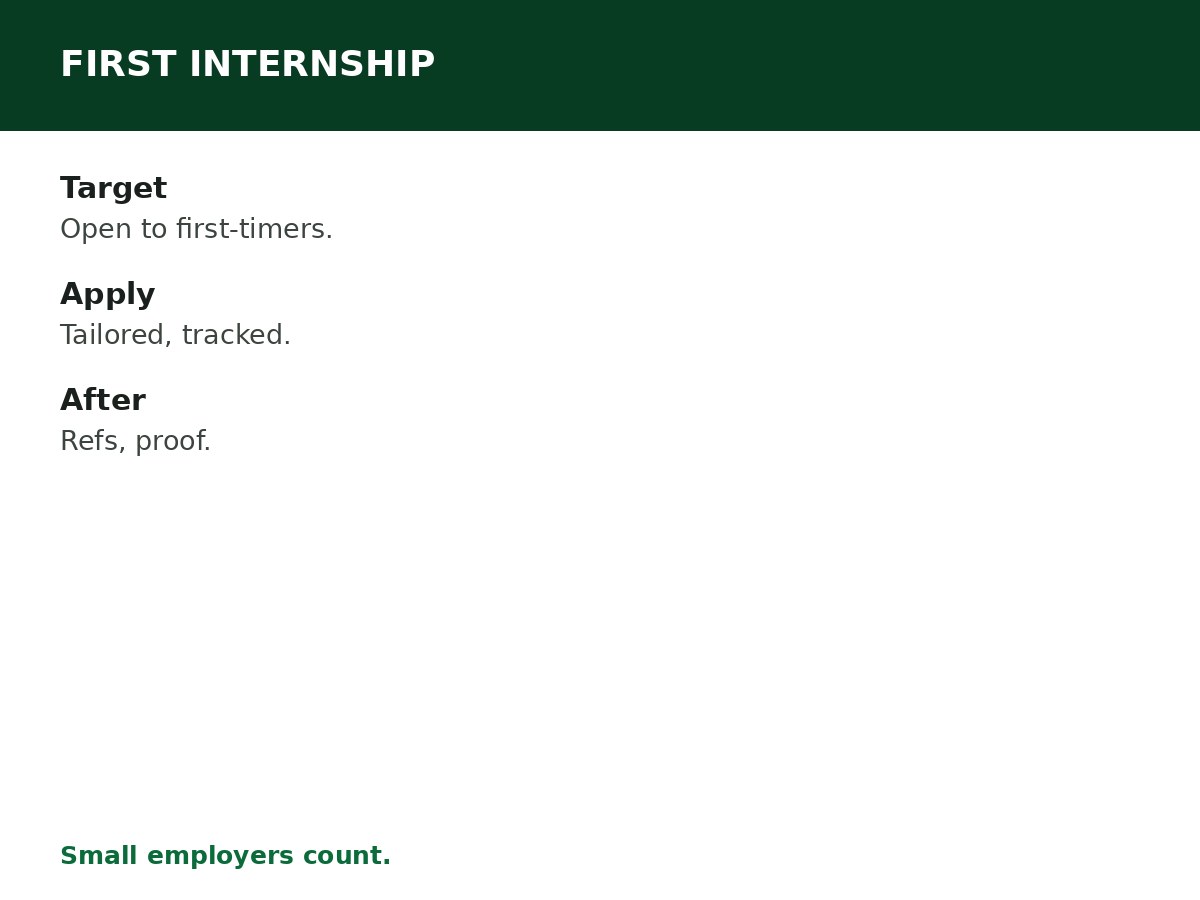
How to get a first internship
- Target structured and small employers — programmes and employers, open to first-time interns, as job descriptions state, not senior roles.
- Tailor CV and cover letter per role — skills and projects, matching each role, highlighted first, as the CV and cover-letter guides cover.
- Prepare for interviews — common answers, STAR examples, and questions, rehearsed, as the interview guides cover.
- Follow up once, politely — after the stated timeline, or 2–3 weeks of silence, as the follow-up rule states, never before the deadline, never repeatedly.
- Accept learning, not just pay — first internships, judged by learning, mentorship, and references, as the market states, not pay alone, where pay is low or unpaid, as terms state.
First internship mistakes
- Applying only to large programmes — large programmes, highly competitive, losing to small-employer applications, where first internships are available, as the market states.
- Generic applications — one generic CV and cover letter, sent everywhere, losing to tailored applications, matching each role.
- Invented experience — fake jobs, inflated titles, and invented employers, are fraud, and background checks expose them.
- Rejecting learning for pay alone — rejecting internships, for low pay, where learning, mentorship, and references are strong, as the market states, losing career value, where alternatives are scarce.
After a first internship
- References and proof — supervisor references, and internship projects, for CVs and portfolios, as the CV and portfolio guides cover.
- Skills and networks — workplace skills, and professional contacts, built during internships, for future applications.
- Convert or move on — conversion to full roles, where offered, or applications elsewhere, with internship proof, as the market states.
Related Guides & Next Steps
- How to Write a CV With No Work Experience
- How to Get Your First Remote Job
- How to Transition From NYSC to Employment
- How to Build a Professional Portfolio
Frequently asked questions
How do I get my first internship? By targeting structured programmes and small employers open to first-time interns, applying with tailored CVs and cover letters, preparing for interviews, and following up once, politely, after the timeline.
Where do first internships live? Structured company programmes, SIWES placements, graduate internships, small businesses, startups, NGOs, university channels (career services, lecturers, alumni), and direct employer applications.
Should I accept a low-paid or unpaid first internship? Judge by learning, mentorship, and references, as the market states, not pay alone, where pay is low or unpaid, as terms state — where alternatives are scarce, learning value matters most.
Should I apply only to large internship programmes? No — large programmes, highly competitive, lose to small-employer applications, where first internships are available, as the market states.
What comes after a first internship? Supervisor references, internship projects for CVs and portfolios, workplace skills and networks, and conversion or applications elsewhere, with internship proof.
Sources and last update
- No salary figure, vacancy count, or hiring outcome is asserted anywhere in this article, deliberately — employer career pages and reputable boards, checked at application time, govern.
- No company is named as currently hiring anywhere in this article, deliberately — hiring windows open and close; employer career pages govern.
- Scam patterns: fees for jobs, payment to personal accounts, guaranteed jobs or placements, and mentorship or networking schemes selling access are red flags — verify every employer and programme on official channels before applying or paying anything.
- No job, salary, placement, or hiring outcome is promised anywhere in this article.
Last updated: 24 October 2026. Guide — review every 6–12 months, and on every major hiring-platform change.

Written by Olaitan Ilori
Olaitan Ilori is the founder and lead researcher at CareerMedal. He provides verified, practical guides on Nigerian tertiary admissions (JAMB, CAPS, Post-UTME), NELFUND student finance, NYSC service-year survival, and early-career job placement.
View all guides by Olaitan Ilori →