
Software developer jobs hire fresh graduates into frontend, backend, mobile, and full-stack roles, through startups, established companies, and remote teams, on portfolio and technical-test performance more than on certificates. This guide explains the developer pipeline, the portfolio bar, and how fresh graduates enter software development.
How developer hiring works
- Startups and established companies — direct hiring, on each company’s timetable, with portfolio review, coding tests, and interviews.
- Remote teams — distributed roles, including international remote work (see the remote-jobs guide), with the same skill bar.
- Internships and trainee roles — fixed-term placements, often converting to permanent roles, and the best route in for fresh graduates.
- Freelance-to-employed paths — freelance projects building a portfolio that converts into employed roles.
The portfolio bar
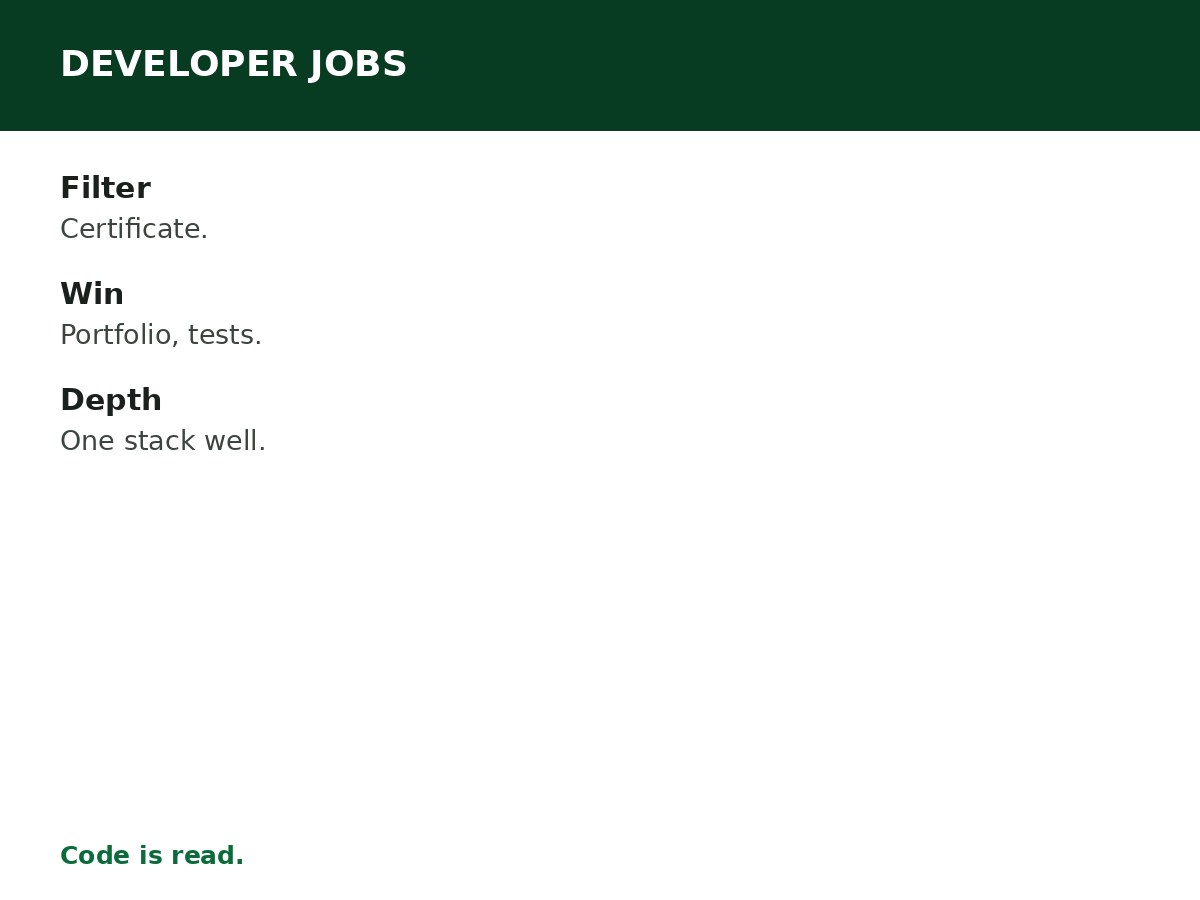
- Shipped projects — working applications, not tutorial copies. Employers check GitHub, live demos, and code quality.
- Depth over breadth — one stack done well beats five stacks done shallowly. Pick a stack, build deeply, show the work.
- Problem-solving evidence — projects that solve real problems (a campus tool, a business site, an automation) beat generic clones.
- Code quality — readable, organised code with documentation. Employers read code, not just demos.
What developer employers screen for
- Coding-test performance — data structures, algorithms, and practical tasks, as each employer states. Practise before applying.
- Portfolio and GitHub — the main filter, ahead of degree class.
- Degree or HND, plus NYSC status where applicable — the baseline for structured pipelines, though some startups waive it for strong portfolios.
- Learning speed — stacks change fast. Employers screen for candidates who learn new tools quickly.
Developer recruitment scams
- Fees for developer roles or ‘job guarantees’ — scams. Legitimate employers charge nothing.
- Unpaid ‘trial’ projects — trial tasks that become free labour. Cap trial work, and walk away from endless ‘tests’.
- Fake startups — verify the company’s registration, product, and team before accepting a role.
Related Guides & Next Steps
- Graduate Jobs in Nigeria 2026
- Data Analyst Jobs in Nigeria
- Cybersecurity Jobs in Nigeria
- Accounting Jobs in Nigeria
Frequently asked questions
How do I get a software developer job as a fresh graduate? Through startups, established companies, internships, or freelance-to-employed paths — with a portfolio of shipped projects and coding-test preparation as the main assets.
Do software developer jobs require a computer science degree? No — employers screen mainly on portfolio and coding-test performance, and hire graduates across disciplines, though structured pipelines may ask for a degree.
What should a developer portfolio contain? Shipped projects — working applications with live demos and readable code on GitHub — showing depth in one stack and problem-solving, not tutorial copies.
Are developer internships paid? Structured developer internships are typically paid, as the employer states. Unpaid ‘internships’ with full-time duties are exploitation, not experience.
Are there fake developer jobs? Yes — fees, unpaid trial projects that become free labour, and fake startups are scams. Verify the company before accepting.
Sources and last update
- No company is named as currently hiring anywhere in this article, deliberately — hiring windows open and close, and a frozen company list misleads readers within months. Employer career pages, checked at application time, govern.
- No salary figure, vacancy count, or hiring outcome is asserted anywhere in this article, deliberately. Employer career pages and reputable job boards, checked at application time, govern.
- Scam patterns: application fees, training fees, payment to personal accounts, and guaranteed jobs are red flags — legitimate employers do not charge to apply.
- No job outcome is promised anywhere in this article.
Last updated: 24 October 2026. Guide — review every 3–6 months, and on major labour-market shifts.

Written by Olaitan Ilori
Olaitan Ilori is the founder and lead researcher at CareerMedal. He provides verified, practical guides on Nigerian tertiary admissions (JAMB, CAPS, Post-UTME), NELFUND student finance, NYSC service-year survival, and early-career job placement.
View all guides by Olaitan Ilori →