

Skills you can learn in 6 months are skills with deeper learning curves — skills you can practise to working competence within half a year, with daily practice and projects, not mastery in half a year. This guide lists realistic 6-month skills, what ‘learned’ means at 6 months, and what comes after, distinct from the 3-month guide (which covers foundational skills) and the skill-choice guide (which covers choosing).
What ‘learned in 6 months’ means
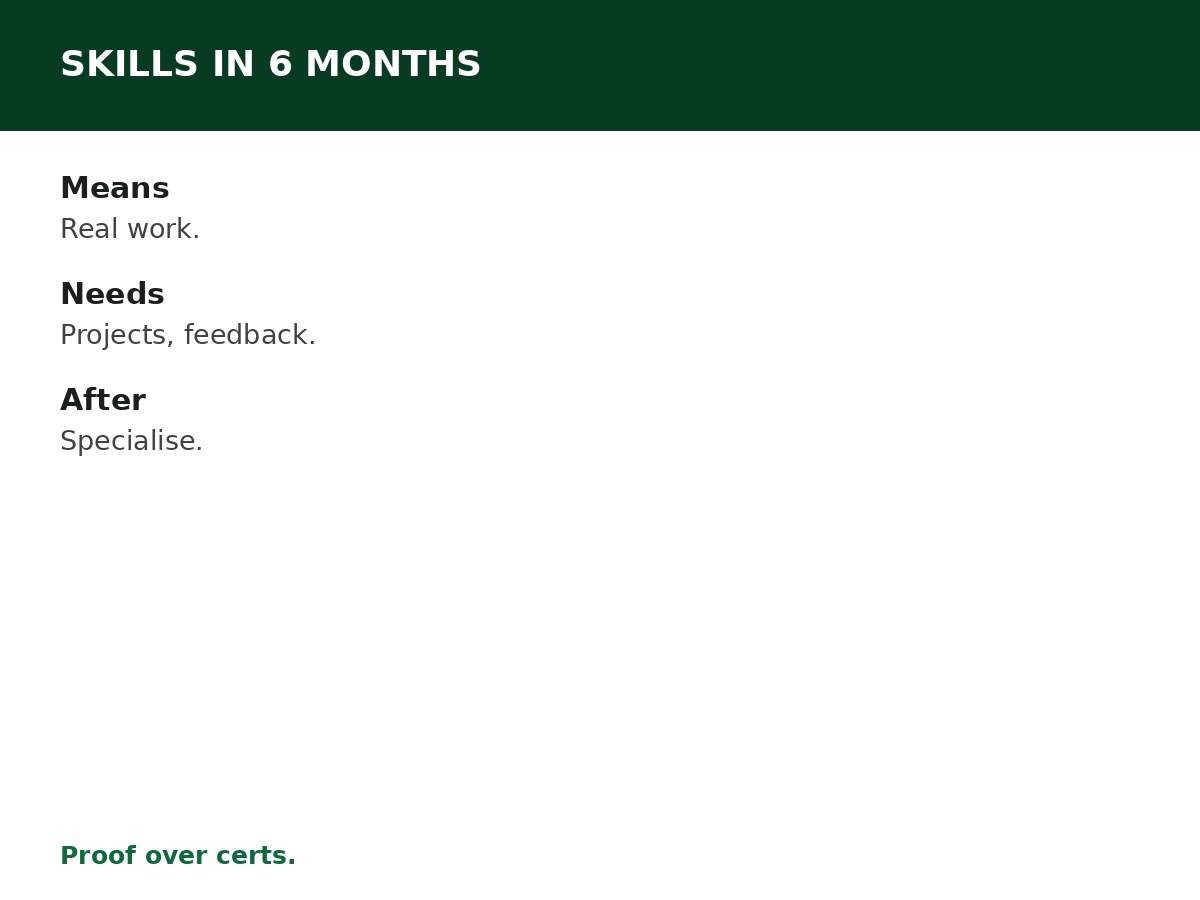
- Working competence, not mastery — you can perform real work, independently or with light supervision, after 6 months of daily practice and projects. Mastery takes longer, as every field states.
- Daily practice and projects required — 6-month learning assumes daily practice, real projects, and feedback, not occasional study. Programmes promising 6-month mastery without projects are misleading.
- Portfolio or proof — finished projects, supervised jobs, or client work, demonstrating the skill, matter more than certificates, for employment and freelance work.
Realistic 6-month skills
- Web development foundations — HTML, CSS, JavaScript, and a framework, with portfolio projects, as the coding guide covers.
- Data analysis foundations — spreadsheets, SQL, and visualisation, with analysis projects, as the data guide covers.
- Digital marketing — social media, content, advertising, and analytics, with campaign practice, as the marketing guide covers.
- Trade competence — welding, plumbing, electrical, tailoring, or catering, to working competence, with supervised workshop practice, as the trade guides cover.
- Design competence — graphic or UI/UX design, to working competence, with portfolio projects, as the design guides cover.
What 6 months does not deliver
- Mastery — no skill is mastered in 6 months. Claims of mastery in 6 months are marketing, not training.
- Guaranteed employment — 6-month skills open more doors than 3-month skills, but do not guarantee jobs. Employment depends on portfolio, practice, and markets.
- Advanced specialisation — advanced cybersecurity, data science, and specialised trades need longer, as experience grows, beyond 6 months.
After 6 months
- Keep building — larger projects, client work, and supervised jobs, for months after the initial 6, toward confidence and specialisation.
- Build proof — portfolio, references, and client work, demonstrating the skill, for employment and freelance work.
- Specialise gradually — deeper skills and niches, as experience grows, not all at once.
Related Guides & Next Steps
- Federal Government TVET Programme 2026
- Skills You Can Learn Without a Degree
- High-Income Skills to Learn in Nigeria
- Skills You Can Learn in 3 Months
Frequently asked questions
What skills can I learn in 6 months? Skills with deeper learning curves, to working competence: web development foundations, data analysis foundations, digital marketing, trade competence (welding, plumbing, electrical, tailoring, catering), and design competence — with daily practice and projects.
Does ‘learned in 6 months’ mean mastery? No — working competence, not mastery. You can perform real work, independently or with light supervision, after 6 months of daily practice and projects. Mastery takes longer.
Can I get a job after 6 months of learning? 6-month skills open more doors than 3-month skills, but do not guarantee jobs. Employment depends on portfolio, practice, and markets.
What does 6-month learning require? Daily practice, real projects, and feedback, not occasional study. Programmes promising 6-month mastery without projects are misleading.
What comes after 6 months? Larger projects, client work, supervised jobs, and gradual specialisation, for months after the initial 6, toward confidence and specialisation.
Sources and last update
- No programme is named as currently open anywhere in this article, deliberately — training windows open and close, and a frozen list misleads readers within months. Official programme channels, checked at application time, govern.
- No fee, stipend, or income figure is asserted anywhere in this article, deliberately. Official programme pages, checked at application time, govern.
- Scam patterns: training fees demanded for ‘free’ programmes, payment to personal accounts, and guaranteed jobs or certificates are red flags — verify every programme on official channels before applying or paying anything.
- No job, certificate, or training outcome is promised anywhere in this article.
Last updated: 24 October 2026. Guide — review every 3–6 months, and on every official programme announcement.

Written by Olaitan Ilori
Olaitan Ilori is the founder and lead researcher at CareerMedal. He provides verified, practical guides on Nigerian tertiary admissions (JAMB, CAPS, Post-UTME), NELFUND student finance, NYSC service-year survival, and early-career job placement.
View all guides by Olaitan Ilori →