

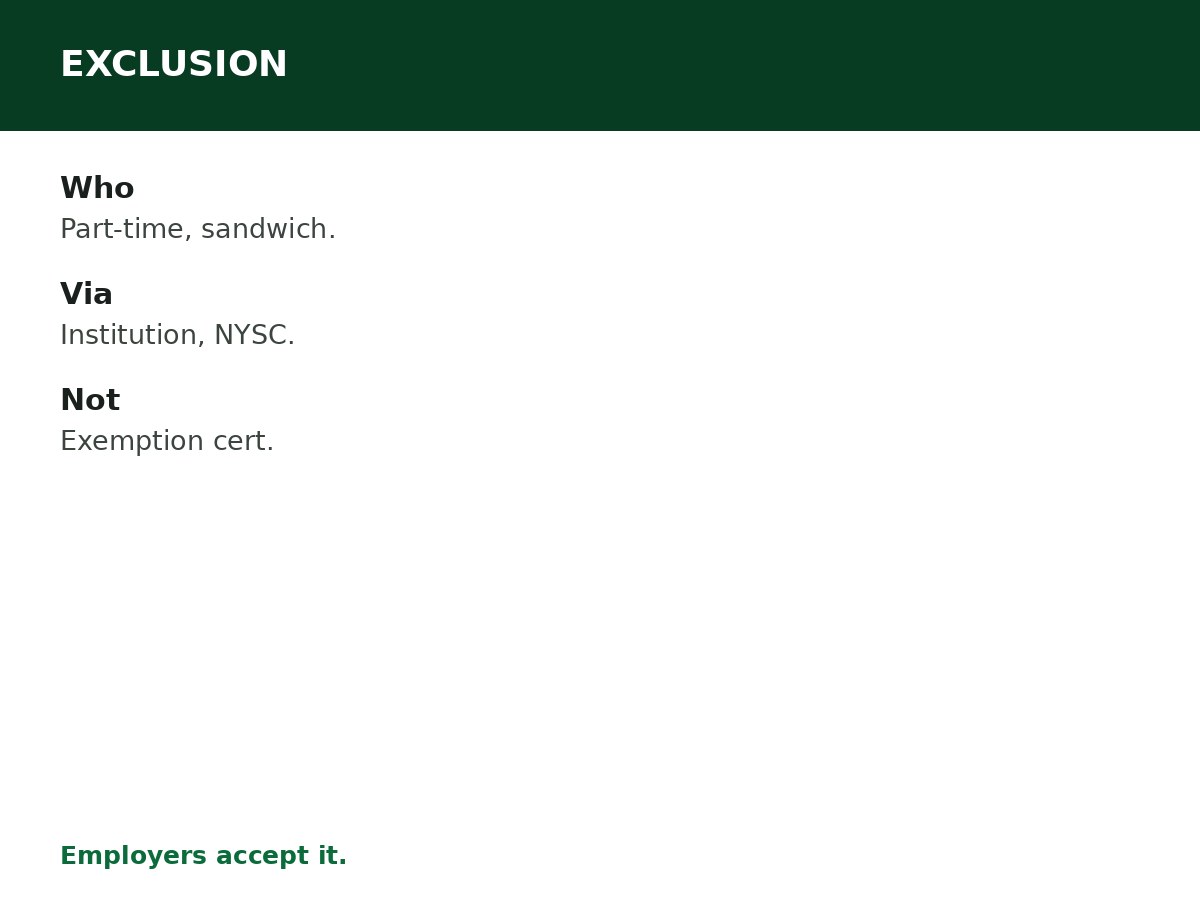
An NYSC exclusion letter is the document issued to graduates of part-time, distance-learning, and sandwich programmes — graduates who are excluded from service by programme type, not by age. It is not an exemption certificate, and the two are not interchangeable. This guide explains who gets an exclusion letter, how it is issued, and what it is used for.
Who gets an exclusion letter
- Part-time graduates — degree programmes run on a part-time basis, as your institution classifies them.
- Distance-learning graduates — programmes run by distance or open learning, as your institution classifies them.
- Sandwich graduates — sandwich programmes, as your institution classifies them.
- Programme type governs — if your programme was full-time, you do not get an exclusion letter, whatever your age or circumstances. If it was part-time, distance, or sandwich, you get an exclusion letter, not mobilisation.
How it is issued
- Your institution processes it — through student affairs and NYSC’s exclusion process, with your programme and graduation evidence.
- Evidence — degree certificate or statement of result, and programme evidence showing part-time, distance, or sandwich status, as NYSC states.
- Letter issued — through NYSC, collected as NYSC directs for your batch. Keep it safe: it is your service-equivalent document for employment, and reissue is a process, not a formality.
Exclusion letter vs exemption certificate vs discharge certificate
- Exclusion letter — programme-type exclusion (part-time, distance, sandwich).
- Exemption certificate — eligibility exclusion (age 30+ at graduation, and other NYSC-stated grounds).
- Discharge certificate — completion of the service year.
- Employers check which document you hold — presenting the wrong document, or a fake one, is a serious offence.
Scams around exclusion
- Fake exclusion letters — sold by agents, detected by verification, with serious consequences.
- Programme misclassification — claiming part-time status for a full-time programme is falsification.
- Payment demands — exclusion processing is not sold.
Related Guides & Next Steps
- NYSC 2026 Batch A, B and C: Complete Guide
- NYSC FAQs for Prospective Corps Members
- NYSC for Foreign-Trained Graduates
- NYSC Foreign Graduate Registration Requirements
- NYSC Exemption Certificate Guide
Frequently asked questions
Who gets an NYSC exclusion letter? Graduates of part-time, distance-learning, and sandwich programmes — excluded from service by programme type, not by age.
How do I get an NYSC exclusion letter? Through your institution and NYSC’s exclusion process, with programme and graduation evidence showing part-time, distance, or sandwich status.
What is the difference between exclusion letter and exemption certificate? Exclusion is by programme type (part-time, distance, sandwich); exemption is by eligibility (age 30+ at graduation, and other NYSC-stated grounds).
Is an exclusion letter accepted by employers? Yes — employers treat it as the service-equivalent document for employment purposes, in place of a discharge certificate.
Can I buy an NYSC exclusion letter? No — fake exclusion letters are detected by verification, with serious consequences.
Sources and last update
- NYSC portal: portal.nysc.org.ng (typed directly — never via a forwarded link).
- Dates, camp details, and batch-specific rules change per batch — the NYSC official timetable and announcements for the batch govern, and no batch-specific date is asserted anywhere in this article, deliberately.
- Scam patterns: agents, fake exemption or exclusion letters, and payment demands to personal accounts are red flags — NYSC documents are issued through the official portal and your institution.
- No mobilisation, deployment, exemption, or exclusion outcome is promised anywhere in this article.
Last updated: 24 October 2026. Guide — review every batch cycle, and on every NYSC announcement.

Written by Olaitan Ilori
Olaitan Ilori is the founder and lead researcher at CareerMedal. He provides verified, practical guides on Nigerian tertiary admissions (JAMB, CAPS, Post-UTME), NELFUND student finance, NYSC service-year survival, and early-career job placement.
View all guides by Olaitan Ilori →