

Administrative jobs are the organisational backbone of every company: office management, executive assistance, records, scheduling, and front-desk work, hiring fresh graduates across sectors on organisation and communication ability. This guide explains the admin pipeline, the roles fresh graduates enter, and how admin work grows into operations and management.
How admin hiring works
- Direct hiring — companies hire admin staff directly, on their own timetables, with interviews and practical tests (typing, scheduling, document handling) as each employer states.
- Outsourcing firms — some admin roles are employed through outsourcing companies. Confirm the actual employer, terms, and client before accepting.
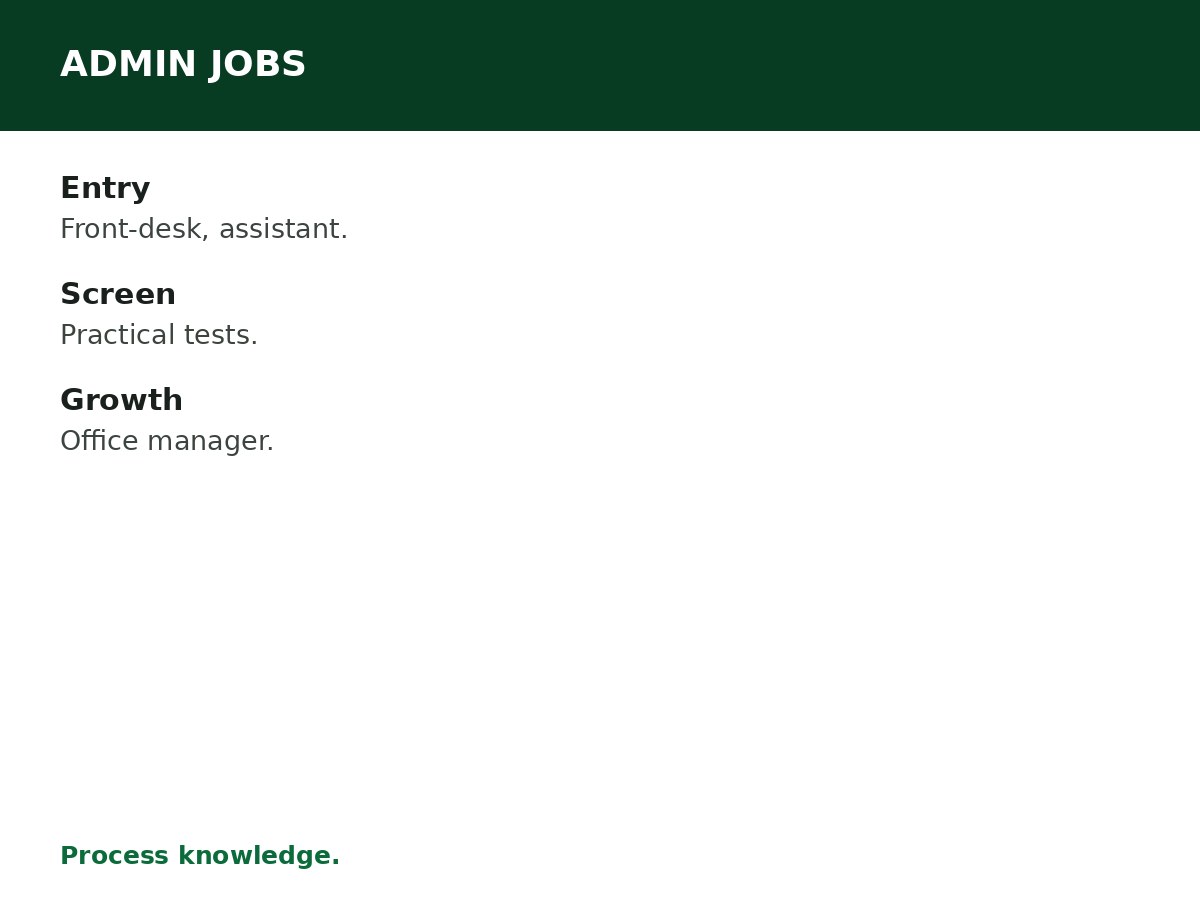
- Entry points — front-desk, office assistant, and data-entry roles, with training built in, are the commonest doors for fresh graduates.
What admin employers screen for
- Degree, HND, or OND, plus NYSC status where applicable — the baseline varies by employer and role.
- Organisation — scheduling, records, filing, and follow-through, demonstrated in practical tests and interviews, not claimed in CVs.
- Communication — clear spoken and written English, phone manner, and professional conduct.
- Digital tools — word processing, spreadsheets, email, and scheduling tools, as the role requires. Practical ability beats certificate claims.
Roles fresh graduates enter in admin
- Front-desk and reception — first contact for visitors and callers, with scheduling and message handling.
- Office and executive assistants — supporting managers and teams with scheduling, documents, and coordination.
- Records and data-entry roles — filing, database entry, and document management.
- Operations support — procurement support, logistics coordination, and facilities support, as each employer structures them.
Growth from admin
- Office manager and operations roles — the standard progression, for admin staff with strong organisation and reliability.
- Executive assistance — senior support roles for executives, with higher responsibility and discretion.
- HR, procurement, and project support — admin experience transfers into HR administration, procurement support, and project coordination, where process knowledge is valued.
Related Guides & Next Steps
- Graduate Jobs in Nigeria 2026
- Sales Jobs in Nigeria
- Human Resources Jobs in Nigeria
- Customer Service Jobs in Nigeria
Frequently asked questions
How do I get an administrative job as a fresh graduate? Through direct hiring or outsourcing firms — apply on the employer’s career page, and prepare for practical tests (typing, scheduling, document handling) and communication screening.
What qualifications do administrative jobs require? Degree, HND, or OND, plus NYSC status where applicable — the baseline varies by employer and role. Organisation and communication are the main filters.
What skills do administrative jobs need? Organisation (scheduling, records, follow-through), communication, and digital tools (word processing, spreadsheets, email, scheduling), demonstrated practically, not claimed.
Can administrative jobs lead to management? Yes — office manager and operations roles are the standard progression, and admin experience transfers into HR, procurement, and project support.
Are there fake administrative jobs? Yes — fees at any stage, fake outsourcing firms, and unpaid ‘training’ are scams. Verify the firm and client before accepting.
Sources and last update
- No company is named as currently hiring anywhere in this article, deliberately — hiring windows open and close, and a frozen company list misleads readers within months. Employer career pages, checked at application time, govern.
- No salary figure, vacancy count, or hiring outcome is asserted anywhere in this article, deliberately. Employer career pages and reputable job boards, checked at application time, govern.
- Scam patterns: application fees, training fees, payment to personal accounts, and guaranteed jobs are red flags — legitimate employers do not charge to apply.
- No job outcome is promised anywhere in this article.
Last updated: 24 October 2026. Guide — review every 3–6 months, and on major labour-market shifts.

Written by Olaitan Ilori
Olaitan Ilori is the founder and lead researcher at CareerMedal. He provides verified, practical guides on Nigerian tertiary admissions (JAMB, CAPS, Post-UTME), NELFUND student finance, NYSC service-year survival, and early-career job placement.
View all guides by Olaitan Ilori →