

IJMB (Interim Joint Matriculation Board) is a one-year advanced-level programme, run by accredited institutions, that prepares candidates for Direct Entry admission into Nigerian universities at 200 level — without writing UTME. You complete the IJMB programme in subjects relevant to your target course, sit the IJMB examination, and use your IJMB result — commonly reported as requiring 6 points or more for competitive courses — to apply for Direct Entry through JAMB’s DE form.
IJMB and JUPEB serve the same purpose through different boards. They are alternatives, not competitors: both lead to Direct Entry at 200 level, and the choice between them depends on which board’s result your target institutions and courses accept, for the session.
IJMB requirements
- O’Level requirements: five credit passes including English Language and, for most courses, Mathematics, in course-relevant subjects, in not more than two sittings — the standard baseline, required before or alongside IJMB registration (confirm the specific centre’s rules for the session).
- IJMB programme completion: the one-year programme at an IJMB-accredited centre, in subjects relevant to your target course. Your subject choices must match your target course’s requirements — an IJMB combination in the wrong subjects does not support a DE application for that course.
- IJMB examination result: the examination, administered by the IJMB board, produces a points-based result. Commonly reported thresholds: 6 points or more for competitive courses, with university thresholds above the floor deciding — the receiving institution’s brochure entry for the course, for the session, governs.
- JAMB Direct Entry form: after the IJMB result, you apply through JAMB’s DE form (profile code, ePIN, Professional Registration Centre), choosing institutions whose DE requirements your IJMB result meets.
- Institutional screening: DE screening by the receiving institution, as it runs it (document verification, and in some cases an exam or interview), followed by CAPS admission in the same way as other DE routes.
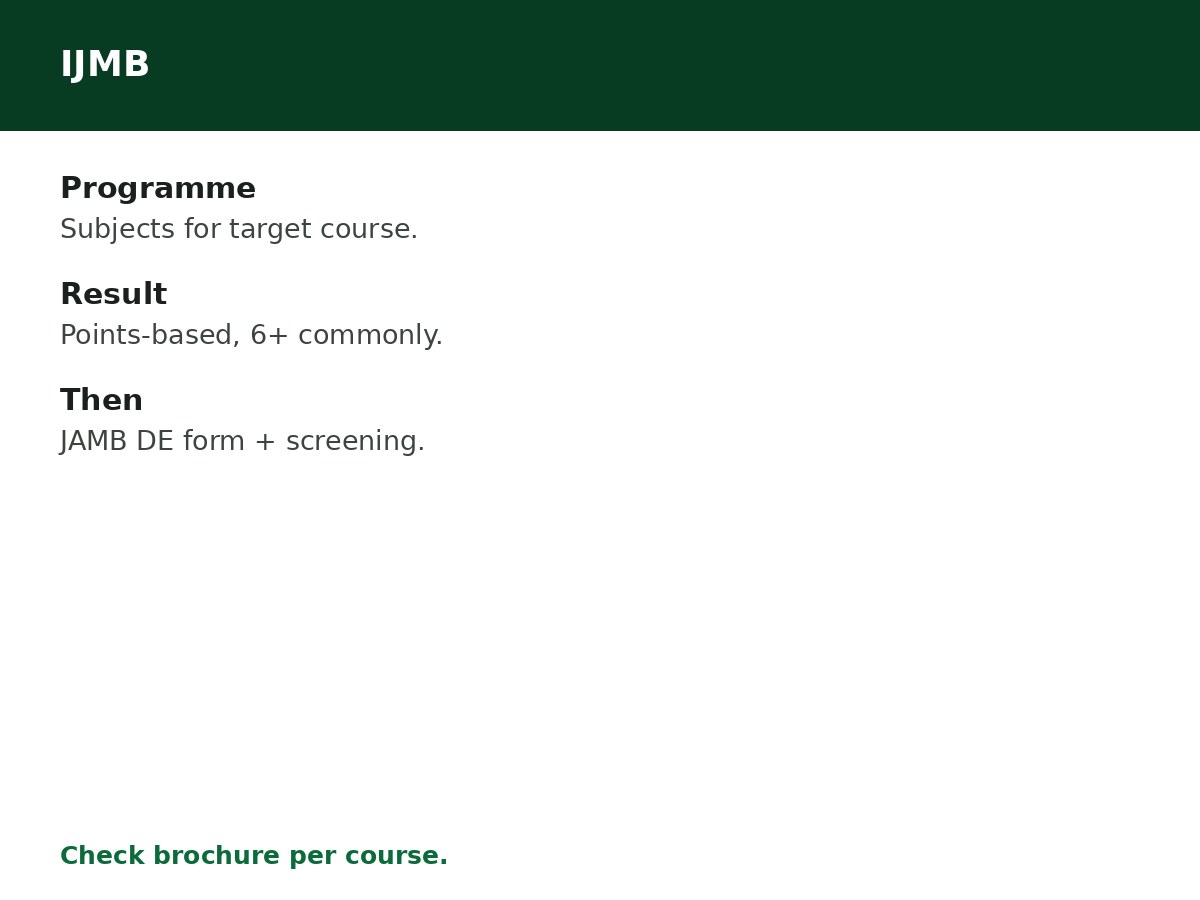
How IJMB works, step by step
- Choose an IJMB-accredited centre — confirm accreditation before registering. A programme at a non-accredited centre does not produce a recognised IJMB result, and the fee paid there is lost.
- Register for the one-year programme in subjects matching your target course, with your O’Level results meeting the baseline requirements.
- Complete the programme — lectures, continuous assessment, and preparation for the board examination, over the academic year.
- Sit the IJMB examination and obtain your points-based result.
- Apply for Direct Entry through JAMB’s DE form, choosing institutions and courses whose DE thresholds your result meets.
- Institutional screening and CAPS admission, as with other DE routes — then entry at 200 level in the course admitted for, subject to the institution’s course-matching rules.
IJMB vs JUPEB: how to choose
| IJMB | JUPEB | |
|---|---|---|
| Board | Interim Joint Matriculation Board | Joint Universities Preliminary Examinations Board |
| Duration | One year | One year |
| Subjects | As the programme structures them, relevant to target course | Three + general studies |
| Outcome | Points-based result → DE at 200 level | Points-based result → DE at 200 level |
| Acceptance | Universities that accept IJMB for DE (check brochure per course) | Universities that accept JUPEB for DE (check brochure per course) |
The deciding factor is not which board is “better” — it is which board’s result your target institutions and courses accept, for the session. Check the JAMB brochure for each target course: it states the accepted DE qualifications. Some institutions accept both; some accept one; and acceptance can change between sessions.
Related Guides & Next Steps
- Direct Entry Admission Explained
- JAMB Direct Entry Registration Guide
- JUPEB Admission: Requirements and How It Works
- How University Admission Works in Nigeria
- 2026/2027 University Admission Guide for Nigerian Students
Frequently asked questions
What is IJMB? A one-year advanced-level programme, run by accredited institutions, that prepares candidates for Direct Entry admission into Nigerian universities at 200 level, without UTME.
How many points do I need in IJMB? Commonly reported thresholds are 6 points or more for competitive courses, with university thresholds above the floor deciding. The receiving institution’s brochure entry for the course, for the session, governs.
Is IJMB better than JUPEB? Neither is universally better. Choose by which board’s result your target institutions and courses accept, for the session — check the JAMB brochure per course.
Can I use IJMB for any course? No — your IJMB subjects must match your target course’s requirements, and the receiving institution must accept IJMB for that course. Subject and institution matching must both hold.
What if my IJMB centre is not accredited? Your result may not be recognised for Direct Entry, and your programme fee is at risk. Confirm accreditation before registering — it is the single most important check in the IJMB process.
Sources and last update
- IJMB structure (one-year programme, subjects relevant to target course, points-based result, DE at 200 level, 6-point commonly reported threshold, brochure authority) from IJMB and DE guides, as compiled by CareerMedal.
- JUPEB comparison from the JUPEB guide (Batch 13), with per-course brochure confirmation directed.
- No IJMB fee, centre list, or grade-point table is asserted — all are board-, centre-, and session-specific.
Last updated: 24 October 2026. Guide — review every admission session and on every IJMB board update.

Written by Olaitan Ilori
Olaitan Ilori is the founder and lead researcher at CareerMedal. He provides verified, practical guides on Nigerian tertiary admissions (JAMB, CAPS, Post-UTME), NELFUND student finance, NYSC service-year survival, and early-career job placement.
View all guides by Olaitan Ilori →