

This is the 2026–2027 university admission guide: the complete admission process for the current cycle, from UTME registration through screening, CAPS admission, acceptance, and resumption — with the session’s policy figures stated, and every figure flagged for re-verification when the next cycle’s official announcements land. It is written as the current-cycle process guide, not as a frozen snapshot: when JAMB or an institution announces a change for the next cycle, this guide is updated in place, at this URL, and the change is noted in the update log below.
If you are reading this guide in a later cycle, check the update log first — it states which cycle’s figures the guide currently reflects, and what changed since.
The 2026–2027 cycle at a glance
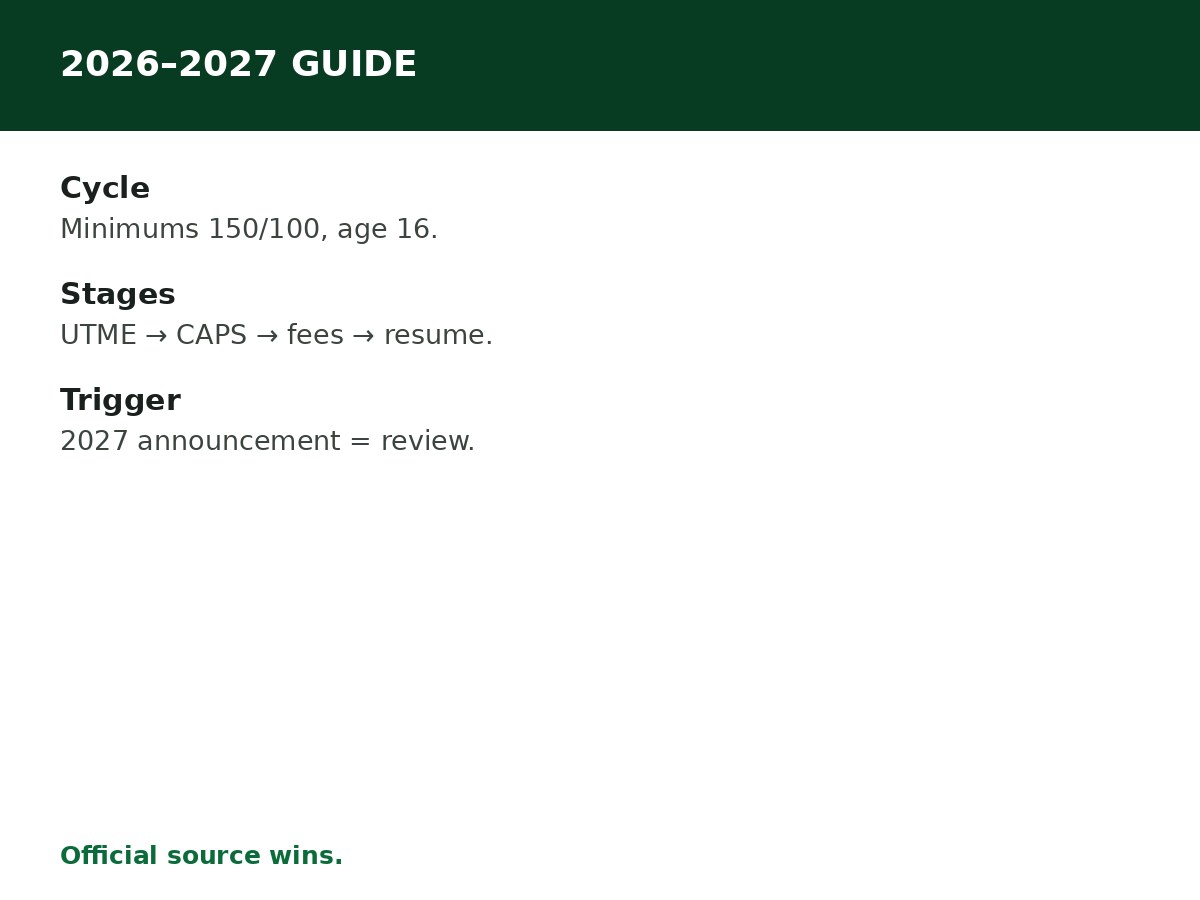
- JAMB policy minimums for 2026 (as reported): universities 150, nursing 150, polytechnics/monotechnics/agriculture/colleges of education/IEI 100, minimum age 16. These are floors for consideration, not departmental cut-offs and not guarantees — departmental cut-offs run higher for competitive courses, and 2027 minimums are not yet set.
- 2026 cut-off bands (as reported): 150 floor; 160 (ATBU, BUK, FUNAAB, UNIZIK, OOU, UNIOSUN, KWASU, MAUTECH); 170 (UNIJOS, Babcock, LAUTECH, Fed Univ of Applied Sciences); 180 (ABU, Yakubu Gowon, UNILORIN, and many others); 185 (LASU Education); 195 (LASU, LASUSTECH); 200 (OAU, UNIBEN, UI, UNILAG, UNN, Covenant, AFIT); 220 (Pan-Atlantic). These are institution minimums for screening consideration, as reported — verify per institution, per session, before applying.
- Admission stages (unchanged across cycles): UTME with JAMB → institution screening (Post-UTME) → institution proposal → JAMB approval on CAPS → your acceptance on CAPS → admission letters → acceptance fee → clearance → school fees → course registration → resumption. The stages do not change; the dates, fees, and cut-offs do.
The full process, step by step
Step 1: UTME registration. Profile code (NIN SMS to 55019/66019), ePIN, registration at an accredited CBT centre, four subjects (English compulsory + three course-relevant subjects, per the brochure), institution and course choices. See the JAMB cluster guides for registration, profile code, subject combinations, and corrections.
Step 2: UTME examination and result. Computer-based test, result out of 400, result checking online and by SMS. A score meeting your institution’s minimum qualifies you for screening; departmental cut-offs decide your course.
Step 3: Institution screening (Post-UTME). First-choice status (in most cases), screening form and fee through the official portal only, format as the institution runs it for the session (exam, screening-only aggregate, or physical verification). See the Post-UTME and screening guides.
Step 4: Admission proposal and CAPS approval. Institution ranking by department, proposal to JAMB on CAPS (“Admission in Progress”), JAMB approval (“Admitted”), with merit, catchment, and ELDS considerations as applicable. See the admission-works and CAPS guides.
Step 5: Acceptance and letters. Accept on CAPS promptly (unanswered offers can expire), print the JAMB admission letter from e-Facility (paid service) and obtain the institution’s letter from its portal. See the after-admission and letter guides.
Step 6: Fees and clearance. Acceptance fee (one-off, official portal, by deadline — missing it risks the offer), school fees (per session, official portal, or NELFUND coverage where verified), clearance with originals and photocopies. See the acceptance, school-fees, and freshers guides.
Step 7: Registration and resumption. Course registration within the window, accommodation and funding sorted early, orientation attended, records kept for the programme’s duration. See the freshers checklist.
Alternative routes in this cycle
- Direct Entry: advanced qualification + JAMB DE form, no UTME, 200-level entry, institutional screening, CAPS admission. See the DE guides.
- IJMB/JUPEB: one-year programmes at accredited centres, points-based results, then DE form. See the IJMB and JUPEB guides.
- Pre-degree/remedial: one-year preparatory programmes at a university, for 100-level entry at that university (pre-degree for candidates meeting O’Level requirements; remedial for deficiency repair). See the pre-degree and remedial guides.
- Part-time and distance learning: same JAMB routes (part-time) or ODL models (open universities without UTME; conventional DLCs with JAMB routes), with programme-specific rules. See the part-time, distance, and open-university guides.
- Open universities: NOUN, Miva, Iconic — O’Level admission without UTME, distance study, NUC programme approval required. See the open-university guide.
Warnings that apply every cycle
- No agent can create a CAPS offer. Guaranteed admission, runs, fake portals, reopened windows, and fee-charging “helpers” are scams, every cycle, without exception.
- No fee figure in this guide is permanent. Screening fees, acceptance fees, school fees, and DE fees are institution-, course-, and session-specific — confirm each on the official portal for the cycle you are applying in.
- No cut-off in this guide is permanent. Departmental cut-offs move every session with competition and places — verify per institution, per session, before applying.
- No list in this guide is permanent. Institution lists (low scores, lowest cut-offs, no screening, two sittings) must be re-verified institution-by-institution each session.
Update log
- 24 October 2026: Guide created for the 2026–2027 cycle, with 2026 policy figures as reported (minimums 150/100, age 16, cut-off bands 150–220) and the full process linked to the cluster’s guides. Next review trigger: official 2027 JAMB policy announcement, or any institution’s 2027 screening notice — whichever lands first.
Related Guides & Next Steps
- How University Admission Works in Nigeria
- JAMB Admission FAQs for Nigerian Candidates
- University Admission Questions Students Ask Most
- Post-UTME Explained: Requirements, Screening and Admission
Frequently asked questions
Is this guide current for my cycle? Check the update log above — it states which cycle’s figures the guide currently reflects. If you are applying in a later cycle, verify dates, fees, and cut-offs on JAMB’s and your institutions’ official pages before acting on any figure here.
What changed between cycles? Dates, fees, cut-offs, and screening formats change between cycles; the stages (UTME → screening → proposal → CAPS approval → acceptance → fees → clearance → registration) do not. The update log records each cycle’s changes.
Where do I find the detail for each step? Each step above links to the cluster’s full guide for that step — the full guides govern where they differ in detail from this summary.
What if a figure here conflicts with an official announcement? The official announcement governs. This guide is updated in place when official announcements land — and until it is updated, the official source wins.
Should I apply based on this guide alone? No — use this guide to understand the process and plan, and confirm every date, fee, and cut-off on JAMB’s and your institutions’ official pages for your cycle before paying or applying.
Sources and last update
- 2026 policy figures (minimums 150/100, age 16, cut-off bands 150–220) from JAMB’s 2026 policy figures as reported, with per-session verification directed.
- Process stages and route summaries from the cluster’s guides, each linked above — the full guides govern where they differ in detail.
- This guide is a current-cycle process guide with a per-session review trigger, on the same pattern as the NELFUND complete guide — not a frozen 2026/2027 snapshot.
Last updated: 24 October 2026. Update hub — review on official 2027 JAMB policy announcement or any institution’s 2027 screening notice, whichever lands first.

Written by Olaitan Ilori
Olaitan Ilori is the founder and lead researcher at CareerMedal. He provides verified, practical guides on Nigerian tertiary admissions (JAMB, CAPS, Post-UTME), NELFUND student finance, NYSC service-year survival, and early-career job placement.
View all guides by Olaitan Ilori →