
Transitioning from NYSC to employment means converting service-year experience — PPA work, CDS projects, and skills — into job applications, before and after discharge, without claiming discharge before it is issued. This guide covers NYSC-to-employment transition specifically, distinct from the NYSC cluster (which covers service processes) and the graduate CV guide (which covers CV content).
Before discharge: prepare
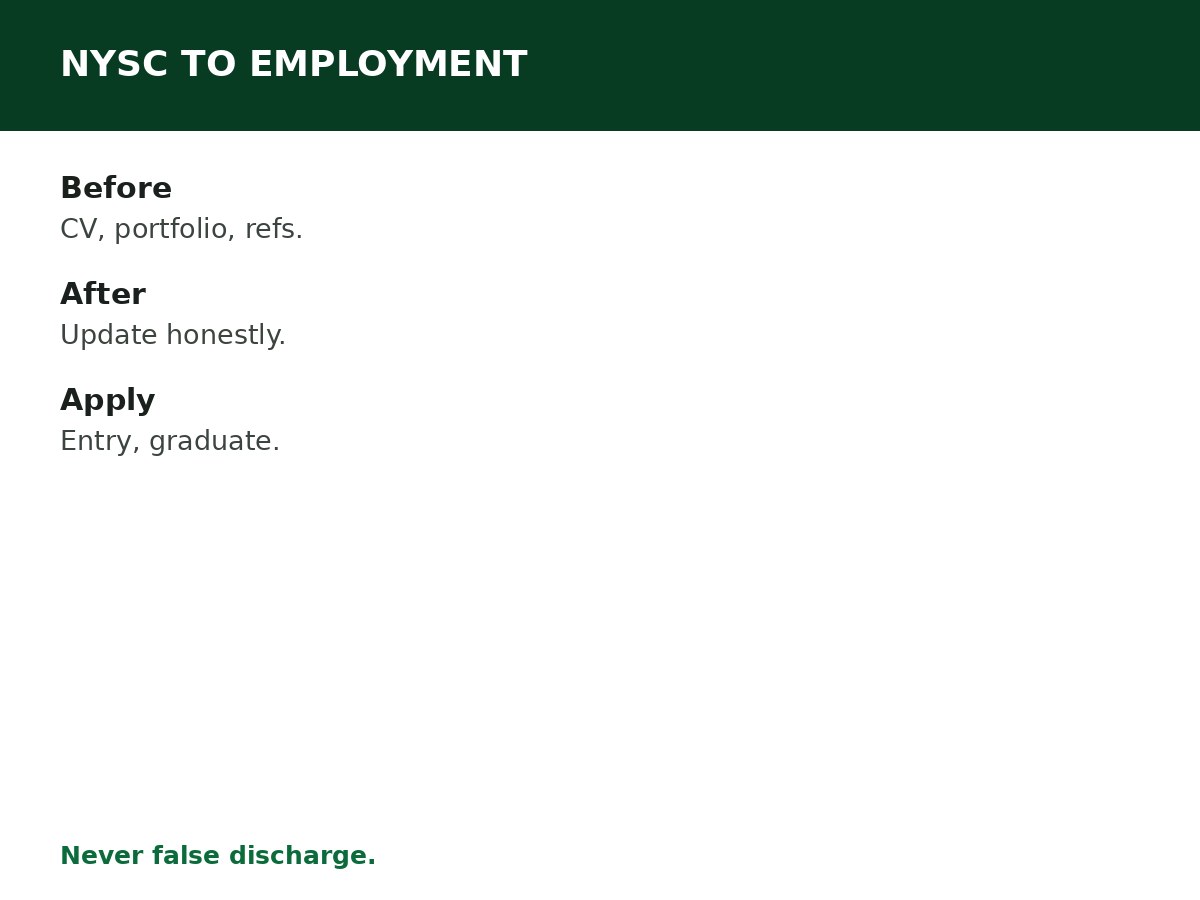
- CV and portfolio ready — CV, with NYSC status stated honestly as ‘Currently Serving’, and portfolio, with PPA and CDS projects, prepared before discharge, as the CV and portfolio guides cover.
- Applications started — applications, for roles starting after discharge, started before discharge, where employers state post-discharge start dates, as job descriptions state.
- References secured — PPA supervisors, and CDS coordinators, where appropriate, as references, with permission, secured before leaving, for employer checks.
- Skills documented — PPA skills, CDS skills, and projects, documented with evidence, for applications, as the portfolio guide covers.
After discharge: apply
- Status updated honestly — CV and applications, updated to ‘NYSC Discharge, [Year]’, with certificate number where applications request it, after discharge is issued, never before.
- Target entry-level and graduate roles — entry-level, graduate, and trainee roles, as job descriptions state, for first post-NYSC employment, as the Jobs cluster covers.
- Apply widely, track everything — applications tracked (role, employer, date, status), for follow-up, as the follow-up rule states.
- Follow up once, politely — after the stated timeline, or 2–3 weeks of silence, as the follow-up rule states, never before the deadline, never repeatedly.
Transition mistakes
- Claiming discharge before discharge — serving corps members claiming discharge, before it is issued, fail background checks. State current status honestly, always.
- Waiting until after discharge to prepare — waiting until discharge, to prepare CVs, portfolios, and applications, losing months, as the market states. Prepare before discharge.
- Generic applications — one generic CV and cover letter, sent everywhere, losing to tailored applications, matching each role.
- Rejecting entry-level roles — rejecting entry-level roles, for senior roles requiring years of experience, wasting applications, as the market states.
If employment is slow
- Freelance and projects — freelance gigs, personal projects, and volunteer work, building proof, while applying, as the freelancing and portfolio guides cover.
- Further skills — short courses with projects, building skills with evidence, not certificates alone, as the skill guides cover.
- Keep applying — applications, continued, while building proof, not paused for one employer, as the market states.
Related Guides & Next Steps
- How to Write a CV With No Work Experience
- Career Options for Arts Students
- Career Options for Science Students
- How to Get Your First Remote Job
Frequently asked questions
How do I transition from NYSC to employment? By preparing CVs, portfolios, and references before discharge, starting applications for post-discharge roles, updating status honestly after discharge is issued, and applying widely to entry-level and graduate roles, with follow-up once, politely.
Should I claim discharge before it is issued? No — serving corps members state current status honestly, never claiming discharge before discharge. False discharge claims fail background checks.
When should I start applying for jobs after NYSC? Before discharge, for roles starting after discharge, where employers state post-discharge start dates — and widely after discharge, with CVs and portfolios prepared in advance.
What should I do if post-NYSC employment is slow? Build proof through freelance gigs, personal projects, volunteer work, and short courses with projects, while continuing applications, not pausing for one employer.
Should I update my CV after discharge? Yes — CV and applications, updated to ‘NYSC Discharge, [Year]’, with certificate number where applications request it, after discharge is issued, never before.
Sources and last update
- No salary figure, vacancy count, or hiring outcome is asserted anywhere in this article, deliberately — employer career pages and reputable boards, checked at application time, govern.
- No company is named as currently hiring anywhere in this article, deliberately — hiring windows open and close; employer career pages govern.
- Scam patterns: fees for jobs, payment to personal accounts, guaranteed jobs or placements, and career coaching selling fake credentials are red flags — verify every employer and programme on official channels before applying or paying anything.
- No job, salary, placement, or hiring outcome is promised anywhere in this article.
Last updated: 24 October 2026. Guide — review every 6–12 months, and on every major hiring-platform change.

Written by Olaitan Ilori
Olaitan Ilori is the founder and lead researcher at CareerMedal. He provides verified, practical guides on Nigerian tertiary admissions (JAMB, CAPS, Post-UTME), NELFUND student finance, NYSC service-year survival, and early-career job placement.
View all guides by Olaitan Ilori →