

Listing internship experience on your CV means presenting internships, SIWES, and attachments — with roles, responsibilities, and results — in the format employers expect. This guide covers internship entries specifically, distinct from the graduate CV guide (which covers graduate CVs broadly) and the internship guides in the Jobs cluster (which cover finding internships).
How to list internships
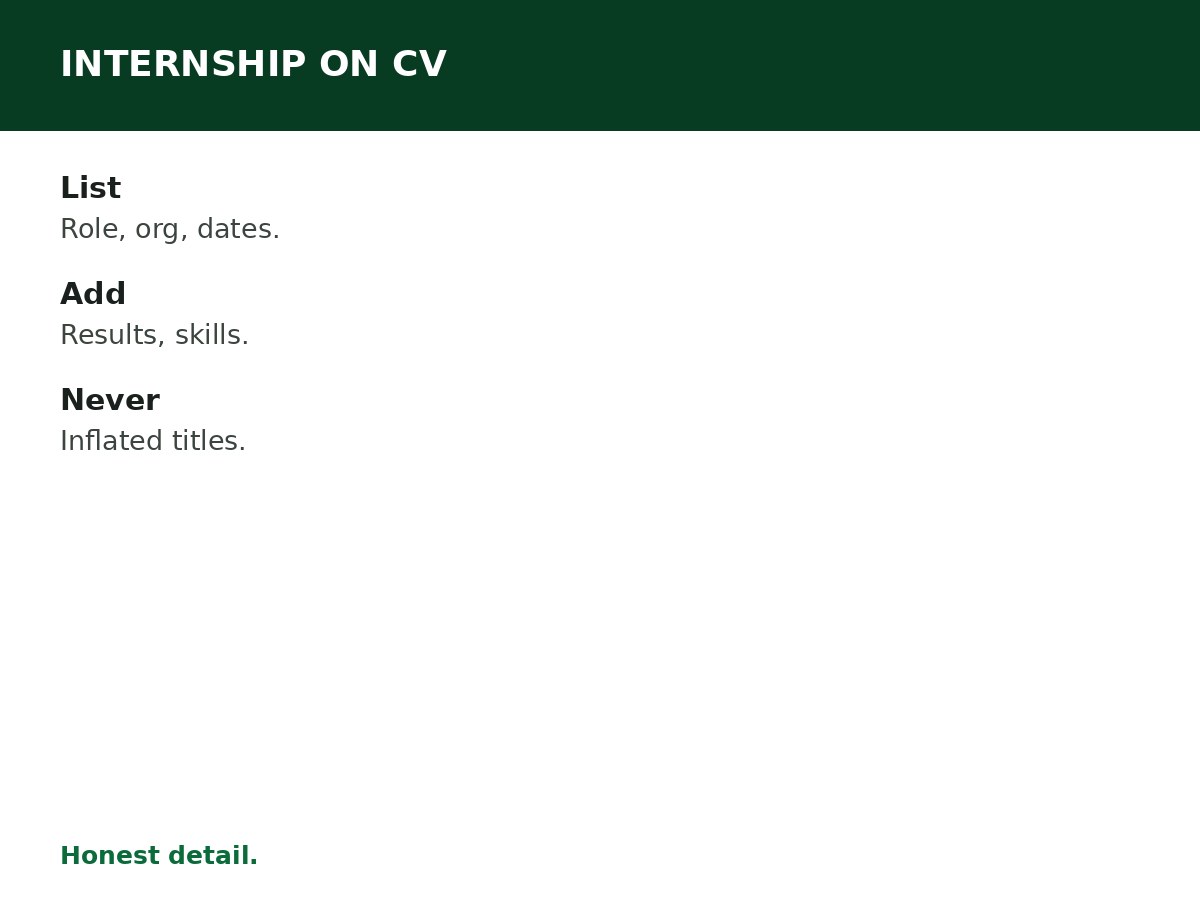
- Role, organisation, dates — internship title, organisation, and dates, most recent first, as employers state.
- Responsibilities with results — 2–4 bullet points, per internship, on responsibilities and results, where measurable, not duty lists without outcomes.
- Skills demonstrated — skills used and learned, where relevant to the role, highlighted, for employer matching.
- SIWES and attachments — SIWES, industrial training, and attachments, listed as internships, with the same format, as employers state.
Internship entry examples (original, adaptable)
- Example — ‘Marketing Intern, [Company], [Dates] — Managed social media content, growing followers by [result, where measurable]; supported campaign reporting, with weekly analytics summaries; assisted event planning, for [event, where relevant].’
- Adapt, do not copy — examples are templates, not text to copy. Adapt wording to your internship, responsibilities, and results, honestly, for every application.
- Results where measurable — results, where measurable and honest, strengthen entries. Unmeasurable work, described by responsibilities, is legitimate without invented numbers.
Internship mistakes
- Inflated titles — inflated internship titles, and invented responsibilities, are fraud, and reference checks expose them.
- Duty lists without results — duty lists (‘responsible for filing’), without outcomes, waste CV space. Add results, where measurable, or skills demonstrated.
- Omitting internships — omitting internships, where employers value them, loses to applicants who list them. List all relevant internships, with honest detail.
- Vague dates — vague or missing dates, raising employer questions. State dates clearly, for every internship.
Internships plus references
- Supervisors as references — internship supervisors, where appropriate, as references, with permission, for employer checks.
- SIWES reports as proof — SIWES reports, and internship reports, where available, as proof, for employer review, where requested.
- Portfolio links — internship projects, where available, linked in portfolios, for employer trust, as the portfolio guide covers.
Related Guides & Next Steps
- How to Write a CV With No Work Experience
- How to Write a Cover Letter in Nigeria
- Cover Letter Examples for Fresh Graduates
- How to List NYSC on Your CV
Frequently asked questions
How do I list internship experience on my CV? By stating role, organisation, and dates, most recent first, with 2–4 bullet points per internship, on responsibilities and results, where measurable.
Should I list SIWES on my CV? Yes — SIWES, industrial training, and attachments, listed as internships, with the same format, as employers state.
How many bullet points per internship? 2–4 bullet points, per internship, on responsibilities and results, where measurable, not duty lists without outcomes.
Should I invent results for internship entries? No — results, where measurable and honest, strengthen entries. Unmeasurable work, described by responsibilities, is legitimate without invented numbers.
Can internship supervisors be references? Yes — internship supervisors, where appropriate, as references, with permission, for employer checks.
Sources and last update
- No salary figure, vacancy count, or hiring outcome is asserted anywhere in this article, deliberately — employer career pages and reputable boards, checked at application time, govern.
- No company is named as currently hiring anywhere in this article, deliberately — hiring windows open and close; employer career pages govern.
- Scam patterns: fees for jobs, payment to personal accounts, guaranteed jobs or shortlisting, and CV services selling fake experience are red flags — verify every employer on official channels before applying or paying anything.
- No job, shortlisting, or hiring outcome is promised anywhere in this article.
Last updated: 24 October 2026. Guide — review every 6–12 months, and on every major hiring-platform change.

Written by Olaitan Ilori
Olaitan Ilori is the founder and lead researcher at CareerMedal. He provides verified, practical guides on Nigerian tertiary admissions (JAMB, CAPS, Post-UTME), NELFUND student finance, NYSC service-year survival, and early-career job placement.
View all guides by Olaitan Ilori →