
An official government recruitment portal belongs to the recruiting agency or its official recruitment platform, is announced on the agency’s official website, and charges nothing. This guide teaches portal identification specifically — distinct from the 2026 verification playbook (which covers openings) and the fake-portals guide (which covers site-level red flags). Learn to identify a real portal, and fakes lose their main weapon.
What an official portal looks like
- Agency-owned domain — the portal domain belongs to the agency, or to an official government recruitment platform the agency names in its announcement. Type it yourself; do not click shortlinks.
- Announced by the agency — the portal is named in the agency’s official announcement, on its official website and verified channels. A portal nobody official names is not official.
- Free application — official portals never charge application, test, training, or placement fees.
- Structured process — application form, document upload, application reference, and status tracking, as the agency states, not WhatsApp chats and personal-email submissions.
How to check a portal
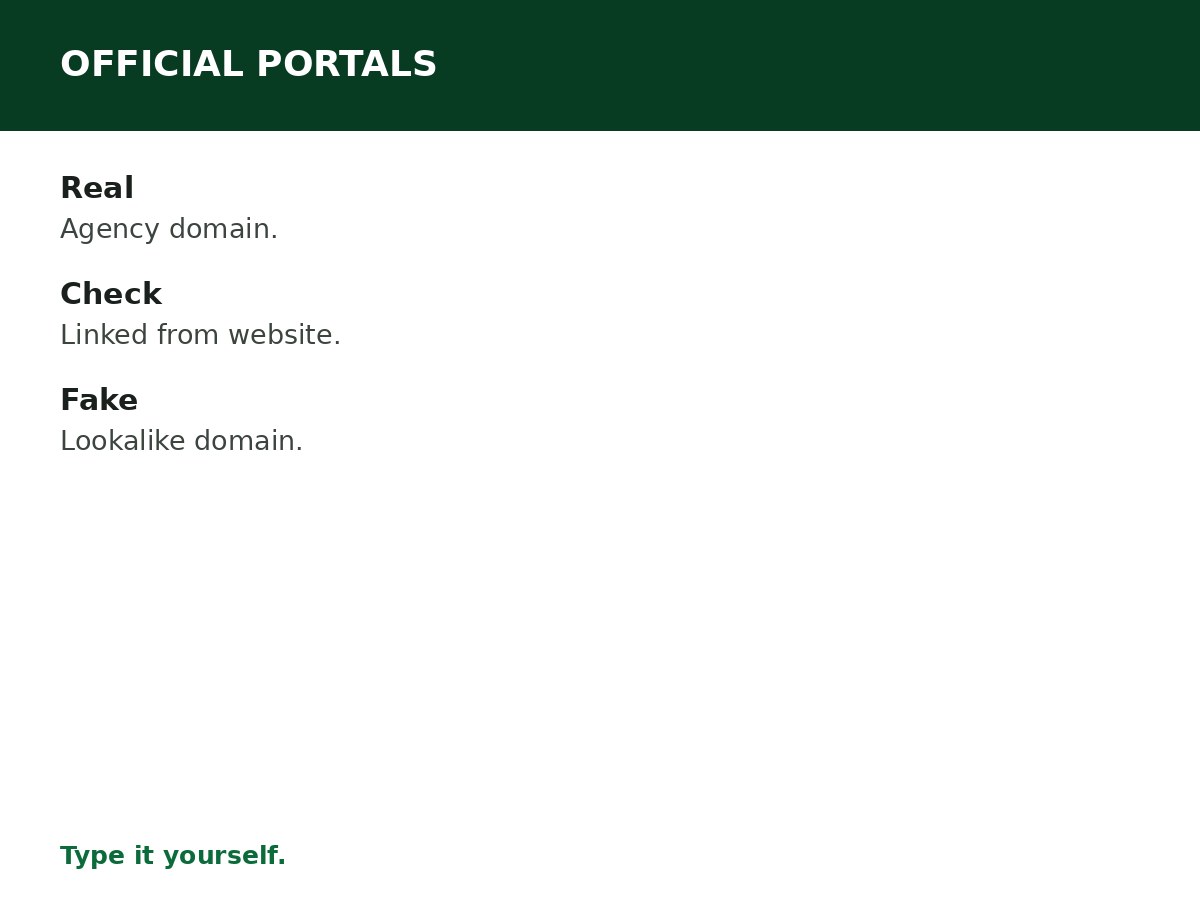
- Start from the agency’s official website — typed directly. Follow its recruitment link to the portal. If the agency’s site does not link to the portal, the portal is suspect.
- Check the domain carefully — lookalike domains (extra words, hyphens, wrong endings, misspellings) are the commonest fake-portal tell. Compare character by character.
- Check for official announcement — search the agency’s official channels for the recruitment announcement naming this portal.
- Check the process — official portals collect applications and documents through forms, with reference numbers. Portals demanding payment, or collecting applications via WhatsApp, are fake.
- Check contact details — official portals list verifiable agency contacts. Portals with only WhatsApp numbers or free-email contacts are suspect.
Portal vs official website — the distinction
- Official website — the agency’s main site, with information about the agency, its mandate, and its announcements.
- Recruitment portal — a dedicated application platform, linked from the official website during recruitment windows, for submitting applications.
- Both must agree — the official website must name the portal, and the portal must match the official announcement. Either one alone, without the other, is unverified. (See the portal-vs-website guide for the full comparison.)
Related Guides & Next Steps
- Federal Government Recruitment 2026: How to Verify Openings
- Government Recruitment FAQs for Nigerian Applicants
- Federal Civil Service Recruitment Guide
- Federal Government Jobs for Graduates
Frequently asked questions
How do I identify an official government recruitment portal? It belongs to the agency or its official platform, is named in the agency’s official announcement, is linked from the agency’s official website, charges nothing, and runs a structured application process with reference numbers.
What is the difference between a recruitment portal and an official website? The official website is the agency’s main site with information and announcements; the recruitment portal is a dedicated application platform, linked from the official website during recruitment windows.
Should a government recruitment portal charge a fee? No — official portals never charge application, test, training, or placement fees. Any fee demand means the portal is fake.
How do I check if a portal domain is real? Start from the agency’s official website (typed directly), follow its recruitment link, and compare the domain character by character — lookalike domains are the commonest fake-portal tell.
What if a portal is not linked from the agency’s website? Treat it as suspect — contact the agency through its official contact to ask whether the portal is genuine, before applying or submitting documents.
Sources and last update
- No agency is named as currently recruiting anywhere in this article, deliberately — recruitment windows open and close, and a frozen list misleads readers within months. Official portals and announcements, checked at application time, govern.
- No salary figure, vacancy count, or recruitment outcome is asserted anywhere in this article, deliberately. Official announcements and portals, checked at application time, govern.
- Scam patterns: ‘slot’ sellers, application fees, payment to personal accounts, and guaranteed appointments are red flags — government recruitment is free, and runs through official portals only.
- No appointment, shortlisting, or recruitment outcome is promised anywhere in this article.
Last updated: 24 October 2026. Guide — review every 3–6 months, and on every official recruitment announcement.

Written by Olaitan Ilori
Olaitan Ilori is the founder and lead researcher at CareerMedal. He provides verified, practical guides on Nigerian tertiary admissions (JAMB, CAPS, Post-UTME), NELFUND student finance, NYSC service-year survival, and early-career job placement.
View all guides by Olaitan Ilori →