
Getting your first remote job means selling skills, portfolio, and self-management — to employers who hire remotely — through platforms, direct applications, and proof, not office presence. This guide covers first remote jobs specifically, distinct from the remote jobs guide in the Jobs cluster (which covers remote roles broadly) and the freelancing guide (which covers freelance work).
What remote employers want
- Skills with proof — portfolio, projects, and results, demonstrating skill, for remote hiring, where managers cannot observe work directly, as the market states.
- Self-management — time management, communication, and reliability, demonstrated by projects and references, as employers state, for remote trust.
- Communication skills — written communication, responsiveness, and clarity, as employers state, for distributed teams.
- Tools familiarity — collaboration tools, as each employer states, learned through projects, for remote work readiness.
How to get a first remote job
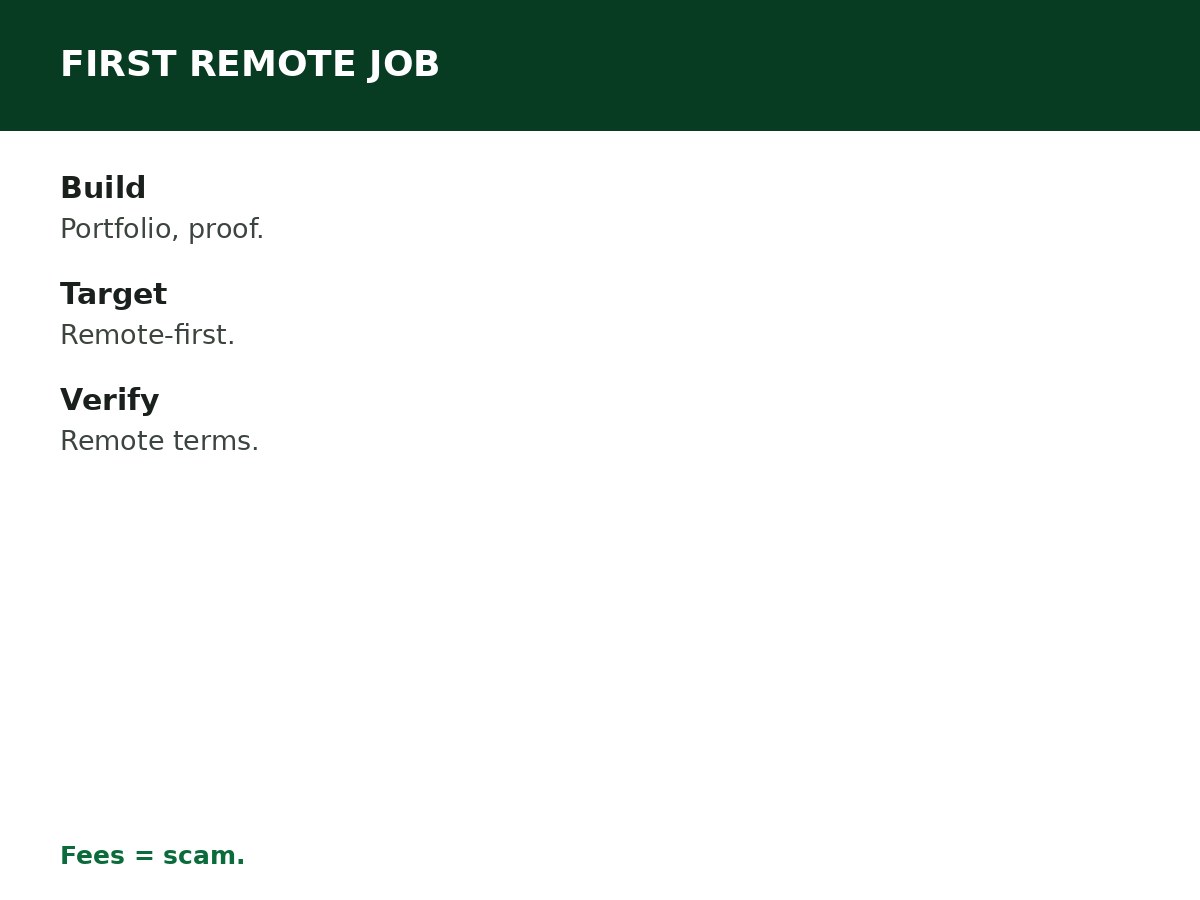
- Build remote-ready proof — portfolio, deployed projects, and measured results, as the portfolio guide covers, for remote hiring.
- Target remote-first employers — employers hiring remotely, as job descriptions state, not office roles mislabelled as remote.
- Apply through platforms and directly — remote job platforms, and direct employer applications, as the Jobs cluster covers, for coverage.
- Prepare for remote interviews — virtual interview preparation, as the prepare and dress guides cover, with technology checked.
- Follow up once, politely — after the stated timeline, or 2–3 weeks of silence, as the follow-up rule states, never before the deadline, never repeatedly.
First remote job mistakes
- No portfolio, no proof — applications without portfolio or projects, losing to proof-based applicants, as remote employers state.
- Office roles mislabelled as remote — roles requiring office presence, mislabelled as remote, wasting applications, as the market states. Verify remote terms, as job descriptions state.
- Poor virtual interview setup — untested technology, poor lighting, and noisy backgrounds, harming virtual interviews, as the market states.
- Remote job scams — remote roles demanding fees, personal details, or unpaid ‘tests’, are scams, as the Jobs cluster covers. Verify every employer, before applying or paying anything.
After a first remote job
- Remote work habits — schedules, communication routines, and delivery habits, built early, for remote success, as employers state.
- References and proof — remote work results, and supervisor references, for future applications, as the CV guides cover.
- Growth and specialisation — deeper skills and niches, as experience grows, for remote career progression, as the market states.
Related Guides & Next Steps
- How to Write a CV With No Work Experience
- How to Transition From NYSC to Employment
- Career Options for Arts Students
- How to Get Your First Internship
Frequently asked questions
How do I get my first remote job? By building remote-ready proof (portfolio, deployed projects, measured results), targeting remote-first employers, applying through platforms and directly, preparing for virtual interviews, and following up once, politely.
What do remote employers want? Skills with proof, self-management, communication skills, and tools familiarity — demonstrated by portfolio, projects, and references, as the market states.
Should I apply for office roles labelled as remote? No — roles requiring office presence, mislabelled as remote, waste applications, as the market states. Verify remote terms, as job descriptions state.
What if a remote job asks for fees? It is a scam — remote roles demanding fees, personal details, or unpaid ‘tests’, are scams, as the Jobs cluster covers. Verify every employer, before applying or paying anything.
How should I prepare for remote interviews? With virtual interview preparation, as the prepare and dress guides cover, with technology, lighting, and background checked, and full professional dress.
Sources and last update
- No salary figure, vacancy count, or hiring outcome is asserted anywhere in this article, deliberately — employer career pages and reputable boards, checked at application time, govern.
- No company is named as currently hiring anywhere in this article, deliberately — hiring windows open and close; employer career pages govern.
- Scam patterns: fees for jobs, payment to personal accounts, guaranteed jobs or placements, and mentorship or networking schemes selling access are red flags — verify every employer and programme on official channels before applying or paying anything.
- No job, salary, placement, or hiring outcome is promised anywhere in this article.
Last updated: 24 October 2026. Guide — review every 6–12 months, and on every major hiring-platform change.

Written by Olaitan Ilori
Olaitan Ilori is the founder and lead researcher at CareerMedal. He provides verified, practical guides on Nigerian tertiary admissions (JAMB, CAPS, Post-UTME), NELFUND student finance, NYSC service-year survival, and early-career job placement.
View all guides by Olaitan Ilori →