

There is no single national aggregate formula. Each institution sets its own formula, and your aggregate is only meaningful on that institution’s scale. Anyone giving you one universal formula without naming the institution is misleading you — politely, but misleading you.
What this guide does is teach you the three formulas institutions actually use, with worked examples you can check, so you can calculate your aggregate correctly once you know which formula your institution uses. The first step, always, is to find your institution’s formula in its admission notice. Everything below follows from that.
First: what an aggregate is
Your UTME score (out of 400) is not your aggregate. Your aggregate is the combined score an institution uses to rank candidates for a course, usually combining UTME with Post-UTME/screening and sometimes O’Level grades. Two candidates with the same UTME score can have different aggregates at the same institution, because their Post-UTME scores or O’Level grades differ — and the same candidate can have different aggregates at different institutions, because the formulas differ.
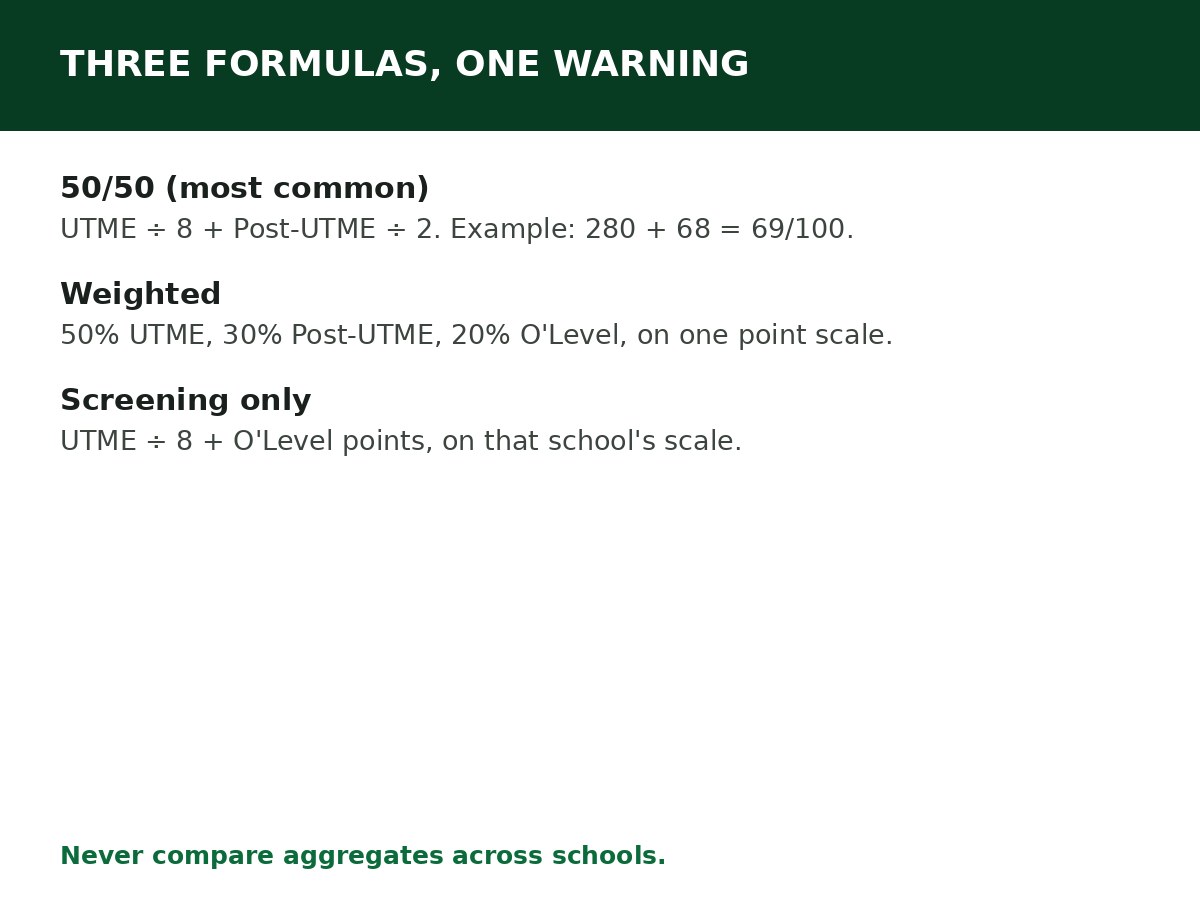
Formula 1: UTME + Post-UTME only (50/50) — the most common
UTME component = UTME score ÷ 8 (converts 400 to a score out of 50) Post-UTME component = Post-UTME score ÷ 2 (converts 100 to a score out of 50) Aggregate = UTME component + Post-UTME component (out of 100)
Worked example: UTME 280, Post-UTME 68.
- UTME: 280 ÷ 8 = 35
- Post-UTME: 68 ÷ 2 = 34
- Aggregate = 35 + 34 = 69 out of 100
Worked example 2: UTME 240, Post-UTME 70.
- UTME: 240 ÷ 8 = 30
- Post-UTME: 70 ÷ 2 = 35
- Aggregate = 65 out of 100
This 50/50 model is the one most commonly reported for institutions including UNILAG and many others. If your institution does not publish a different formula, this is the one to try first — but confirm it, don’t assume it.
Formula 2: UTME + Post-UTME + O’Level, weighted by percentage
Some institutions weight the three parts as percentages, for example 50% UTME, 30% Post-UTME, 20% O’Level. The calculation is:
- UTME: (UTME score ÷ 400) × UTME weight
- Post-UTME: (Post-UTME score ÷ 100) × Post-UTME weight
- O’Level: (your O’Level points ÷ maximum points) × O’Level weight
O’Level points in this model commonly use: A1 = 4, B2 = 3.5, B3 = 3, C4 = 2.5, C5 = 2, C6 = 1.5, for your best five relevant subjects — maximum 20 points.
Worked example, 50/30/20 model: UTME 260, Post-UTME 72, O’Level grades A1, A1, B2, B3, C4.
- UTME: (260 ÷ 400) × 50 = 32.5
- Post-UTME: (72 ÷ 100) × 30 = 21.6
- O’Level points: 4 + 4 + 3.5 + 3 + 2.5 = 17; (17 ÷ 20) × 20 = 17
- Aggregate = 32.5 + 21.6 + 17 = 71.1 out of 100
Note how the O’Level scale matters: this model uses a 4-point maximum per subject. Other institutions use a 6-point scale (A1 = 6, B2 = 5, B3 = 4, C4 = 3, C5 = 2, C6 = 1). Never mix scales — use the scale your institution publishes, with its own maximum.
Formula 3: UTME + O’Level only (screening, no Post-UTME exam)
Some institutions, including some polytechnics and universities that run screening instead of a Post-UTME exam, calculate from UTME and O’Level only. The shape is:
Aggregate = (UTME score ÷ 8) + O’Level points (on that institution’s own point scale and maximum)
Worked example, on a scale where O’Level points go up to 20: UTME 240, O’Level points 16.
- UTME: 240 ÷ 8 = 30
- O’Level: 16
- Aggregate = 46 out of 70 on that institution’s scale
That “out of 70” is the point: you cannot compare a 46/70 at one institution with a 69/100 at another. Compare your aggregate only with the departmental cut-off published by the same institution, on the same scale.
How to use your aggregate once you have it
- Find your institution’s departmental cut-off for your course, for the current cycle. That is the number your aggregate is compared against — not the general JAMB minimum, and not last year’s cut-off from a blog.
- If your aggregate is above it, you have a strong chance, subject to CAPS processing and clearance.
- If it is slightly below it, you may still be considered in supplementary lists — keep checking CAPS.
- If it is well below it, consider a change of course or institution to one whose cut-off your aggregate does meet, while the window is open.
Mistakes that ruin an otherwise correct calculation
- Using another institution’s formula for your institution. This is the commonest error, and it produces a confident, wrong number.
- Mixing O’Level point scales (4-point and 6-point) in the same calculation.
- Using all O’Level subjects instead of your best five relevant subjects, where the formula specifies best five.
- Forgetting that Post-UTME scores are out of 100 in Formula 1 (÷ 2) but out of a different total in some institutions’ own exams — check the total before dividing.
- Comparing aggregates across institutions as if they were on the same scale. They are not.
Related Guides & Next Steps
- How to Check JAMB Result Online
- JAMB CAPS Explained for First-Time Candidates
- JAMB Cut-Off Mark for Universities Explained
- JAMB Admission FAQs for Nigerian Candidates
- JAMB Cut-Off Mark for Polytechnics Explained
Frequently asked questions
Is my aggregate the same as my UTME score? No. Your UTME score is out of 400. Your aggregate is a combined score, usually out of 100 (or out of that institution’s own maximum), built from UTME plus Post-UTME and sometimes O’Level.
Which formula does my institution use? Check its admission notice or Post-UTME/screening guidelines for the current cycle. If it is not published there, ask the institution’s admission office. Do not rely on a blog’s claim about your institution without confirming it.
Can a high UTME score compensate for a low Post-UTME score? Partly, in a combined formula — a strong UTME component lifts the total. But it cannot fully compensate if the institution also has a minimum Post-UTME or screening threshold. Check both.
Do O’Level grades really affect my aggregate? At institutions that include O’Level in the formula, yes — materially. At 50/50 institutions, they do not enter the aggregate, but they still matter for eligibility (minimum credits, including English and Mathematics).
My aggregate is higher than a friend’s, but my friend got admitted and I didn’t. Why? Different courses have different cut-offs, and admission also depends on catchment, O’Level eligibility, subject combination, and CAPS processing. Aggregate is the main ranking tool, not the only factor.
Sources and last update
- Formulas cross-checked across multiple independent JAMB guides: 50/50 model (UTME ÷ 8 + Post-UTME ÷ 2), percentage-weighted model (50/30/20 with 4-point O’Level scale), and screening-only model (UTME ÷ 8 + O’Level points). Institution examples (UNILAG for 50/50, UI/OAU-style for weighted) are as reported by those guides — confirm your institution’s current formula in its own notice before relying on any example.
- Arithmetic in all worked examples checked by hand.
Last updated: 24 October 2026. Evergreen guide — review every 3–6 months and on every admission-cycle announcement.

Written by Olaitan Ilori
Olaitan Ilori is the founder and lead researcher at CareerMedal. He provides verified, practical guides on Nigerian tertiary admissions (JAMB, CAPS, Post-UTME), NELFUND student finance, NYSC service-year survival, and early-career job placement.
View all guides by Olaitan Ilori →