

A job search strategy is a plan, not a hope: target sectors, weekly routines, application targets, evidence building, and review cycles, run consistently for months. This guide builds the plan — distinct from the trainee-tracking guide (which covers trainee windows specifically) and the application guides (which cover single applications).
Step 1: Define targets
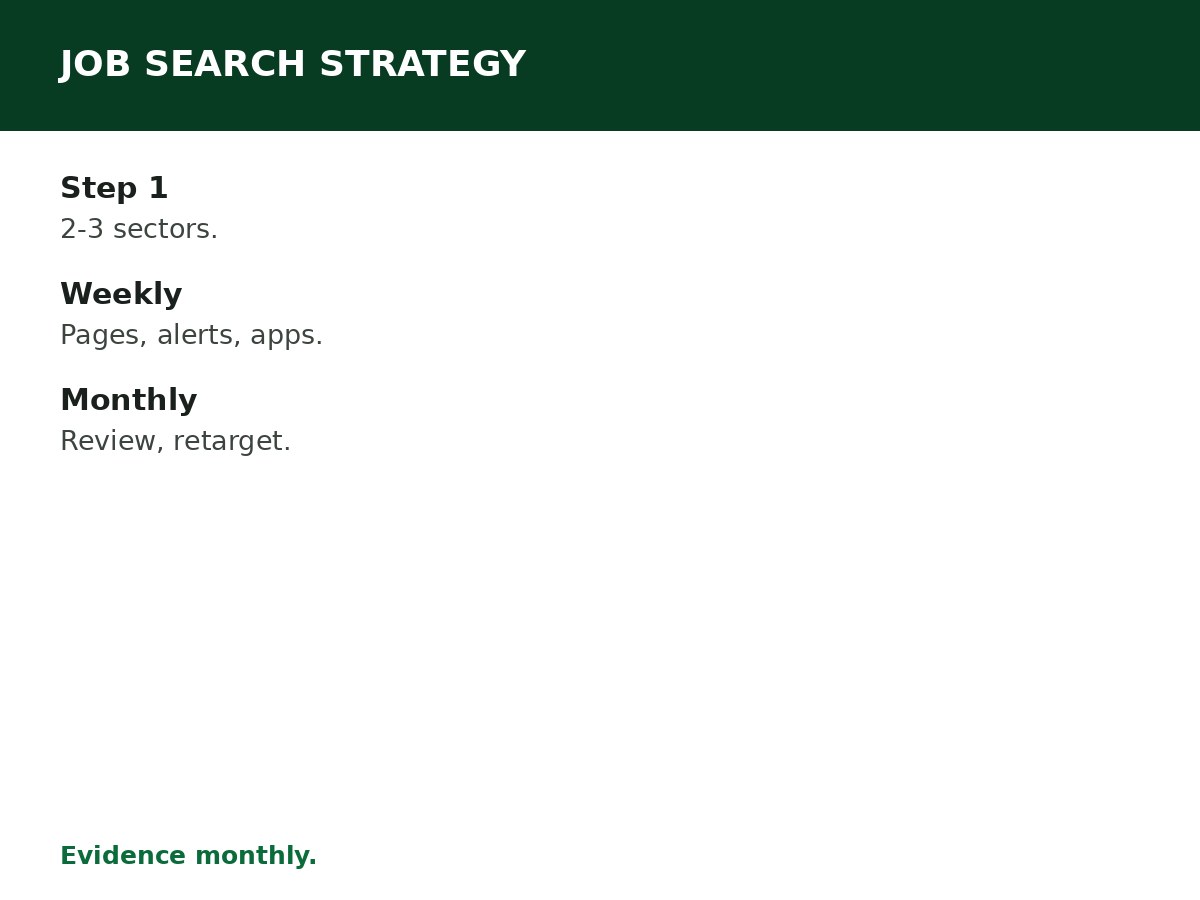
- Pick 2–3 target sectors — sectors where your degree, skills, and interests fit, not every sector at once. Focus beats scatter.
- Pick target roles — roles within those sectors that match your evidence, not just your aspirations.
- List target employers — employers in those sectors with graduate pipelines, whose career pages you will track weekly.
- Set a timeline — a realistic horizon (months, not weeks) for structured pipelines, with interim milestones (applications, tests, interviews).
Step 2: Build the weekly routine
- Career-page checks — weekly, for your target employers’ career pages.
- Board alerts — daily, for your sectors and roles, on reputable boards.
- Applications — a weekly application target, to roles you genuinely fit, with tailored CVs, not a daily spam count.
- Evidence building — one new piece of evidence per month: a project, a certification, a volunteer stint, a freelance job. Evidence compounds; waiting does not.
Step 3: Prepare the toolkit
- Tailored CVs — a base CV, tailored per role, with evidence matched to requirements.
- Cover-note template — brief, specific, adapted per role, not generic.
- Aptitude-test practice — ongoing, before windows open, not after shortlisting.
- Interview preparation — employer knowledge, common questions, and evidence stories, rehearsed, not improvised.
Step 4: Review and adjust monthly
- Count applications, tests, interviews — what is moving, and what is not. Low response rates mean retargeting, not more of the same.
- Retarget sectors or roles — if one sector yields nothing after months, shift emphasis, not effort.
- Strengthen evidence — if rejections cite experience, build internships, projects, or volunteer work, then reapply stronger.
- Protect morale — job searching is long and rejecting. Routine, exercise, and peer support sustain it; isolation and despair do not.
Strategy mistakes
- Applying everywhere, fitting nowhere — scatter loses to focus. Target sectors and roles you genuinely fit.
- Waiting for one application — one application is not a strategy. Keep applying while waiting.
- Ignoring evidence — applications without growing evidence stall. Build monthly.
- Paying for shortcuts — fees, agents, and ‘slots’ are scams, not strategy.
Related Guides & Next Steps
- Graduate Jobs in Nigeria 2026
- Government Jobs vs Private Sector Jobs in Nigeria
- How to Find Internships Without Connections
Frequently asked questions
How do I build a job search strategy? Define 2–3 target sectors and roles, list target employers, build a weekly routine (career-page checks, board alerts, applications, evidence building), prepare the toolkit (CVs, cover notes, test practice), and review monthly.
How many jobs should I apply for per week? A weekly target of tailored applications to roles you genuinely fit — quality over quantity, but consistently, not a daily spam count.
How long does a job search take? Months, not weeks, for structured pipelines — set a realistic horizon with interim milestones, and review monthly.
What if my job search is not working? Retarget — low response rates mean retargeting sectors or roles, and strengthening evidence (internships, projects, volunteer work), not more of the same.
What is the biggest job search mistake? Applying everywhere and fitting nowhere, waiting for one application, ignoring evidence building, or paying for shortcuts — all lose to a focused, consistent strategy.
Sources and last update
- No company is named as currently hiring anywhere in this article, deliberately — hiring windows open and close, and a frozen company list misleads readers within months. Employer career pages, checked at application time, govern.
- No salary figure, vacancy count, or hiring outcome is asserted anywhere in this article, deliberately. Employer career pages and reputable job boards, checked at application time, govern.
- Scam patterns: application fees, training fees, payment to personal accounts, and guaranteed jobs are red flags — legitimate employers do not charge to apply.
- No job outcome is promised anywhere in this article.
Last updated: 24 October 2026. Guide — review every 3–6 months, and on major labour-market shifts.

Written by Olaitan Ilori
Olaitan Ilori is the founder and lead researcher at CareerMedal. He provides verified, practical guides on Nigerian tertiary admissions (JAMB, CAPS, Post-UTME), NELFUND student finance, NYSC service-year survival, and early-career job placement.
View all guides by Olaitan Ilori →