

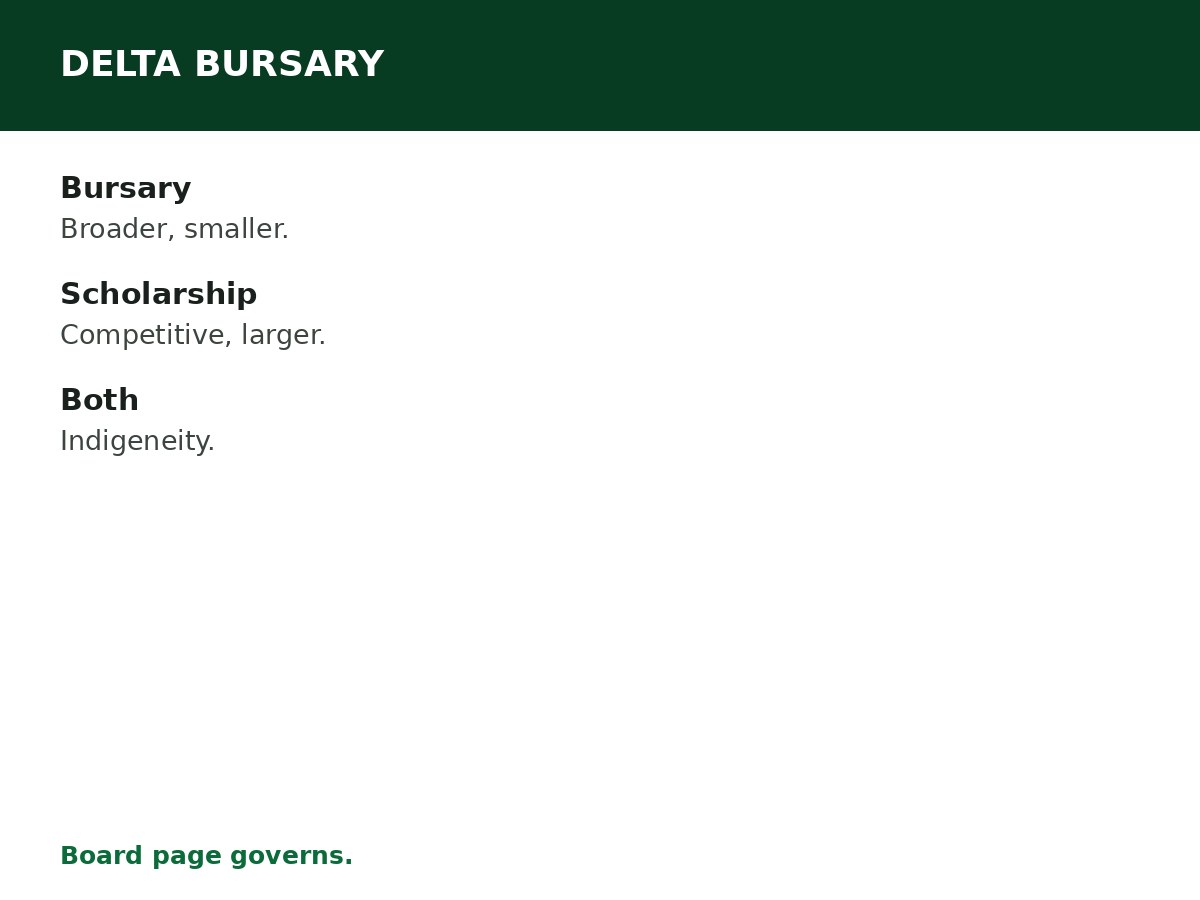
Delta State runs both a bursary and a scholarship scheme, through the Delta State Bursary and Scholarship Board — and the two are different. A bursary is typically a smaller, broader payment, often for indigenes in tertiary institutions generally; a scholarship is typically a larger, competitive award, for merit, need, or both. This guide explains both, and tells you how to verify the current cycle — because amounts, deadlines, fields, and levels change every cycle, and no state-specific amount, deadline, or field list is asserted anywhere in this article, deliberately. The Delta State Bursary and Scholarship Board’s official page or office is the only reliable source for the Delta scheme.
Bursary vs scholarship: the distinction
- Bursary — typically broader eligibility (indigenes in tertiary institutions), smaller payment, and simpler selection. Think of it as broad support, not a competitive prize.
- Scholarship — typically competitive selection (merit, need, or both), larger payment, and stricter renewal terms. Think of it as a competitive award.
- Both require indigeneity — proven by a certificate of origin, as the board states.
- Both change per cycle — amounts, deadlines, fields, and levels, as the board’s current announcement states. Do not apply from a previous cycle’s details.
Who qualifies, in general
- Indigene of Delta State — proven by a certificate of origin, as the board states.
- Admission — to a recognised tertiary institution, as the board states for the cycle.
- Academic record — grades and transcripts, as the board states. Bursary thresholds are typically lower than scholarship thresholds; scholarship thresholds are competitive.
- Level and field — as the board states for the cycle.
How to apply, in general
- Find the Delta State Bursary and Scholarship Board’s official page or office — typed directly, not via a forwarded link.
- Read the current cycle’s announcement — bursary and scholarship streams, levels, fields, amounts, deadlines, documents.
- Decide which stream fits you (bursary, scholarship, or both, where the board allows both).
- Prepare documents early — indigene certificate, admission letter, results, identification, as the board states.
- Apply through the board’s official channel only — never through an agent or a personal account.
- Track results through the board’s official channels.
Red flags: Delta bursary and scholarship scams
- Fees to personal accounts — the board does not collect application fees to personal accounts. A fee demand is a scam.
- Guaranteed bursary or scholarship — no genuine award is guaranteed before selection.
- Agents selling Delta slots — Delta slots are not sold. Anyone selling one is running a scam.
- Fake board pages — verify the board’s official page or office before applying; forwarded links and group messages are not verification.
Related Guides & Next Steps
- Scholarships for Nigerian Students in 2026/2027
- State Government Scholarships in Nigeria
- Rivers State Scholarship Guide
- Kwara State Scholarship Guide
- Ogun State Scholarship Guide
Frequently asked questions
What is the difference between Delta bursary and Delta scholarship? A bursary is typically broader eligibility and smaller payment; a scholarship is typically competitive selection and larger payment. Both require Delta indigeneity, and both change per cycle — check the board’s current announcement.
Who qualifies for Delta bursary or scholarship? Indigenes of Delta State, as the board states — usually proven by a certificate of origin, as the board states. Check the board’s current cycle for levels, fields, and thresholds.
Where do I apply for Delta bursary or scholarship? Through the Delta State Bursary and Scholarship Board’s official channel only — typed directly, not via a forwarded link.
Does Delta bursary or scholarship charge a fee? The board does not collect application fees to personal accounts. A fee demand to a personal account is a scam.
How do I verify the current Delta details? On the board’s official page or office, for the current cycle: streams, levels, fields, amounts, deadlines, and documents. No amount or deadline is asserted here, deliberately.
Sources and last update
- Scholarship programmes named here are established programmes as reported; amounts, deadlines, and eligibility change every cycle — the official programme page for the current cycle governs, and no amount or deadline is asserted anywhere in this article, deliberately.
- Scholarship-vs-loan distinction from the NELFUND cluster guides (Batches 6–10): a scholarship is not repaid; NELFUND is a loan, repayable from 2 years after NYSC at 10% of income.
- Scam patterns from the fake-agents guide (Batch 12): application fees, guaranteed awards, and payment to personal accounts are red flags.
- No admission, award, or visa outcome is promised anywhere in this article.
Last updated: 24 October 2026. Guide — review every 3–6 months and on every scholarship-cycle update.

Written by Olaitan Ilori
Olaitan Ilori is the founder and lead researcher at CareerMedal. He provides verified, practical guides on Nigerian tertiary admissions (JAMB, CAPS, Post-UTME), NELFUND student finance, NYSC service-year survival, and early-career job placement.
View all guides by Olaitan Ilori →