
Data analyst jobs hire fresh graduates into reporting, analytics, and business-intelligence roles, across banks, telecoms, FMCG, tech, and NGOs, on demonstrable data work more than on certificates. This guide explains the analyst pipeline, the project bar, and how fresh graduates enter data analysis.
How analyst hiring works
- Companies and NGOs — direct hiring, on each employer’s timetable, with project review, practical tests, and interviews.
- Internships and trainee roles — fixed-term placements, often converting to permanent roles, and the best route in for fresh graduates.
- Freelance-to-employed paths — freelance analysis projects building a portfolio that converts into employed roles.
The project bar
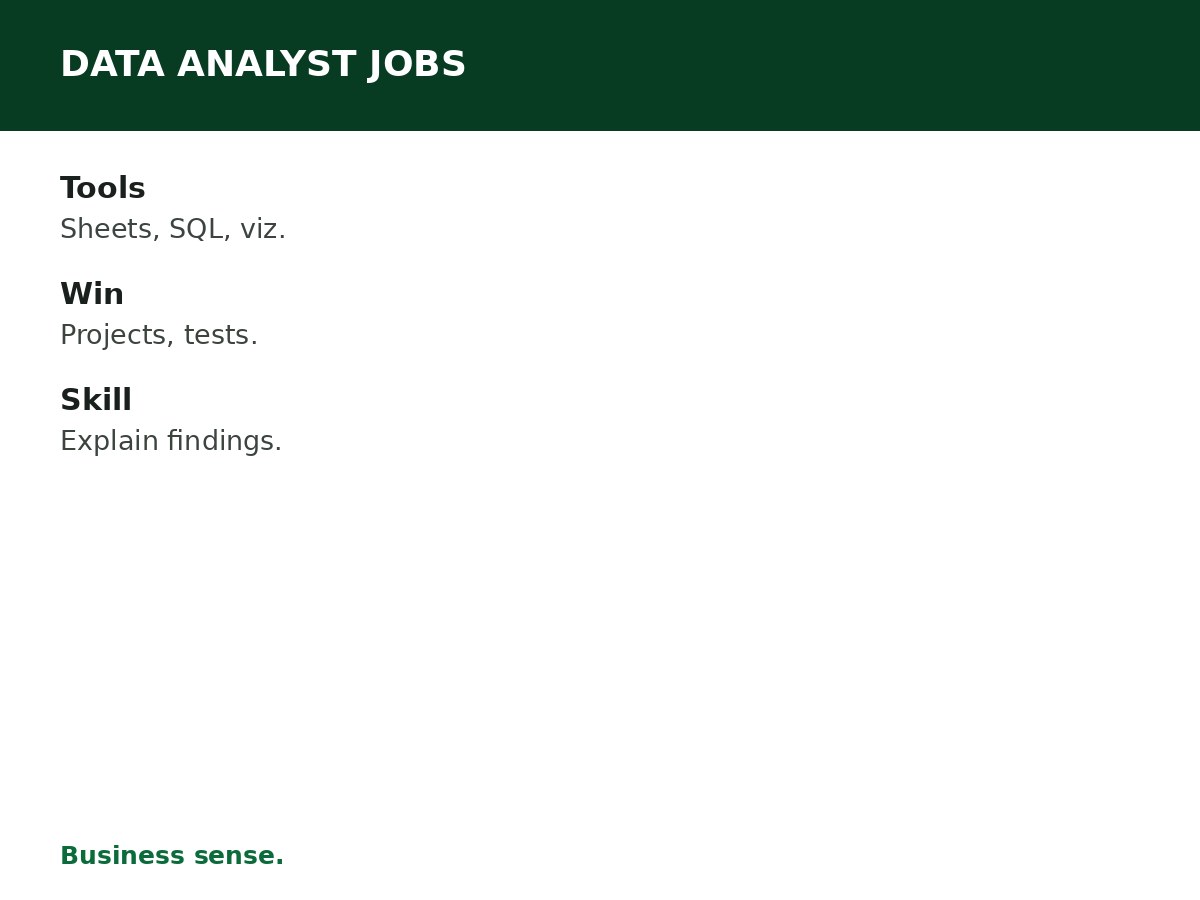
- Analysis projects — cleaned datasets, dashboards, and findings, published or demonstrable, not just certificates. Employers check work, not just course completions.
- Tools that matter — spreadsheets, SQL, and a visualisation tool, as the role requires, with Python or R strengthening candidacies for advanced roles, as each employer states.
- Business sense — analysis that answers a business question (sales trends, customer patterns, operational bottlenecks) beats technical exercises with no question behind them.
- Communication — findings presented clearly, in plain language, with recommendations. Analysts who cannot explain findings do not get hired.
What analyst employers screen for
- Practical-test performance — data exercises with real datasets, as each employer states. Practise before applying.
- Project portfolio — the main filter, ahead of degree class.
- Degree or HND, plus NYSC status where applicable — the baseline for structured pipelines, with statistics, mathematics, economics, computer science, or related degrees preferred for many roles, as each employer states.
- Attention to detail — data work punishes carelessness. Employers screen for accuracy in tests and projects.
Analyst recruitment scams
- Fees for analyst roles or ‘job guarantees’ — scams. Legitimate employers charge nothing.
- Unpaid ‘trial’ analysis — trial tasks that become free labour. Cap trial work, and walk away from endless ‘tests’.
- Fake employers — verify the company’s registration and team before accepting a role.
Related Guides & Next Steps
- Graduate Jobs in Nigeria 2026
- Cybersecurity Jobs in Nigeria
- Digital Marketing Jobs in Nigeria
- Software Developer Jobs in Nigeria
Frequently asked questions
How do I get a data analyst job as a fresh graduate? Through companies, NGOs, internships, or freelance-to-employed paths — with a portfolio of analysis projects and practical-test preparation as the main assets.
Do data analyst jobs require a statistics degree? No — employers screen mainly on project work and practical-test performance, though statistics, mathematics, economics, computer science, or related degrees are preferred for many roles, as each employer states.
What tools do data analysts need? Spreadsheets, SQL, and a visualisation tool, as the role requires, with Python or R strengthening candidacies for advanced roles, as each employer states.
What should a data analyst portfolio contain? Analysis projects — cleaned datasets, dashboards, and findings answering real business questions — published or demonstrable, not just certificates.
Are there fake data analyst jobs? Yes — fees, unpaid trial analysis that becomes free labour, and fake employers are scams. Verify the company before accepting.
Sources and last update
- No company is named as currently hiring anywhere in this article, deliberately — hiring windows open and close, and a frozen company list misleads readers within months. Employer career pages, checked at application time, govern.
- No salary figure, vacancy count, or hiring outcome is asserted anywhere in this article, deliberately. Employer career pages and reputable job boards, checked at application time, govern.
- Scam patterns: application fees, training fees, payment to personal accounts, and guaranteed jobs are red flags — legitimate employers do not charge to apply.
- No job outcome is promised anywhere in this article.
Last updated: 24 October 2026. Guide — review every 3–6 months, and on major labour-market shifts.

Written by Olaitan Ilori
Olaitan Ilori is the founder and lead researcher at CareerMedal. He provides verified, practical guides on Nigerian tertiary admissions (JAMB, CAPS, Post-UTME), NELFUND student finance, NYSC service-year survival, and early-career job placement.
View all guides by Olaitan Ilori →