
Best careers that allow remote work are careers where work is delivered digitally — writing, code, design, data, and analysis — not tied to physical locations, workshops, or face-to-face service. This guide groups remote-friendly careers by type, without ranking them, since ‘best’ depends on interests, skills, and markets, not on any official ranking.
Careers grouped by type
- Writing and content — content writing, editing, copywriting, and publishing, as the market states, judged by portfolios and published work.
- Technology — software development, data analysis, cybersecurity, and design, as the market states, judged by projects and portfolios.
- Marketing and sales — digital marketing, social media, and remote sales, as the market states, judged by measured results.
- Support and operations — customer support, virtual assistance, and remote operations, as the market states, judged by reliability and communication.
- Teaching and training online — online tutoring, course creation, and remote training, as the market states, judged by content and results.
- No ranking asserted — careers are grouped by type, not ranked. ‘Best’ depends on interests, skills, and markets, not on any official ranking.
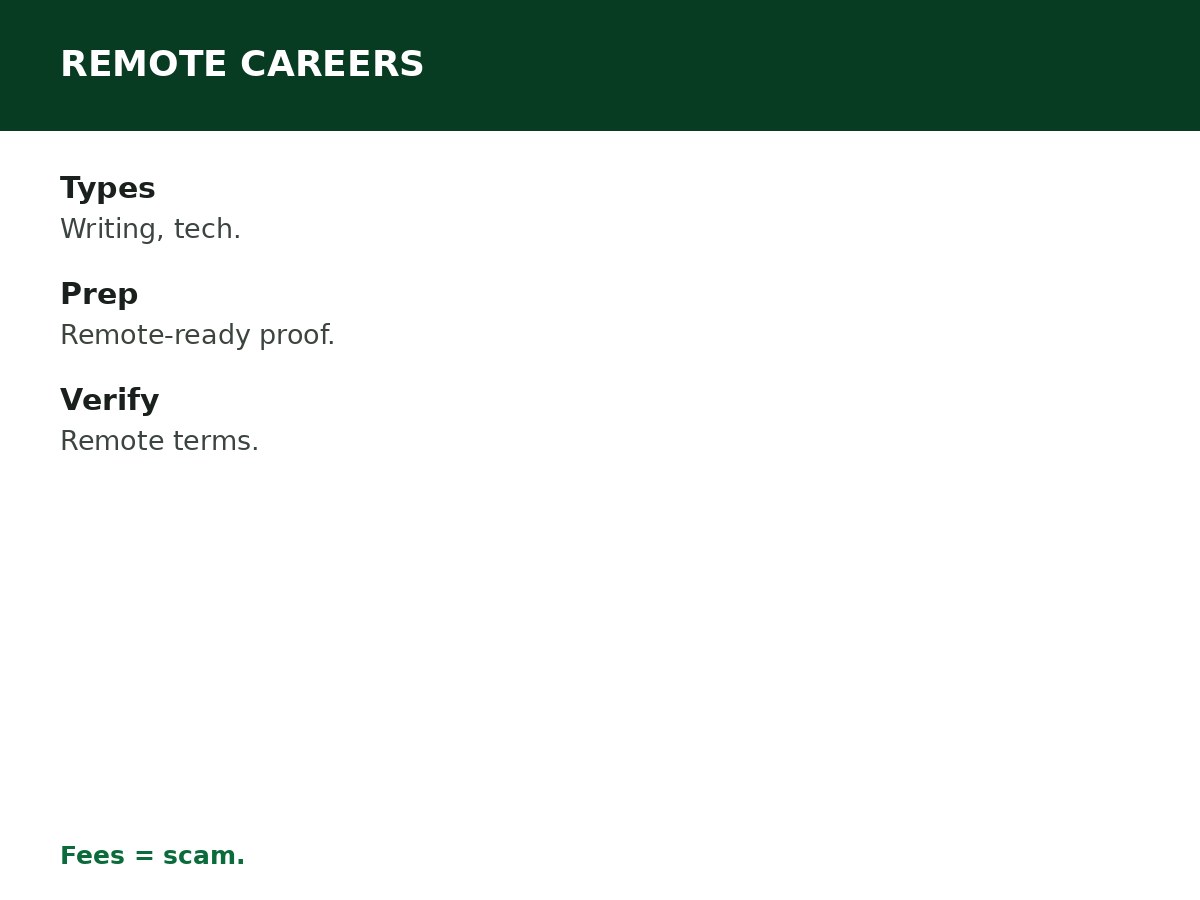
How remote workers should prepare
- Build remote-ready proof — portfolios, deployed projects, and measured results, as the portfolio guide covers, for remote hiring, where managers cannot observe work directly.
- Demonstrate self-management — time management, communication, and reliability, demonstrated by projects and references, as employers state, for remote trust.
- Target remote-first employers — employers hiring remotely, as job descriptions state, not office roles mislabelled as remote, as the first-remote-job guide covers.
- Verify remote terms — remote terms, working hours, and equipment, as job descriptions state, checked before accepting, for sustainable remote work.
Remote career myths
- ‘Remote work means no supervision’ — remote work involves deadlines, check-ins, and accountability, as employers state, not unsupervised freedom. Self-management is the core remote skill.
- ‘Remote careers guarantee flexibility’ — flexibility varies by employer, role, and timezone, as job descriptions state. Verify terms, before accepting, not assumed.
- ‘Remote jobs are scams’ — legitimate remote roles exist, as the market states, but remote roles demanding fees, personal details, or unpaid ‘tests’, are scams, as the Jobs cluster covers. Verify every employer, before applying or paying anything.
Related Guides & Next Steps
- How to Write a CV With No Work Experience
- How to Choose a Career After University
- How to Change Careers in Nigeria
- Best Careers for People Who Like Technology
Frequently asked questions
What are the best careers that allow remote work? Writing and content, technology, marketing and sales, support and operations, and online teaching and training — grouped by type, not ranked.
How should remote workers prepare for careers? By building remote-ready proof (portfolios, deployed projects, measured results), demonstrating self-management, targeting remote-first employers, and verifying remote terms before accepting.
Does remote work mean no supervision? No — remote work involves deadlines, check-ins, and accountability, as employers state, not unsupervised freedom. Self-management is the core remote skill.
Are remote jobs scams? Legitimate remote roles exist, as the market states, but remote roles demanding fees, personal details, or unpaid ‘tests’, are scams, as the Jobs cluster covers. Verify every employer, before applying or paying anything.
Should I verify remote terms before accepting? Yes — remote terms, working hours, and equipment, as job descriptions state, checked before accepting, for sustainable remote work.
Sources and last update
- No salary figure, vacancy count, or hiring outcome is asserted anywhere in this article, deliberately — employer career pages and reputable boards, checked at application time, govern.
- No company is named as currently hiring anywhere in this article, deliberately — hiring windows open and close; employer career pages govern.
- Scam patterns: fees for jobs, payment to personal accounts, guaranteed jobs or placements, and career coaching selling fake credentials are red flags — verify every employer and programme on official channels before applying or paying anything.
- No job, salary, placement, or hiring outcome is promised anywhere in this article.
Last updated: 24 October 2026. Guide — review every 6–12 months, and on every major hiring-platform change.

Written by Olaitan Ilori
Olaitan Ilori is the founder and lead researcher at CareerMedal. He provides verified, practical guides on Nigerian tertiary admissions (JAMB, CAPS, Post-UTME), NELFUND student finance, NYSC service-year survival, and early-career job placement.
View all guides by Olaitan Ilori →