

Jobs without work experience are entry-level roles, trainee programmes, internships, and volunteer-to-paid paths, designed for people with no employment history — and the way to win them is evidence, not experience: SIWES, projects, volunteer work, and portfolios, stated with specifics. This guide is the no-experience playbook, distinct from the fresh-graduate guide: it covers anyone without experience, graduate or not.
Doors open without experience
- Entry-level roles — designed for beginners, with training built in, across banks, telecoms, FMCG, NGOs, and government.
- Graduate trainee programmes — structured pipelines, with rotations and assessment, for graduates without experience.
- Internships — fixed-term, paid placements, with real duties, often converting to permanent roles.
- Volunteer-to-paid paths — NGO and community roles converting volunteer experience into paid roles.
- Apprenticeships and technician routes — trade and technical roles, for OND holders and school leavers, with on-the-job training.
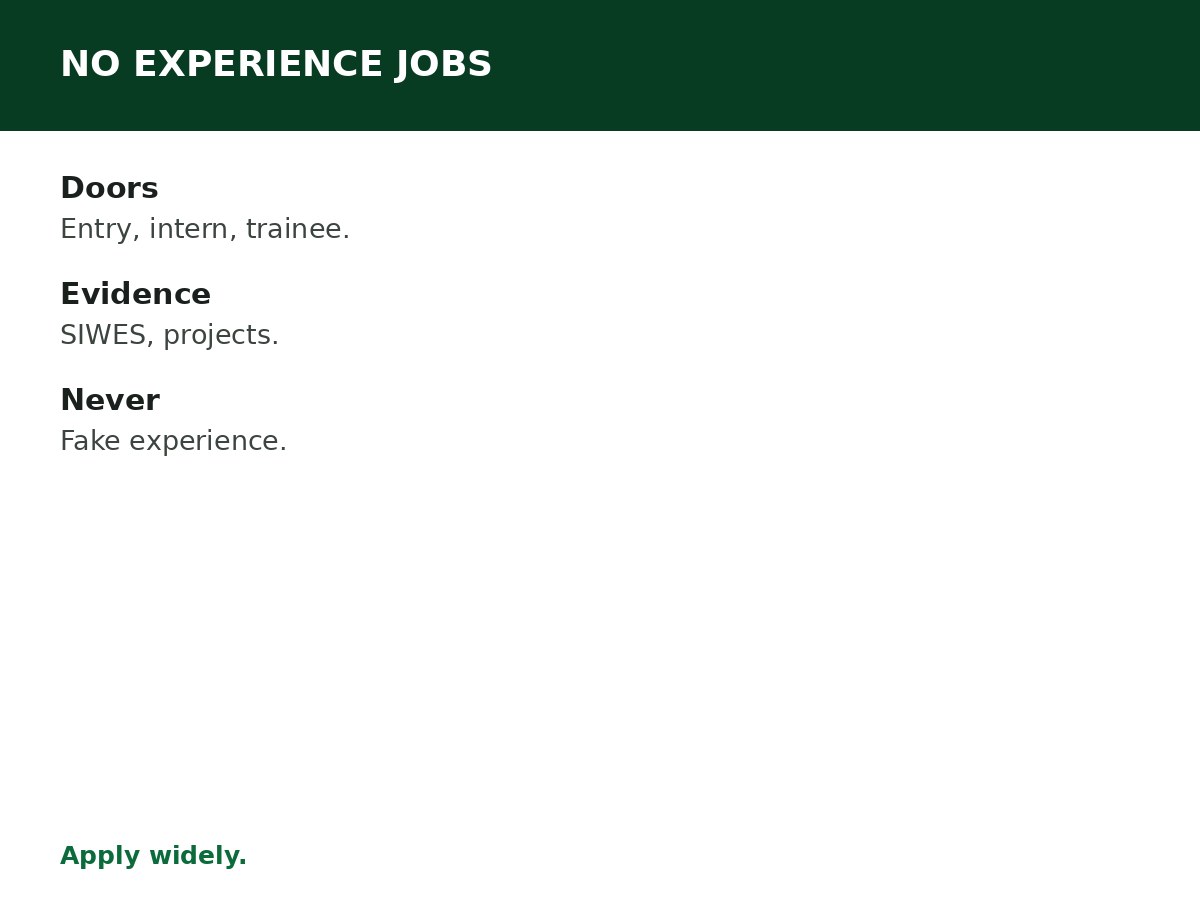
Evidence, not experience
- SIWES and internships — the strongest no-experience evidence for graduates. Choose placements for learning, not convenience.
- Projects — class projects, personal projects, freelance jobs, and campus businesses, stated with results, not adjectives.
- Volunteer work — community, religious, and NGO volunteering, stated with duties and outcomes.
- Portfolios — for tech, design, data, marketing, and writing roles, a portfolio is the application. Build it before applying, not after rejection.
Applying without experience
- Tailor every application — a generic CV sent everywhere loses to a tailored CV sent to roles you genuinely fit, with evidence matched to the role’s requirements.
- Apply widely — competitive pipelines reject most applicants. A narrow application set is not a strategy.
- Prepare for tests — aptitude tests screen most structured pipelines. Practise before applying, not after shortlisting.
- Do not pay for jobs — application fees, training fees, and personal-account payments are scams, not shortcuts, whatever your experience level.
What not to do without experience
- Do not fake experience — invented roles, inflated titles, and false references are background-check failures. State your actual evidence, honestly.
- Do not wait for experience to arrive — experience comes from entry roles, internships, and volunteer work, not from waiting.
- Do not ignore internships — an internship refused today is a permanent role lost tomorrow.
Related Guides & Next Steps
- Graduate Jobs in Nigeria 2026
- How to Find Legitimate Jobs in Nigeria
- How to Verify a Job Vacancy Before Applying
- Jobs That Accept NYSC Graduates
Frequently asked questions
What jobs can I get without work experience in Nigeria? Entry-level roles, graduate trainee programmes, internships, volunteer-to-paid paths, and apprenticeships — doors designed for people with no employment history.
How do I get a job without experience? With evidence, not experience: SIWES, projects, volunteer work, and portfolios, stated with specifics, matched to each role’s requirements, applied widely.
Can I get a job without experience and without a degree? Yes, through technician, support, trade, and apprenticeship routes — OND holders and school leavers enter through these doors, with on-the-job training.
Should I lie about experience to get a job? No — invented roles, inflated titles, and false references are background-check failures. State your actual evidence, honestly.
What is the biggest no-experience mistake? Waiting — for experience to arrive, for the perfect role, for connections. Experience comes from entry roles, internships, and volunteer work, not from waiting.
Sources and last update
- No company is named as currently hiring anywhere in this article, deliberately — hiring windows open and close, and a frozen company list misleads readers within months. Employer career pages, checked at application time, govern.
- No salary figure, vacancy count, or hiring outcome is asserted anywhere in this article, deliberately. Employer career pages and reputable job boards, checked at application time, govern.
- Scam patterns: application fees, training fees, payment to personal accounts, and guaranteed jobs are red flags — legitimate employers do not charge to apply.
- No job outcome is promised anywhere in this article.
Last updated: 24 October 2026. Guide — review every 3–6 months, and on major labour-market shifts.

Written by Olaitan Ilori
Olaitan Ilori is the founder and lead researcher at CareerMedal. He provides verified, practical guides on Nigerian tertiary admissions (JAMB, CAPS, Post-UTME), NELFUND student finance, NYSC service-year survival, and early-career job placement.
View all guides by Olaitan Ilori →