

Jobs that accept NYSC graduates are, in practice, most graduate jobs in Nigeria — employers ask for NYSC discharge, exemption, or exclusion as the standard graduate baseline, and roles that accept serving corps members are a narrower, specific set. This guide explains the distinction clearly, because confusing the two costs graduates applications.
The standard baseline: discharge, exemption, or exclusion
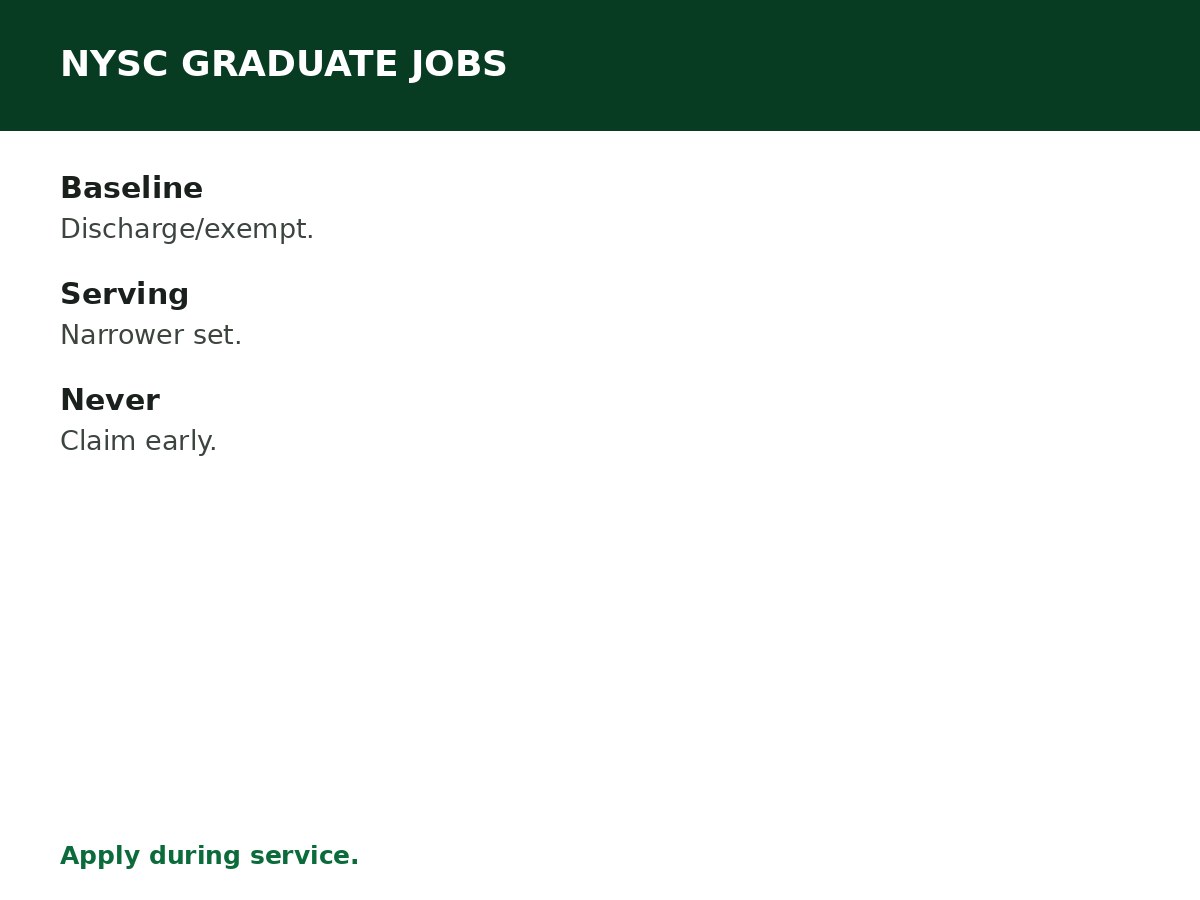
- Most graduate roles — banks, telecoms, FMCG, tech, NGOs, government, and companies of every size — ask for NYSC discharge, exemption, or exclusion as the standard graduate baseline. This is not an extra requirement; it is the default.
- Why employers ask — NYSC status confirms graduation, mobilises the graduate pipeline, and, for employers, confirms the candidate has completed the national service obligation.
- What to show — discharge certificate, exemption certificate, or exclusion letter, as applicable, at application or onboarding, as the employer states.
Roles that accept serving corps members
- PPA-adjacent roles — some employers hire serving corps members for roles connected to their PPA, or for part-time and contract work alongside service, as each employer states.
- Freelance and remote work — freelance, remote, and contract work is open to serving corps members, subject to NYSC rules on PPA attendance and permission (see the NYSC service-year rules guide).
- Internships — some internships accept serving corps members, as each employer states.
- What serving corps members cannot do — full-time permanent roles requiring discharge, and any work conflicting with PPA attendance, CDS, and clearance, without NYSC permission.
Exemption and exclusion — accepted equally
- Exemption certificate — for graduates aged 30+ at graduation and other NYSC-stated grounds. Employers accept exemption certificates as the standard baseline, equally with discharge.
- Exclusion letter — for part-time, distance-learning, and sandwich graduates. Employers accept exclusion letters as the standard baseline, equally with discharge.
- No stigma in hiring — exemption and exclusion are NYSC statuses, not employer judgements. Any employer rejecting exemption or exclusion certificates outright is applying its own policy, not an NYSC rule — and such policies are rare.
Applying before discharge
- Apply during service — graduates in service can apply for roles starting after discharge, stating their expected discharge date, as each employer states.
- Do not misrepresent status — claiming discharge before discharge is a background-check failure. State your actual status, with your expected date, honestly.
- Track windows — trainee and graduate pipelines open months before start dates. Serving corps members should track windows during service, not after discharge.
Related Guides & Next Steps
- Graduate Jobs in Nigeria 2026
- Jobs Without Work Experience in Nigeria
- How to Find Legitimate Jobs in Nigeria
- Digital Marketing Jobs in Nigeria
Frequently asked questions
What jobs accept NYSC graduates? Most graduate jobs in Nigeria — employers ask for NYSC discharge, exemption, or exclusion as the standard graduate baseline. Roles accepting serving corps members are a narrower, specific set.
Can serving corps members work? Yes, in PPA-adjacent, freelance, remote, contract, and some internship roles, subject to NYSC rules on PPA attendance and permission — but not full-time permanent roles requiring discharge.
Do employers accept NYSC exemption certificates? Yes — exemption certificates are accepted as the standard baseline, equally with discharge. Exemption is an NYSC status, not an employer judgement.
Do employers accept NYSC exclusion letters? Yes — exclusion letters are accepted as the standard baseline, equally with discharge, for part-time, distance-learning, and sandwich graduates.
Can I apply for jobs before NYSC discharge? Yes — apply for roles starting after discharge, stating your expected discharge date honestly. Do not claim discharge before discharge; background checks will catch it.
Sources and last update
- No company is named as currently hiring anywhere in this article, deliberately — hiring windows open and close, and a frozen company list misleads readers within months. Employer career pages, checked at application time, govern.
- No salary figure, vacancy count, or hiring outcome is asserted anywhere in this article, deliberately. Employer career pages and reputable job boards, checked at application time, govern.
- Scam patterns: application fees, training fees, payment to personal accounts, and guaranteed jobs are red flags — legitimate employers do not charge to apply.
- No job outcome is promised anywhere in this article.
Last updated: 24 October 2026. Guide — review every 3–6 months, and on major labour-market shifts.

Written by Olaitan Ilori
Olaitan Ilori is the founder and lead researcher at CareerMedal. He provides verified, practical guides on Nigerian tertiary admissions (JAMB, CAPS, Post-UTME), NELFUND student finance, NYSC service-year survival, and early-career job placement.
View all guides by Olaitan Ilori →