

Writing a cover letter in Nigeria means writing one page, addressed to a named hiring manager where possible, explaining why you fit a specific role — not repeating your CV. This guide covers cover letters specifically, distinct from the CV guides (which cover CV content) and the cover-letter-examples guide (which covers fresh-graduate examples).
What a cover letter is
- One page, for a specific role — a short letter, for one role, at one employer, not a generic letter, for every application.
- Why you fit, not CV repetition — skills, experience, and motivation, matching the role, explained, not CV bullet points repeated.
- Professional tone — formal, concise, Nigerian business English, as employers state, without slang or over-familiarity.
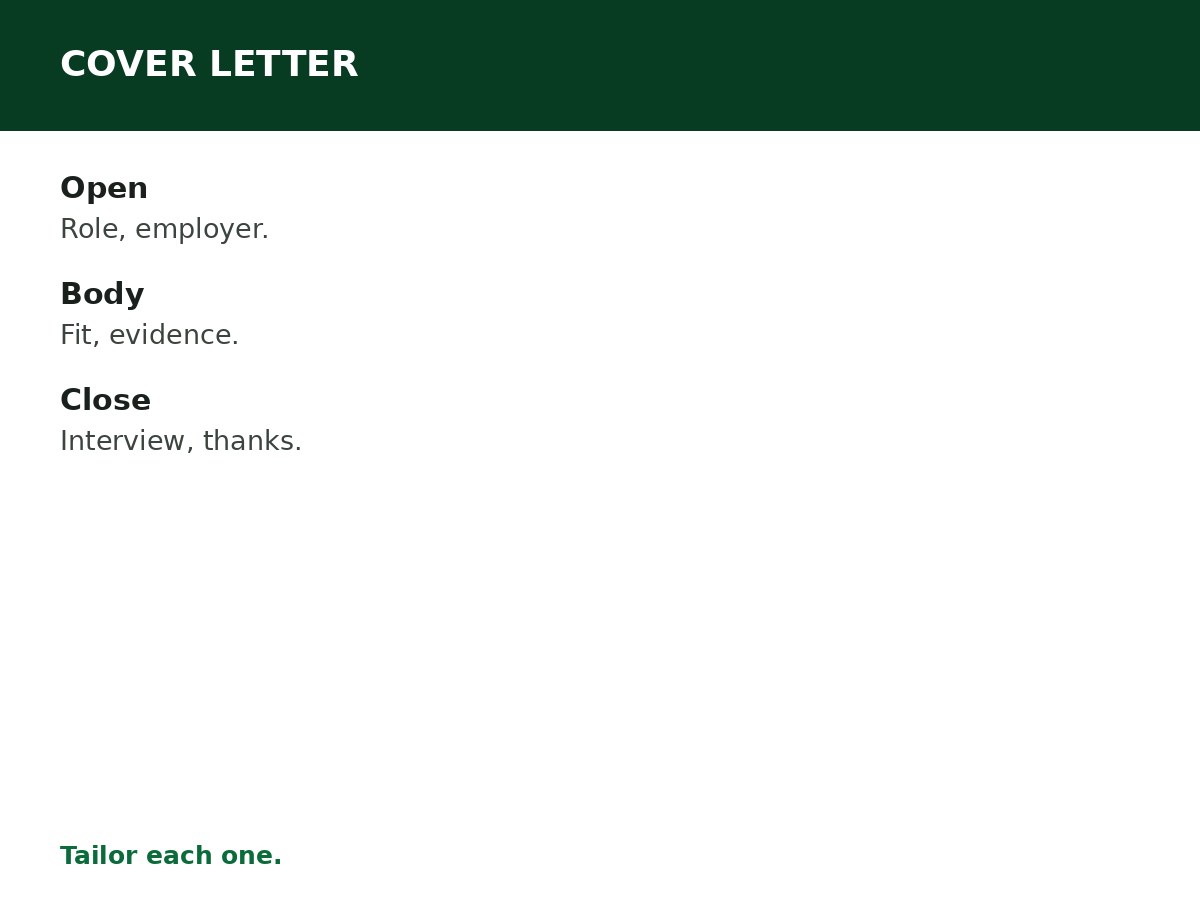
Cover letter structure
- Header — name, phone, email, city, and date, as on your CV.
- Addressee — hiring manager name, where known, or ‘Dear Hiring Manager’, where unknown, never ‘Dear Sir/Madam’ by default, where a name is findable.
- Opening — role, employer, and where you found the role, in 1–2 lines, with a brief fit statement.
- Body — 2 paragraphs, on skills, experience, and projects, matching the role’s requirements, with evidence, not adjectives alone.
- Motivation — 1 paragraph, on why this employer and role, specifically, not generic praise.
- Closing — availability for interview, thanks, and professional sign-off, with name and contact.
Cover letter mistakes
- Generic letters for every role — one generic letter, sent to every employer, loses to tailored letters, matching each role.
- CV repetition — repeating CV bullet points, without explanation, wastes letter space. Explain fit, with evidence, not lists.
- Length over one page — letters over one page lose employer attention, whatever the content.
- Errors and wrong names — spelling errors, wrong employer names, and wrong role titles, ending applications. Proofread, and check names, before every submission.
When cover letters are optional
- Application states optional — cover letters, where applications state optional, are still worth writing, for competitive roles, as employers state.
- Application states not required — cover letters, where applications state not required, are omitted, following instructions, not ignored.
- Email applications — email bodies, serving as cover letters, following the same structure, concisely, for email applications.
Related Guides & Next Steps
- How to Write a CV With No Work Experience
- Cover Letter Examples for Fresh Graduates
- How to Apply for a Job With No Experience
- How to List Internship Experience on Your CV
Frequently asked questions
What is a cover letter? One page, for a specific role, at one employer, explaining why you fit the role — skills, experience, and motivation, matching the role — not repeating your CV.
How long should a cover letter be? One page, for most roles, as employers state. Letters over one page lose employer attention, whatever the content.
Should I address my cover letter to a named person? Yes, where possible — hiring manager name, where known, or ‘Dear Hiring Manager’, where unknown, never ‘Dear Sir/Madam’ by default, where a name is findable.
Should I write a cover letter if the application says optional? Yes, for competitive roles — cover letters, where applications state optional, are still worth writing, as employers state.
Should I repeat my CV in my cover letter? No — cover letters explain fit, with evidence, not lists. Repeating CV bullet points, without explanation, wastes letter space.
Sources and last update
- No salary figure, vacancy count, or hiring outcome is asserted anywhere in this article, deliberately — employer career pages and reputable boards, checked at application time, govern.
- No company is named as currently hiring anywhere in this article, deliberately — hiring windows open and close; employer career pages govern.
- Scam patterns: fees for jobs, payment to personal accounts, guaranteed jobs or shortlisting, and CV services selling fake experience are red flags — verify every employer on official channels before applying or paying anything.
- No job, shortlisting, or hiring outcome is promised anywhere in this article.
Last updated: 24 October 2026. Guide — review every 6–12 months, and on every major hiring-platform change.

Written by Olaitan Ilori
Olaitan Ilori is the founder and lead researcher at CareerMedal. He provides verified, practical guides on Nigerian tertiary admissions (JAMB, CAPS, Post-UTME), NELFUND student finance, NYSC service-year survival, and early-career job placement.
View all guides by Olaitan Ilori →