
Reporting a fake recruitment website warns the impersonated agency, protects other applicants, and creates a record for enforcement — and it costs nothing. This guide explains what to report, where, and in what order, distinct from the fake-portal guide (which covers spotting fakes) and the shortlist-verification guide (which covers fake lists).
What to report
- The fake site’s address — full URL, as displayed, with screenshots of the homepage, application form, and any fee demands.
- How you found it — group, message, shortlink, or search result, with sender details where available, so the spread can be traced.
- What it asked for — applications, documents, fees, or attendance, with amounts, account details, and payment instructions, where demanded.
- What you submitted — documents, details, or payments, if any, so the agency and authorities can assess exposure.
Where to report
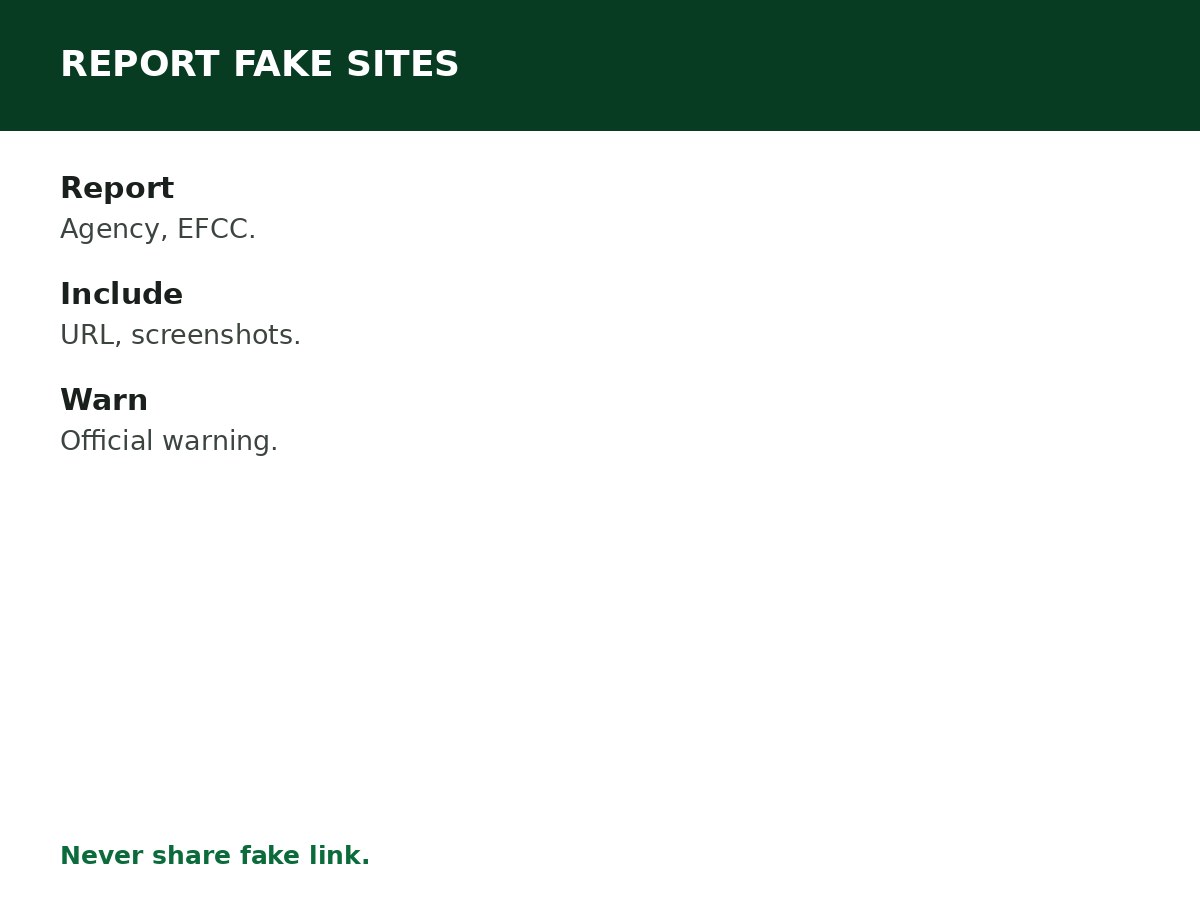
- The impersonated agency — through its official contact (website contact form, official email, or official phone), typed directly, with the fake site’s address and screenshots. Agencies act on impersonation reports, and warn applicants through official channels.
- Relevant authorities — the Economic and Financial Crimes Commission (EFCC) and the Nigeria Police Force, for fraud reports, with evidence, as each authority’s reporting channel states.
- The hosting or domain provider — abuse reports to the fake site’s host or registrar, where identifiable, for takedown.
- The platform where it spread — group admins, messaging platforms, and social platforms, through their reporting tools, so the spread stops.
After reporting
- Protect yourself first — stop payments and contact, monitor submitted documents for misuse, change reused passwords, and report identity theft where it occurs.
- Keep your report records — reference numbers, screenshots, and correspondence, saved, for follow-up.
- Warn others — share the agency’s official warning, not the fake site’s link, so others verify without clicking.
- Re-apply properly — through the genuine portal, typed directly from the agency’s official website, if the window is still open.
Related Guides & Next Steps
- Federal Government Recruitment 2026: How to Verify Openings
- Government Recruitment FAQs for Nigerian Applicants
- How to Identify Official Government Recruitment Portals
Frequently asked questions
How do I report a fake recruitment website? Stop payments and contact immediately, protect your documents, and report to the impersonated agency through its official contact, and to relevant authorities, with the fake site’s address, screenshots, and evidence.
What should I include in a fake-site report? The fake site’s full URL, screenshots, how you found it, what it asked for (fees, documents, attendance), and what you submitted, if anything.
Where do I report fake recruitment websites? To the impersonated agency through its official contact, to the EFCC and the Nigeria Police Force for fraud, to the hosting or domain provider for takedown, and to the platform where it spread.
Should I share the fake site’s link when warning others? No — share the agency’s official warning, not the fake site’s link, so others verify without clicking.
What do I do after reporting a fake site? Protect yourself (stop payments, monitor documents, change reused passwords), keep report records, warn others through official warnings, and re-apply through the genuine portal if the window is still open.
Sources and last update
- No agency is named as currently recruiting anywhere in this article, deliberately — recruitment windows open and close, and a frozen list misleads readers within months. Official portals and announcements, checked at application time, govern.
- No salary figure, vacancy count, or recruitment outcome is asserted anywhere in this article, deliberately. Official announcements and portals, checked at application time, govern.
- Scam patterns: ‘slot’ sellers, application fees, payment to personal accounts, and guaranteed appointments are red flags — government recruitment is free, and runs through official portals only.
- No appointment, shortlisting, or recruitment outcome is promised anywhere in this article.
Last updated: 24 October 2026. Guide — review every 3–6 months, and on every official recruitment announcement.

Written by Olaitan Ilori
Olaitan Ilori is the founder and lead researcher at CareerMedal. He provides verified, practical guides on Nigerian tertiary admissions (JAMB, CAPS, Post-UTME), NELFUND student finance, NYSC service-year survival, and early-career job placement.
View all guides by Olaitan Ilori →