
Following up after an interview means thanking interviewers, confirming interest, and checking timelines — once, politely, at the right time — not chasing repeatedly. This guide covers post-interview follow-up specifically, distinct from the follow-up-after-application guide in the Jobs cluster (which covers application follow-up) and the prepare-for-interview guide (which covers preparation).
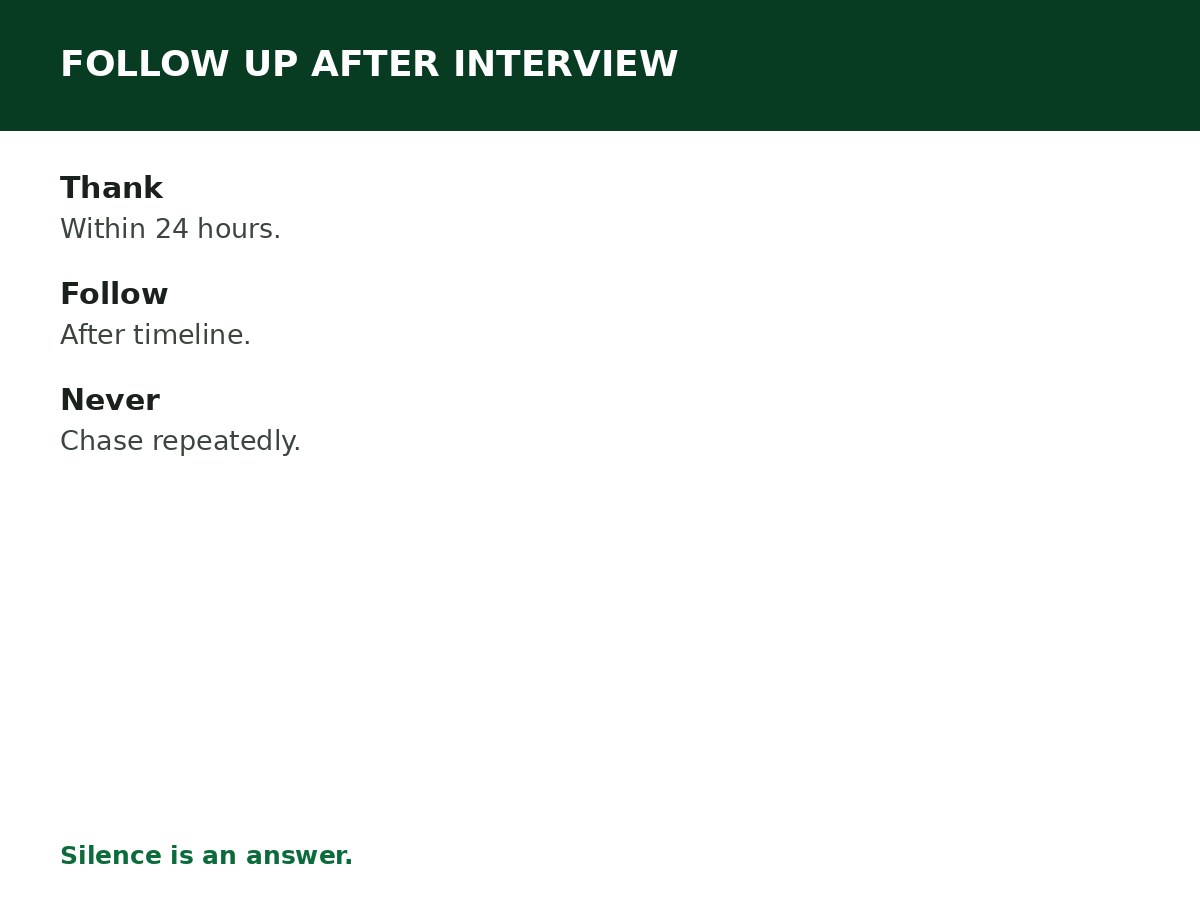
Thank-you within 24 hours
- Thank-you email, within 24 hours — short thank-you, to interviewers, within 24 hours, as employers state, for professional impressions.
- Thank-you content — thanks for the opportunity, brief role enthusiasm, and one specific interview point, referenced, for memorability, not generic thanks.
- One thank-you, not multiple — one thank-you, to interviewers, not repeated messages, as employers state.
Follow-up timing
- After the stated timeline — follow-up, after the timeline interviewers stated, where given, as employers state.
- 2–3 weeks of silence, where no timeline given — follow-up, after 2–3 weeks of silence, where no timeline was given, as the Jobs cluster follow-up rule states.
- Never before the deadline — follow-up, before stated timelines, or before 2–3 weeks of silence, signals impatience, as employers state.
- Once, politely — one follow-up, politely, as the Jobs cluster rule states, never repeatedly.
Follow-up content
- Brief and professional — short email, referencing the role, interview date, and interviewers, with thanks and interest confirmed.
- Ask for timeline, not decision — ‘Could you share an updated timeline?’ rather than ‘Did I get the job?’, for professional tone, as employers state.
- No pressure or ultimatums — no deadlines, competing offers as pressure, or demands, in follow-ups, as employers state, unless genuinely withdrawing.
If no response
- Move on after one follow-up — one follow-up, without response, then applications continued elsewhere, as the market states. Silence after follow-up is itself an answer.
- Keep applying — applications, continued elsewhere, while waiting, not paused for one employer, as the market states.
- No repeated chasing — repeated emails, calls, and messages, after follow-up, harming reputation, as employers state. One follow-up, then move on.
Related Guides & Next Steps
- How to Write a CV With No Work Experience
- How to Negotiate Salary as a Graduate
- How to Ask for a Salary Increase
- How to Explain a Career Gap in an Interview
Frequently asked questions
How do I follow up after an interview? With a thank-you, within 24 hours, and one follow-up, politely, after the stated timeline, or 2–3 weeks of silence, never before the deadline, never repeatedly.
When should I send a thank-you after an interview? Within 24 hours, as employers state — short thank-you, to interviewers, with brief role enthusiasm, and one specific interview point, referenced.
When should I follow up if no timeline was given? After 2–3 weeks of silence, as the Jobs cluster follow-up rule states, never before, never repeatedly.
What should a follow-up email say? Brief, professional content: role, interview date, interviewers, thanks, interest confirmed, and a timeline question (‘Could you share an updated timeline?’), not a decision demand.
What if there is no response after follow-up? Move on after one follow-up — applications continued elsewhere, as the market states. Silence after follow-up is itself an answer.
Sources and last update
- No salary figure, vacancy count, or hiring outcome is asserted anywhere in this article, deliberately — employer career pages and reputable boards, checked at application time, govern.
- No company is named as currently hiring anywhere in this article, deliberately — hiring windows open and close; employer career pages govern.
- Scam patterns: fees for jobs, payment to personal accounts, guaranteed jobs or shortlisting, and interview coaching selling fake experience are red flags — verify every employer on official channels before applying or paying anything.
- No job, shortlisting, salary, or hiring outcome is promised anywhere in this article.
Last updated: 24 October 2026. Guide — review every 6–12 months, and on every major hiring-platform change.

Written by Olaitan Ilori
Olaitan Ilori is the founder and lead researcher at CareerMedal. He provides verified, practical guides on Nigerian tertiary admissions (JAMB, CAPS, Post-UTME), NELFUND student finance, NYSC service-year survival, and early-career job placement.
View all guides by Olaitan Ilori →