

Fake recruitment websites copy real employers’ branding, list fake vacancies, and harvest personal details, documents, and fees from applicants. This guide is the site-level defence: how to spot a fake site, how to check a domain, and what to do if you already applied through one. It is distinct from the vacancy-verification checklist (which covers the role) — this guide covers the website itself.
How fake recruitment sites work
- Cloned branding — logos, colours, and layouts copied from real employers, sometimes with slightly altered names or domains.
- Fake vacancies — attractive roles, often with inflated pay, designed to harvest applications.
- Harvested details — CVs, certificates, ID numbers, and bank details, collected for identity fraud or sold on.
- Fee extraction — application, training, or ‘processing’ fees, demanded after application, to personal accounts.
Spotting a fake site
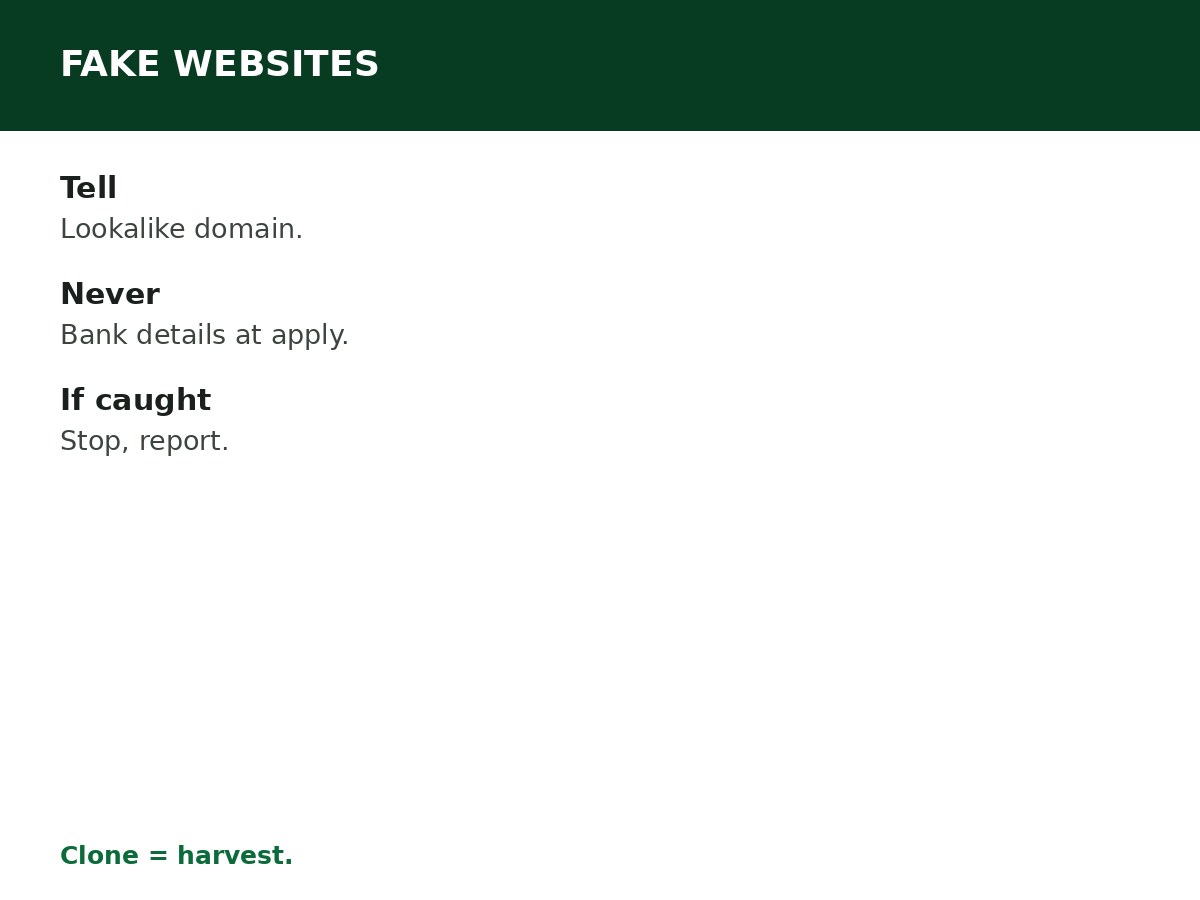
- Check the domain — type the employer’s real domain yourself, and compare. Lookalike domains (extra words, hyphens, wrong endings) are the commonest fake-site tell.
- Check the site’s age and quality — newly created sites, copied content, broken links, and no verifiable office address are warning signs.
- Check for a career page match — genuine vacancies appear on the employer’s real career page. A vacancy existing only on an unfamiliar site is suspect.
- Check contact details — genuine sites list verifiable offices, phone numbers, and company-domain emails. Sites with only WhatsApp numbers or free-email contacts are suspect.
Protecting your details
- Never submit ID numbers or bank details at application — genuine applications ask for CVs and certificates, not bank details, BVN, or NIN, at application stage.
- Never pay through a job site — no genuine recruitment site charges applicants.
- Use a job-search email — a dedicated email for applications, limiting exposure if a site is fake.
- Watermark documents where appropriate — for sensitive documents, consider watermarking copies shared with unverified parties, as applicable.
If you already applied through a fake site
- Stop all contact and payments immediately — do not pay any fee, whatever the threat or promise.
- Monitor your accounts and identity — watch bank accounts, and consider reporting identity exposure to your bank and relevant authorities.
- Report the site — report to the impersonated employer, through its official contact, and to relevant authorities, so others are warned.
- Re-apply properly — apply for the genuine role, if it exists, through the employer’s real career page.
Related Guides & Next Steps
- Graduate Jobs in Nigeria 2026
- How to Apply for Jobs Online in Nigeria
- How to Follow Up After a Job Application
- How to Verify a Job Vacancy Before Applying
Frequently asked questions
How do I spot a fake recruitment website? Check the domain against the employer’s real domain (typed yourself), look for site age and quality warning signs, confirm the vacancy on the employer’s real career page, and check for verifiable offices and company-domain emails.
Should a job site ask for my bank details? No — genuine applications ask for CVs and certificates, not bank details, BVN, or NIN, at application stage. Any such request is a scam.
What if I applied through a fake recruitment site? Stop all contact and payments immediately, monitor your accounts and identity, report the site to the impersonated employer and relevant authorities, and re-apply through the real career page if the role exists.
Do fake recruitment sites copy real companies? Yes — cloned branding, logos, and layouts, with slightly altered names or domains, are the standard fake-site method. Always type the real domain yourself.
Should I pay a fee on a recruitment website? No — no genuine recruitment site charges applicants. Any fee demand means the site is a scam.
Sources and last update
- No company is named as currently hiring anywhere in this article, deliberately — hiring windows open and close, and a frozen company list misleads readers within months. Employer career pages, checked at application time, govern.
- No salary figure, vacancy count, or hiring outcome is asserted anywhere in this article, deliberately. Employer career pages and reputable job boards, checked at application time, govern.
- Scam patterns: application fees, training fees, payment to personal accounts, and guaranteed jobs are red flags — legitimate employers do not charge to apply.
- No job outcome is promised anywhere in this article.
Last updated: 24 October 2026. Guide — review every 3–6 months, and on major labour-market shifts.

Written by Olaitan Ilori
Olaitan Ilori is the founder and lead researcher at CareerMedal. He provides verified, practical guides on Nigerian tertiary admissions (JAMB, CAPS, Post-UTME), NELFUND student finance, NYSC service-year survival, and early-career job placement.
View all guides by Olaitan Ilori →