
Applying for jobs online means submitting tailored applications through employer career pages and reputable boards, with a CV, cover note, and documents matched to each role — and tracking every application. This guide covers the application process itself: preparation, submission, and tracking. Verification comes first (see the verify-a-vacancy guide); follow-up comes after (see the follow-up guide).
Before you apply
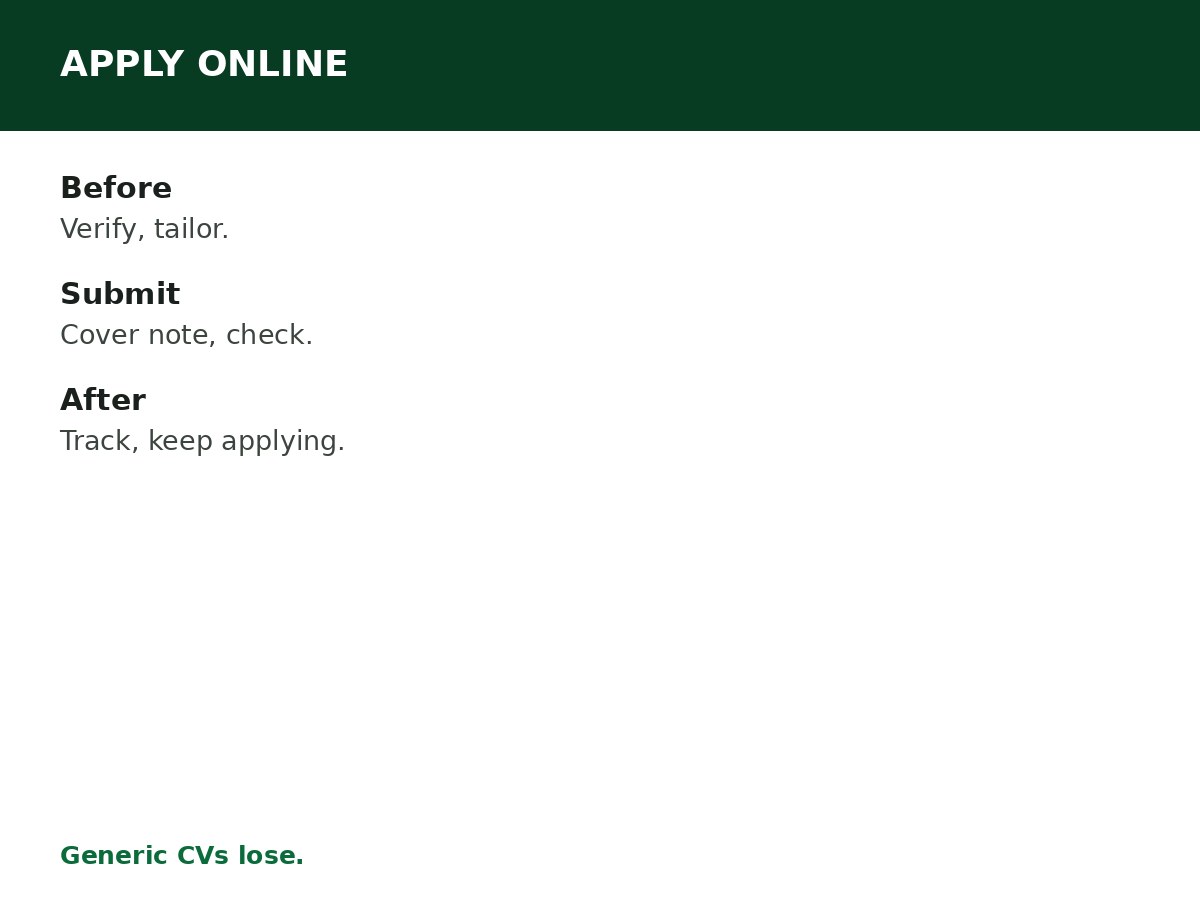
- Verify the vacancy — on the employer’s own career page, before submitting anything (see the verify-a-vacancy guide).
- Read the role properly — requirements, responsibilities, location, and deadline, not just the title. Apply only to roles you genuinely fit.
- Tailor your CV — match your evidence to the role’s requirements, with specifics, not a generic CV sent everywhere.
- Prepare documents — CV, certificates, NYSC discharge/exemption/exclusion, ID, and references, as the role states, in clean digital copies.
Submitting the application
- Use the official channel — the employer’s career page or official portal, not WhatsApp, personal email, or agents.
- Write a cover note — brief, specific, and matched to the role: why this role, why you fit, with one or two evidence points. Generic cover notes lose.
- Check before submitting — spelling, dates, document attachments, and contact details. Errors in an application signal carelessness to employers.
- Meet the deadline — apply well before the deadline. Portals close, and late applications are not accepted, whatever the reason.
Tracking applications
- Keep a spreadsheet — employer, role, date applied, deadline, portal link, status, and next action. Organised applicants follow up better and miss fewer windows.
- Save confirmations — application reference numbers, confirmation emails, and portal screenshots, for follow-up.
- Note test and interview dates — aptitude tests, assessment centres, and interviews, with preparation time blocked, not discovered the day before.
After submitting
- Wait for the employer’s timeline — structured pipelines take weeks to months. Do not assume rejection from silence in the first weeks.
- Keep applying — one application is not a job search. Continue applying widely while waiting.
- Follow up appropriately — see the follow-up guide for timing and method. Do not spam employers.
Related Guides & Next Steps
- Graduate Jobs in Nigeria 2026
- How to Follow Up After a Job Application
- How to Find Graduate Trainee Opportunities
- How to Avoid Fake Recruitment Websites
Frequently asked questions
How do I apply for jobs online in Nigeria? Verify the vacancy on the employer’s career page, tailor your CV to the role, prepare documents (CV, certificates, NYSC status, ID), submit through the official channel with a brief specific cover note, and track the application.
Should I use the same CV for every job? No — tailor your CV to each role’s requirements, with evidence matched to the role. Generic CVs sent everywhere lose to tailored CVs.
What documents do job applications need? CV, certificates, NYSC discharge/exemption/exclusion, ID, and references, as the role states, in clean digital copies.
How do I track job applications? With a spreadsheet: employer, role, date applied, deadline, portal link, status, and next action — plus saved confirmations and reference numbers.
How long should I wait after applying? Structured pipelines take weeks to months — do not assume rejection from silence in the first weeks, and keep applying widely while waiting.
Sources and last update
- No company is named as currently hiring anywhere in this article, deliberately — hiring windows open and close, and a frozen company list misleads readers within months. Employer career pages, checked at application time, govern.
- No salary figure, vacancy count, or hiring outcome is asserted anywhere in this article, deliberately. Employer career pages and reputable job boards, checked at application time, govern.
- Scam patterns: application fees, training fees, payment to personal accounts, and guaranteed jobs are red flags — legitimate employers do not charge to apply.
- No job outcome is promised anywhere in this article.
Last updated: 24 October 2026. Guide — review every 3–6 months, and on major labour-market shifts.

Written by Olaitan Ilori
Olaitan Ilori is the founder and lead researcher at CareerMedal. He provides verified, practical guides on Nigerian tertiary admissions (JAMB, CAPS, Post-UTME), NELFUND student finance, NYSC service-year survival, and early-career job placement.
View all guides by Olaitan Ilori →