

Customer service jobs hire fresh graduates into call centres, support teams, and frontline roles, across banks, telecoms, e-commerce, and service companies, on communication ability more than on certificates. This guide explains the customer service pipeline, the shift and target reality, and how fresh graduates enter and grow from these roles.
How customer service hiring works
- Call centres and support teams — the largest entry point, hired directly or through outsourcing firms, with communication screening and training built in.
- Frontline roles — branch, shop, and service-desk roles, with customer-facing screening.
- Remote support roles — work-from-home support teams, with the same communication bar and infrastructure requirements (see the WFH guide).
- Outsourcing firms — many customer service roles are employed through outsourcing companies, serving client companies. Confirm the actual employer, terms, and client before accepting.
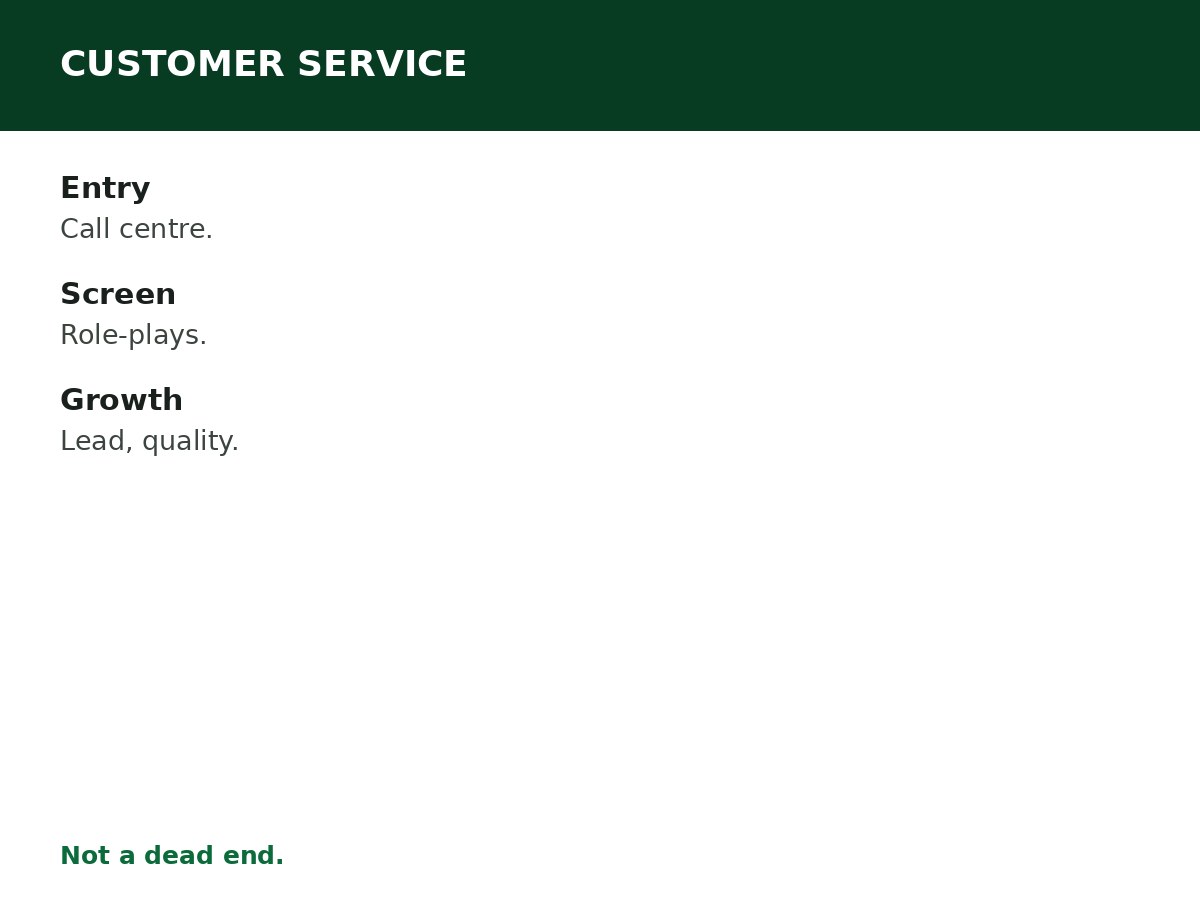
What customer service employers screen for
- Communication — clear spoken and written English, listening, and patience, demonstrated in interviews and role-plays, not claimed in CVs.
- Degree, HND, or OND, plus NYSC status where applicable — the baseline varies by employer and role.
- Shift tolerance — call-centre roles run on shifts, including evenings and weekends, as the employer states. Confirm shift patterns before accepting.
- Target and quality discipline — support roles carry quality scores, resolution targets, and handling-time measures, as the employer states.
Growth from customer service
- Team lead and supervisor roles — the standard first promotion, for agents with strong quality scores and reliability.
- Quality, training, and operations roles — quality assurance, training, workforce management, and operations support, for experienced agents.
- Moves into sales, product, and operations — customer service experience transfers into sales, product support, and operations roles, where customer knowledge is valued.
- Not a dead end — customer service is an entry point, not a destination, for graduates who build quality scores and internal relationships.
Customer service recruitment scams
- Fees at any stage — application, training, or placement fees are scams. Legitimate employers charge nothing.
- Fake outsourcing firms — verify the firm’s registration, office, and client before accepting a role.
- Unpaid ‘training’ — training for a paid role is paid work. Unpaid training beyond a brief assessment is exploitation.
Related Guides & Next Steps
- Graduate Jobs in Nigeria 2026
- Administrative Jobs in Nigeria
- Sales Jobs in Nigeria
- Tech Jobs in Nigeria
Frequently asked questions
How do I get a customer service job as a fresh graduate? Through call centres, support teams, frontline roles, or outsourcing firms — apply on the employer’s career page, and prepare for communication screening and role-plays.
Do customer service jobs require a degree? It varies by employer and role — degree, HND, or OND, plus NYSC status where applicable. Communication ability is the main filter, ahead of certificate level.
Are customer service jobs shift work? Yes, typically — call-centre and support roles run on shifts, including evenings and weekends, as the employer states. Confirm shift patterns before accepting.
Can customer service lead to other careers? Yes — team lead, quality, training, and operations roles, and moves into sales, product, and operations, where customer knowledge is valued.
Are there fake customer service jobs? Yes — fees at any stage, fake outsourcing firms, and unpaid ‘training’ are scams. Verify the firm and client before accepting.
Sources and last update
- No company is named as currently hiring anywhere in this article, deliberately — hiring windows open and close, and a frozen company list misleads readers within months. Employer career pages, checked at application time, govern.
- No salary figure, vacancy count, or hiring outcome is asserted anywhere in this article, deliberately. Employer career pages and reputable job boards, checked at application time, govern.
- Scam patterns: application fees, training fees, payment to personal accounts, and guaranteed jobs are red flags — legitimate employers do not charge to apply.
- No job outcome is promised anywhere in this article.
Last updated: 24 October 2026. Guide — review every 3–6 months, and on major labour-market shifts.

Written by Olaitan Ilori
Olaitan Ilori is the founder and lead researcher at CareerMedal. He provides verified, practical guides on Nigerian tertiary admissions (JAMB, CAPS, Post-UTME), NELFUND student finance, NYSC service-year survival, and early-career job placement.
View all guides by Olaitan Ilori →